Working with Pacific partners to tackle marine litter
Marine litter is found in all the oceans of the world. It is not only found in densely populated parts of the Commonwealth but also in remote areas, far from obvious sources and human contact. Up to 90% of marine litter is made up of plastics, originating from both land and sea-based sources.
Cefas is leading the delivery of the Commonwealth Litter Programme (CLiP) funded by the UK government via the Department of Environment, Food and Rural Affairs (Defra) to bring together partners in Commonwealth SIDS to understand their experiences of marine litter, the scale of the issue locally and how we can work together to tackle this global issue. CLiP supports the UK’s commitment to the UK and Vanuatu led Commonwealth Clean Ocean Alliance (CCOA).
During November 2018 - February 2019 the CLiP team worked with local partners in government, NGOs, industry and communities in Vanuatu and the Solomon Islands. The partnerships led to the development of proposed national action plans to support the country’s existing efforts to reduce the issues of marine litter. As part of their activities, the CLiP team carried out scientific monitoring at beaches.
Their monitoring revealed that plastic and polystyrene were the most prevalent types of litter, constituting up to 98% of the items collected at some locations. Altogether, approximately 15,000 items of litter were recovered. The team also set up laboratories, trained scientists, conducted socio-economic surveys, produced community and education packs and held government workshops and a South Pacific regional conference to share lessons and possible solutions.
The team are now preparing to leave for Belize to further build a Commonwealth community to share ideas and best practice to tackle marine litter.
For more information visit: the CLiP website and follow the CLiP Facebook Page.
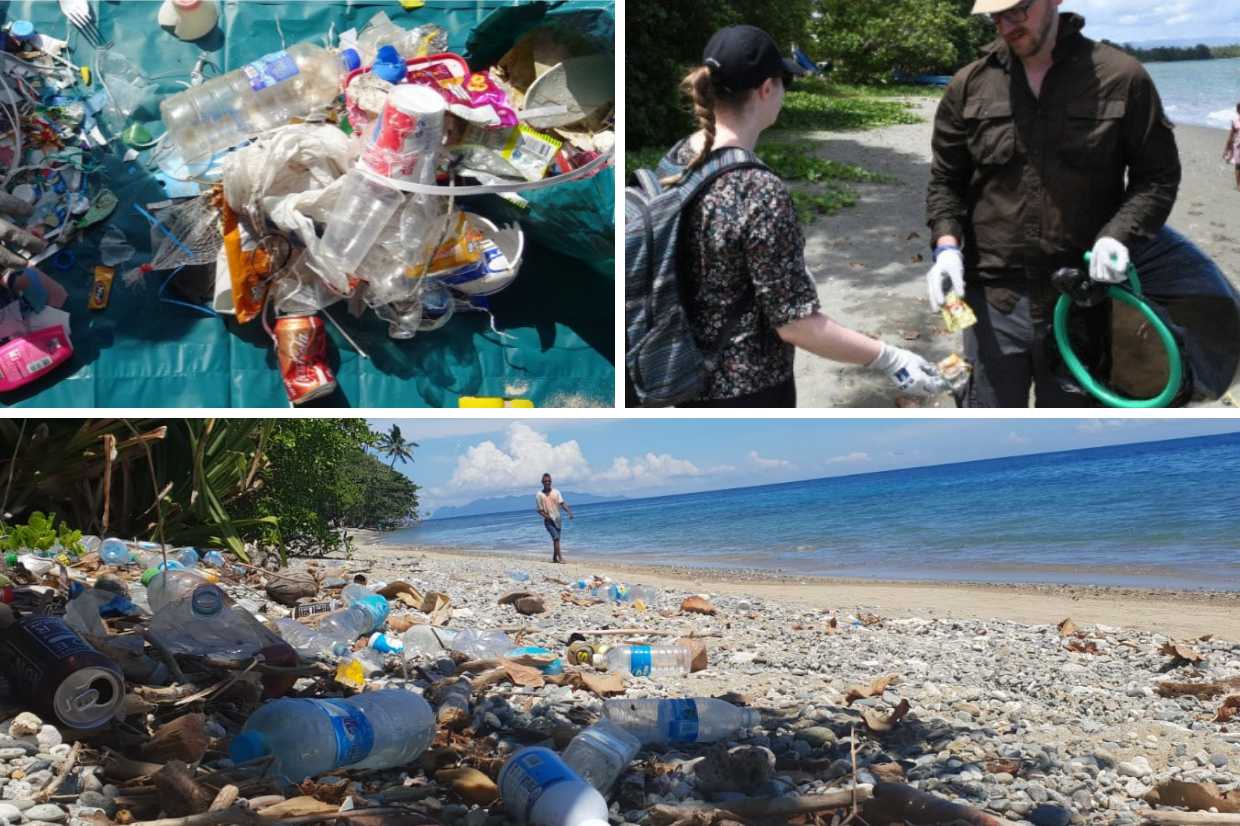 CLiP work in the Pacific including litter found on the beach, scientists carrying out a beach survey and an image of a beach with marine litter.
Building local capacity to fill the data gap in Caribbean fisheries science
Caribbean spiny lobster and queen conch support some of the most valuable fisheries in the Caribbean. These species represent a significant source of income to fishers, contribute to food security and create jobs within the wider community.
Despite their importance, the status of the stock is unknown in many Caribbean countries. Some of the common obstacles that have hampered the sustainable exploitation of the fisheries include the scarcity of fisheries data, developing science capacity and limited capability for effective enforcement. This is especially relevant to islands ravaged by hurricanes and other natural disasters.
Cefas is leading a Darwin project ‘regional collaboration to achieve sustainable Caribbean fisheries management’. This enables us to work with the governments of Anguilla, British Virgin Islands and Turks and Caicos to share expertise with our Caribbean colleagues and build their capacity to assess and manage the spiny lobster and conch fisheries.
In March 2019, Cefas scientists Rosana Ourens, Chris Firmin and Gwladys Lambert visited Anguilla to run a workshop on fisheries data collection. During the workshop, fisheries officers and fishermen from the three countries identified data gaps and the main challenges associated with their fisheries data collection, then discussed tools and approaches that would help them to meet data needs.
In order to make their data collection more effective and enable local samplers to increase their number of observations, the three Caribbean governments were provided with tablets and Bluetooth callipers, a database adapted to their catch sampling needs and a phone app for fishermen to report catch data.
Learn more about the project in the case study on the Cefas website here.
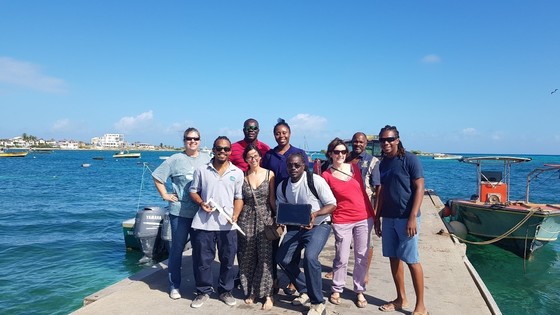 The Cefas team and local partners from Anguilla
Providing training to support new ocean economy opportunities in St Lucia
The CME Programme is working with the most vulnerable Small Island Developing states to help them make the most of their natural maritime advantages, to enable sustainable economic growth, and to alleviate poverty. Funded by the UK Government’s Conflict, Stability and Security Fund (CSSF) and led by the Foreign and Commonwealth Office, the programme is delivering world leading expertise in marine science through its main delivery partners: the United Kingdom Hydrographic Office (UKHO), the Centre for Environment, Fisheries and Aquaculture Science (Cefas) and the National Oceanography Centre (NOC).
As part of the CME Programme Cefas scientists carried out an aquaculture training workshop in St Lucia. The workshop provided practical training to local fisheries officers and sea moss farmers on how to develop and manage start-up systems for spiny lobster aquaculture in Caribbean islands.
On the final day of the workshop the group deployed the first sea-based culture units for juvenile Spiny lobster. Cefas’ Matthew Sanders, who led the 3-day workshop, adds “3 months on and the Department of Fisheries and sea moss farmers have started to collect and culture juvenile lobsters. There remains a number of obstacles to overcome but through education and training we are helping local people to develop sustainable aquaculture practices to support new ocean economy opportunities in the Caribbean”.
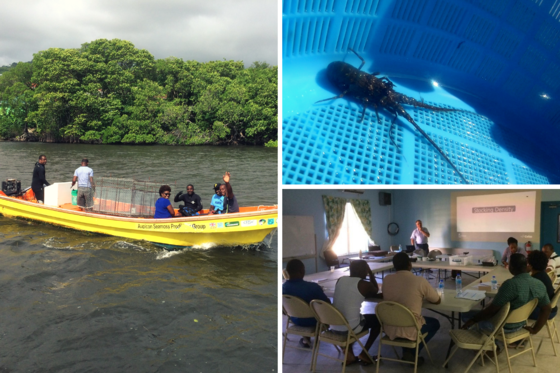 Left: deployment of first lobster culture container by Aupicon sea moss producers in St. Lucia. Upper right: a photo of a juvenile lobster collected by CME Programme partners, credit: The Department of FIsheries in St Lucia. Lower right: the workshop also consisted of classroom-based training.
Improving the management of Montserrat’s marine environment
Montserrat has a large marine area, which presents challenges in protecting biodiversity and achieving sustainable management. There has been a strong commitment towards marine conservation including the development of a Sustainable Ocean Policy (SOP) in partnership with the Waitt Institute. In June 2017, the Government of Montserrat announced a commitment to protect 10-30% of its marine environment as a no-take marine reserve.
Cefas are leading a Darwin Plus project alongside the Government of Montserrat and Waitt to improve the management of Montserrat’s marine environment and key marine resources. The project combines hydrographic and sampling data to strengthen the evidence base, local capacity and management tools to help inform the sustainable development of Montserrat’s marine based economy. The project also educates the younger generation on marine issues relevant to Montserrat to ensure the future sustainability of their marine environment.
The project aims to increase awareness of the sustainability of Montserrat marine life across both the wider community and specifically amongst the young people of Montserrat Secondary School (MSS). To achieve this, the partnership is delivering an educational resource pack, to be incorporated into the Geography curriculum of MSS, and has attended outreach events.
In March 2019, Cefas scientists Jo Smith, Charlotte Jennings and Kate Downes visited Montserrat to host an educational stand as part of the island’s St Patrick’s Day festival. The festival is one of the island’s largest cultural events, and enabled the project team to share their knowledge with individuals involved in creating and using the resource pack and others with an interest in the marine environment.
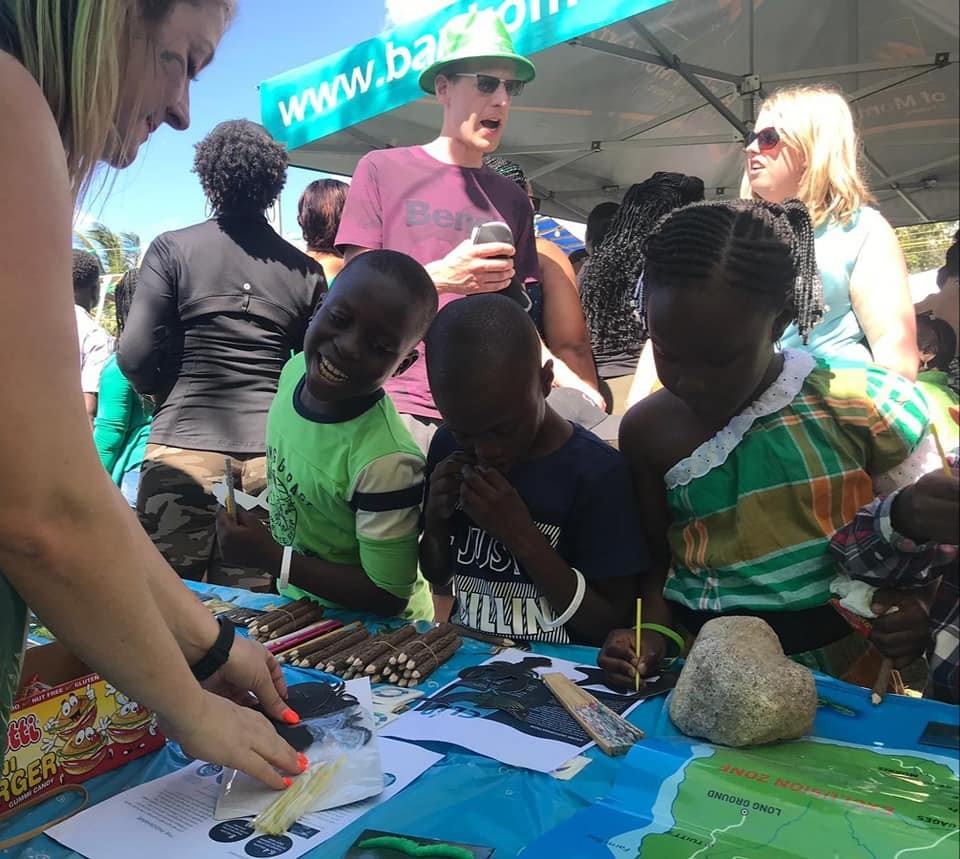 Cefas scientists demonstrate marine science to young students from Montserrat
Biosecurity in the Caribbean - reducing the risk of introducing marine invasive species
Invasive species are recognised as one of the greatest threats to global biodiversity and have been identified as a major factor in extinction events, significantly threatening whole ecosystems and key resources. Invasive species are considered particularly difficult to manage in the marine environment once established so a focus on preventing their introduction is essential.
As part of the CME Programme, invasive species specialists from Cefas have been working with St Vincent and the Grenadines and Grenada over the past 2 years aiding in developing methods to more effectively manage the risk of introductions into the marine environment.
First, the team identified the locations where introductions are most likely to occur. Invasive species in the region that potentially pose the greatest threats were also identified. Having highlighted the high-risk hotspots and species of concern, Cefas scientists set about designing a biosecurity tool kit to help stakeholders to reduce the risk of introductions from occurring, including monitoring for arrivals and controlling further spread.
Lead scientist Dr. Paul Stebbing adds “it was important that as part of the project we produced an output that had legacy and will be of use to local authorities and stakeholders going into the future. The biosecurity tool kit, we feel does just that, by facilitating effective biosecurity planning to help future-proof the marine environment from invasive species.”
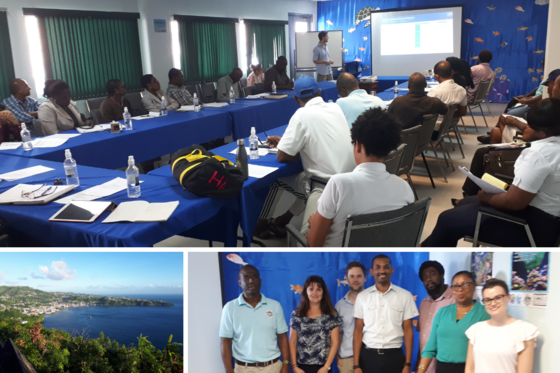 Top: a meeting with local stakeholders in St Vincent and the Grenadines. Bottom left: the bay of Kingston St Vincent and the Grenadines. Bottom right: the Cefas invasive species team (Debbie Murphy, James Guilder, Hannah Tidbury) meeting staff from the St Vincent Fisheries Department.
Thank you for reading, to subscribe to future editions click here.
|