Report improves our understanding of UK Shelf Seas ‘blue carbon’ role
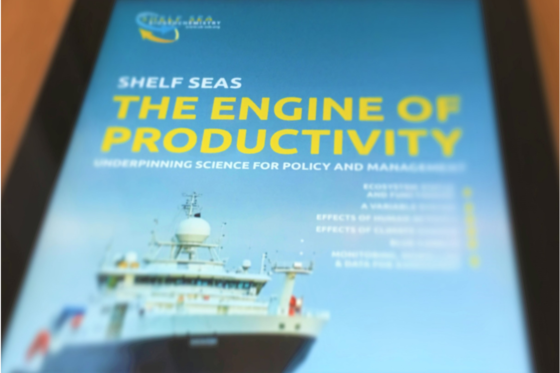 The UK Shelf Sea Biogeochemistry research programme brought together more than 100 researchers and involved more than ten research cruises on RRS Discovery and RV Cefas Endeavour.
The Shelf Seas report summarises the main outcomes from a five-year NERC/Defra research programme. The programme investigated how the shelf seas around the UK process carbon and nutrients, and how they are affected by human activities and climate change. Results include a much-improved understanding of the role of shelf seas in removing and storing carbon, a process known as ‘blue carbon’, and lessons for policy in monitoring, managing and valuing these precious habitats.
The programme involved over 100 researchers including Cefas’ Ruth Parker and Silke Kröger. Ruth was Cefas principle investigator for the seabed and iron work packages during the proposal development and initial stages of the programme and Silke took on the role of overall science lead for Cefas whilst Ruth was on adoption leave. Ruth adds ‘on my return from leave it was great to job-share this role – a real example where flexible working can really benefit personal development and also the programme as a whole in terms of retaining expertise.”
Silke adds, ‘for me this programme is a great example of what can be done collaboratively regardless of age, gender, nationality, employer or status – providing there is mutual respect and scientific integrity. At the moment we’re working really hard to ensure that the science from this programme is heard by the right people at the right time so that the UK marine environment is used sustainably.“ Read the full Shelf Seas report here.
SmartBuoy survey conducted on RV Cefas Endeavour
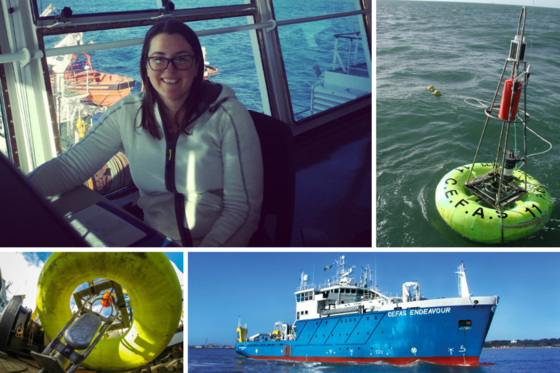 Upper left: Elisa pictured on the bridge of the RV Cefas Endeavour, where she spent much of her time during the survey. Upper right & lower left: SmartBuoys before and after deployment. Lower right: the RV Cefas Endeavour.
SmartBuoys are autonomous recording platforms that provide data for a range of science. The data they collect gives us new insights into ecosystem functionality, improves our understanding of environmental variability and can even help us track changes to marine biodiversity.
The RV Cefas Endeavour recently returned from a survey to carry out essential maintenance on several SmartBuoys, Waveriders, and landers. Cefas’ Elisa Capuzzo explains, “as scientist in charge of this survey I spent a lot of my time on the bridge of the vessel recording positions and meteo-marine information during operations to make sure the instrumentation is deployed in the right place. My role requires continuous liaising between scientists, crew on deck, master and officers on the bridge so communication is essential. Between stations I helped clean equipment, which after 3 months at sea, is always covered in all sorts of algae and organisms.”
Elisa has now been on over 30 surveys, 7 of which she has been the scientist in charge. “One of the favourite parts of my job is being at sea on the RV Cefas Endeavour. Taking part in surveys not only gives you great hands-on experience of collecting data, but it provides a unique perspective of the marine environment and its processes. The work I contribute to increases the knowledge of the marine environment which scientists, stakeholders and the general public all benefit from”. Data from SmartBuoys is available via the Cefas Data Hub.
UN recognises UK science excellence in shellfish safety
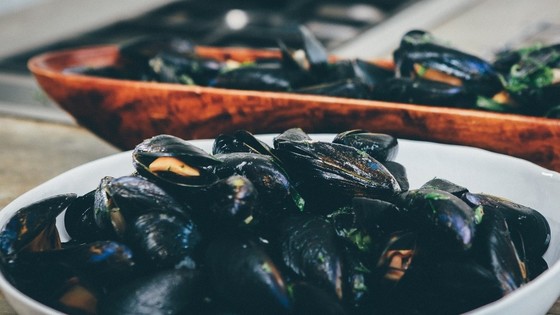 Cefas has been designated as a Reference Centre for Bivalve Mollusc Sanitation by the Food and Agriculture Organization of the United Nations.
UK expertise and leadership in shellfish safety has been recognised by the Food and Agriculture Organization of the United Nations (FAO) with the designation of Cefas as a Reference Centre for Bivalve Mollusc Sanitation.
The Reference Centre will help to support the FAO vision for a globally unified system for shellfish safety, recognising the importance of both wild caught and aquaculture production in global food security and future trade. You can read more on about the Reference Centre here.
Rachel Hartnell, Cefas lead for the new centre, adds “this is excellent news for Cefas scientists and for UK science in general. Bivalve shellfish play a very important role in global food security but can sometimes pose risks to the consumer. This designation gives us a fantastic platform to work internationally and to use our experience of delivering reference laboratories within the EU, to assist FAO member countries globally with the aim of improving shellfish safety for all.”
Building the Caribbean’s resilience to climate change
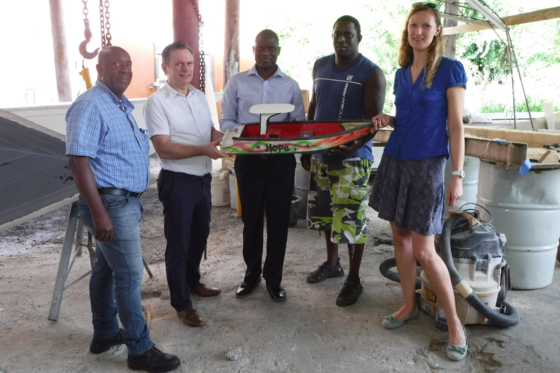 Bryony pictured in Dominica where she was gathering data on how hurricanes have affected boat builders in the area.
The consequences of climate change far reaching impacting the lives of people all over the world. As part of the Commonwealth Marine Economies (CME) Programme Cefas is collecting data over several Caribbean countries. The programme studies how resilient fisheries and the marine environment are to climate change stressors, particularly hurricanes and storms.
Marine climate change scientist Bryony Townhill adds, “I work on a range of climate-related projects to determine the climate impacts on species and coastal communities. I also identify measures to put in place to build resilience. My work focuses on the use of models in assessing the impacts of climate change on marine ecosystems. I also help improve our understanding of marine climate change and adaptation issues in small islands.”
The data collected from Bryony’s recent visit to the Caribbean was fed into insurance models. The countries are now in the process of getting insurance in place for their fisherfolk by the start of the next hurricane season. The longer term aim is to use the insurance as an incentive to improve climate-smart fisheries management in the Caribbean.
Supporting the growth of natural capital
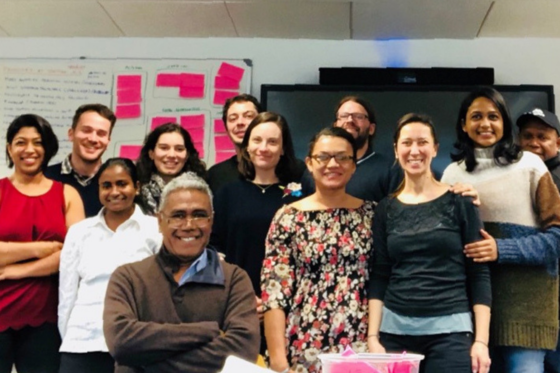 Tiziana, third from right, during a four-day workshop at the University of East Anglia she recently organised to discuss coastal and marine ecosystem services valuation for policy and decision making within the South Pacific Region.
Cefas’ economists are experts in developing economic analysis applied to the marine and coastal natural capital and the ecosystem services it provides.
Cefas’ Tiziana Luisetti leads the team of six economists. “I lead, supervise, and collaborate in a wide range of interdisciplinary projects related to the economics of natural capital. I specialised in marine and coastal ecosystem services valuation and management. Most of the work I do at Cefas is about valuing the ecosystem services provided by the marine environment for policy and decision making” explains Tiziana.
Tiziana organised, chaired and facilitated a NERC funded workshop for universities, governmental agencies, and the private sector. The workshop aimed to link marine governance and economics with shelf sea biogeochemistry.
Tackling water quality issues across the Pacific
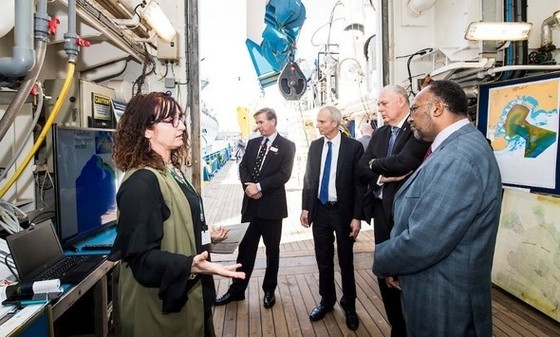 Michelle outlines the work to help address water quality issues in Vanuatu to Cefas CEO Tom Karsten, Cabinet Office Minister David Lidington, St Lucia Prime Minister Allen Chastenet and Vanuatu Prime Minister Charlot Salwai.
Water quality issues are impacting many coastal communities around the world. Cefas scientists are working with Pacific collaborators under the CME Programme to combat the issue. The team are mapping and modelling the impacts of poor water quality on human health and the coastal ecosystem.
Cefas’ Michelle Devlin is leading on projects in Vanuatu, the Solomon Islands, and Kiribati to improve our understanding of water quality issues and their impact on coastal habitats. She is also working with partners to incorporate this data into national and regional monitoring and decision frameworks.
Michelle adds, “my interest in defining, mapping and modelling the impacts of water quality began when I worked on the Great Barrier Reef many years ago and has been a major component of my ongoing research. I enjoy my work in the Pacific under the CME programme as it’s allowed me to work on tropical waters again and to work closely with decision makers on how best to use this data.”
Taking action to address our plastic problem
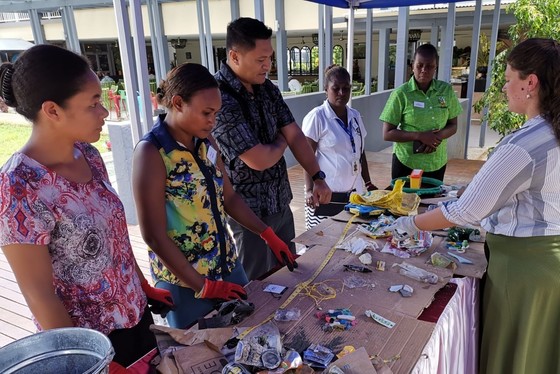 Josie explaining litter categories during a the national workshop on the Solomon Islands, January 2019.
Up to 90% of the marine litter found in our oceans is plastics – making it one of the most widespread problems facing our oceans today. To help address this growing issue Cefas’ Commonwealth Marine Litter Programme (CLiP) is supporting five developing countries across the Commonwealth to take action.
Marine litter researcher Josie Russell explains her role in the programme, “I have been working in both Vanuatu and the Solomon Islands since November. In Vanuatu we conducted baseline monitoring. This involved categorising and quantifying the litter found along the coast and collecting microplastic samples from the seawater and sediments. In the Solomon Islands, I led on education and outreach. I met many different stakeholders to raise awareness of marine litter.”
Workshops, training and education are another vital part of the programme. They ensure the benefits of the 2 year programme continue long after it ends.
Thank you for reading, to subscribe to future editions click here.
|