Developing a coastal management tool to support seaweed aquaculture in the Philippines
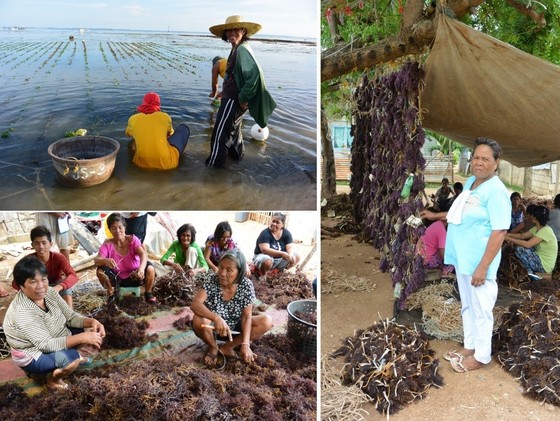 Seaweed aquaculture is an important livelihood source in the Philippines; women are actively involved in seaweed farming from seedling preparation to harvest and sale.
The aquaculture sector contributes significantly towards food security and employment in the Philippines. In particular, seaweed aquaculture improves the socio-economic status of coastal communities by generating employment, diversifying livelihoods, promoting development of small and medium enterprises, and strengthening stewardship of marine resources. Aquaculture can also help reduce pressure on wild fish resources by allowing overfished stocks to recover.
However, seaweed aquaculture presents other risks, notably the associated environmental impacts on sensitive habitats such as coral reefs. Cefas and the University of Cebu are collaborating on a Newton Institutional Links project, now in its final year, to develop a toolkit for local stakeholders to identify suitable seaweed aquaculture production sites in the Philippines.
Through stakeholder engagement workshops, environmental surveys and socio-economic surveys (targeted at seaweed farmers) the project team have been building a unique reference database of the municipality of Bantayan in the Philippines. The database forms the basis of a user-friendly, open source toolkit which will support local communities to make informed decisions regarding the management of their marine resources - maximising economic returns and minimising environmental effects. The results of the project and a practical demonstration of the toolkit will be presented to the local community at a closing workshop in Bantayan.
Working with Thailand towards a high density sustainable and insurable shrimp farming future
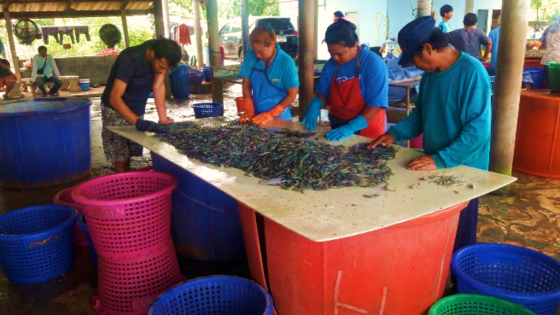 An emergency harvest due to disease taking place at a farm site in Thailand last year.
Aquaculture, the growth and farming of aquatic animals, is the fastest developing and most highly traded food production sector, with first sale value exceeding $165 billion. As the global population and our appetite for aquatic protein rises, aquaculture production must double by 2050 to satisfy demand. The sector also supplies food and income to resource-poor people in many countries that are eligible for overseas development assistance. As such, current and potential producer nations are being encouraged to establish policies, institutions and governance to deliver enhanced sustainable production.
Within the aquaculture industry shrimp farming is particularly dominant. But high-density farming, poor stock control, and other factors have led to a series of emerging disease problems over several decades. These issues have massively impacted the yield, profit, insurability and investability of the sector and threaten enhanced sustainable aquaculture production.
Cefas is collaborating with the National Centre for Genetic Engineering and Biotechnology/National Science and Technology Development Agency in Thailand to help combat these issues. The new project, which is funded by a Royal Society International Collaboration Award, will build upon a strong collaborative partnership between the UK and Thailand from a recent Newton Fund Institutional Links Project. Over the next 3 years the team will focus on studying shrimp through all stages of production and relating this to their underlying health status. The project aims to generate the first comprehensive profile of a ‘healthy shrimp’ providing the evidence needed to manage high-density shrimp farms of the future.
International Conference on Plastics in the Marine Environment Singapore 2018
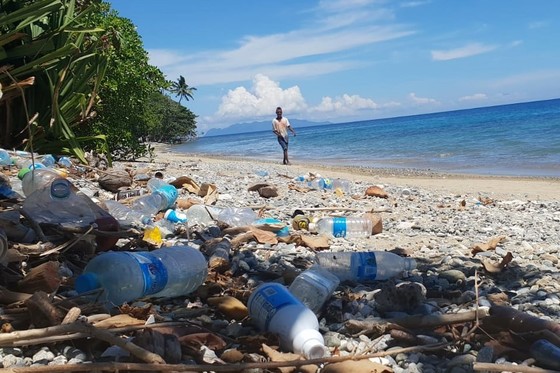 The conferenced aimed to to explore and discuss the global issue of plastic waste in the marine environment.
The International Conference on Plastics in the Marine Environment (ICPME) was held between the 5th and 7th December 2018. The event, which was hosted by the National University of Singapore, was co-organised by Cefas, the Singapore Centre for Environmental Life Sciences Engineering and NParks. The conference brought together a diverse delegation that consisted, among others, of local and international governments, academia, industry and NGOs to explore and discuss the global issue of plastic waste in the marine environment, lessons learnt and real solutions for the future.
Across three days speakers from around the world presented on their experiences with marine litter and shared strategies for what needs to be done at the national and regional level to tackle this very global issue. The conference followed a series of key international events that served to bring marine litter to the forefront as a challenge in urgent need of address; namely the ASEAN conference on reducing marine debris November 2017; Our Oceans in Bali, October 2018 and; the Sustainable Blue Economy Conference in Nairobi, November 2018.
The conference was a great success with the knowledge shared and network established paving the way for effective and harmonious initiatives in the future.
Delivering an ecosystem-based approach for sustainable marine fisheries and biodiversity in Vietnam
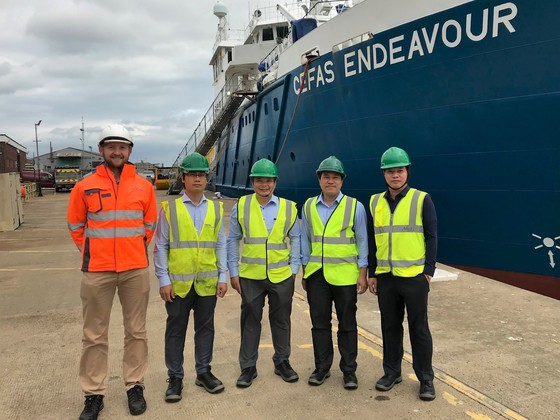 Cefas' Paul McIlwaine with members of the Vietnam Research Institute for Marine Fisheries (RIMF) during a visit to the UK last September.
Cefas has been working with the Vietnam Research Institute for Marine Fisheries (RIMF) on a collaborative project to provide an assessment of the status of marine fisheries, biodiversity, sensitive/ecologically important species and environmental quality in the coastal and offshore waters of Vietnam. Vietnam has a diverse and large marine sector with many marine species that are subject to interacting pressures (e.g. over and unregulated fishing, pollution and environmental change) and monitoring requirements. Through the collaboration, which is supported by the British Council through the UK Government Newton Fund, Cefas has drawn on its scientific expertise to work alongside RIMF in order to integrate and assess existing datasets, and to develop and initiate the implementation of a spatially-explicit ecosystem-based management plan for Vietnam’s marine resources.
Historically, fish stock assessments and ecosystem studies have often taken a less holistic approach, focussing on a single species or fisheries targeting a specific habitat. This approach does not recognise in full the significance of between species interactions and interactions with their environment, for example the restoration of mangrove habitats can increase the availability of essential nursery grounds for some fish species. The project has consisted of several collaborative workshops where scientists from each organisation have worked together to understand the datasets available, any gaps and assumptions on which the in-depth assessment would be based.
The outcome has been the production of a report which presents recommendations for the definition of new ecologically meaningful spatial management areas across Vietnamese waters. This serves to reform the current spatial management structure into one that aims to more directly reflect the ecological boundaries in Vietnamese waters. The next steps and follow-on projects for the collaboration will move towards an implementation phase, to apply the recommendations and findings from this work to a live context in Vietnam.
Tackling the illegal trade of sharks and rays in the world’s largest shark fishing nation
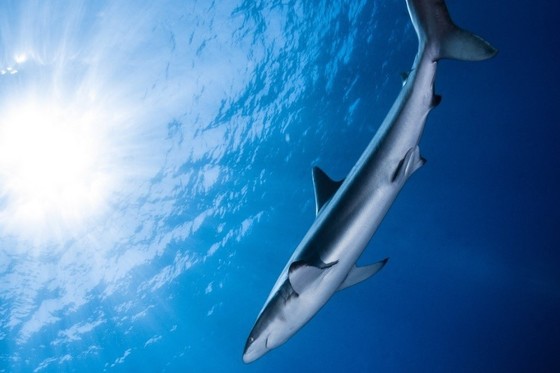 Photo © Paul Hilton, Wildlife Conservation Society
Indonesia is one of the world’s largest exporters of shark and ray products. These products are used in everything from luxury dishes to medicines, cosmetics, and dietary supplements. But the unsustainable trade of shark products, most notably shark fins, endangers the survival of some species.
Despite monitoring and regulation illegal trade of prohibited species still occurs. This not only threatens the survival of shark species but the health of the oceans and the livelihoods of people who depend on them.
Identifying shark species from processed products is a big challenge for those trying to monitor and regulate the industry. Over the next 3 years Cefas will be working with the Ministry of Marine Affairs and Fisheries, the Republic of Indonesia, the Wildlife Conservation Society, Indonesia Program and the University of Salford on a project funded by the Illegal Wildlife Trade Challenge Fund to tackle illegal and unsustainable shark trade in Indonesia. Cefas will be combining the most up-to-date techniques in fin identification with state-of-the-art DNA forensics to equip enforcement agencies with the resources they need.
Project lead Dr Joanna Murray adds, “this project is a really exciting opportunity for Cefas to share our experience with project partners in Indonesia. We’ve just returned from our first stakeholder workshop in Indonesia where staff from across government came together to define the current challenges with effective management of the shark product trade and unify on the interventions needed to improve it into the future.” Read more about the project on the Cefas blog.
Thank you for reading. Our next edition will focus on our wok in Small Island Developing States, to subscribe to future editions click here.
|