Blue Belt Programme technology workshop
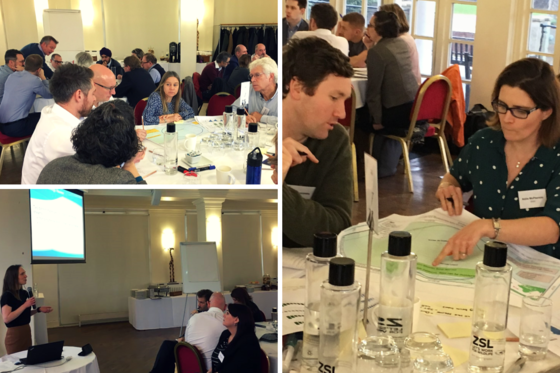 Photos from the “Beyond the Blue Belt” technology event in London.
On 16 January the MMO hosted a technology workshop in London as part of the Blue Belt Programme. The workshop provided an update on technology innovation for fisheries monitoring and surveillance within the Blue Belt Programme.
The fully booked workshop was an opportunity for attendees to identify and prioritise the key requirements and challenges for fisheries compliance and enforcement and encourage collaboration.
Blue Belt Discovery Expeditions to visit SGSSI, Tristan da Cunha and St Helena
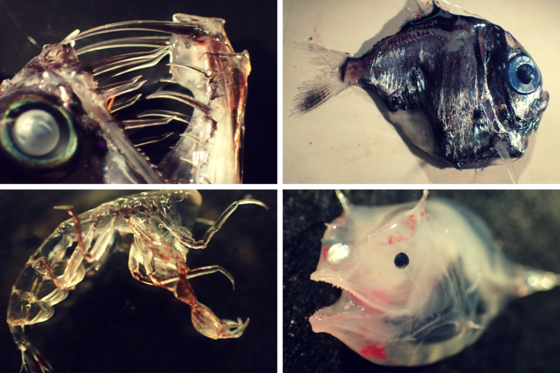 Animals caught in mid-water trawls around St Helena during the last Blue Belt survey of the island in 2018.
The Blue Belt team has been busy preparing for Discovery Expeditions 99 & 100 which will take place between February and April this year.
Discovery Expedition 99 will investigate the biodiversity of the continental shelf around South Georgia and the South Sandwich Islands (SGSSI) in February. Utilising deep sea cameras and benthic sampling equipment the survey will help to assess the state of the benthic environment and investigate the potential impact of the licensed longline fishery on the benthic biodiversity.
The second marine survey, Discovery Expedition 100, will visit Tristan Da Cunha and St Helena in March/April. The expedition is a collaboration between British Antarctic Survey and the Blue Belt Programme and will spend 10 days in Tristan waters and 10 in St Helena. Around Tristan da Cunha the expedition will focus on understanding the biodiversity and habitats associated with the seamounts, about which very little information is known.
In St Helena, the expedition will concentrate upon the ecosystems that live in the water column, with a view to improving the understanding of the food webs that underpin tuna fisheries around the area. The crew will also be joined by St Helena resident, Jamie Ellick, who won a competition to join the Discovery Expedition 100. Jamie is a keen diver who currently works for the St Helena National Trust marine team. He hopes the Discovery Expedition 100 will improve his knowledge of the ocean around St Helena and expose him to new areas of ocean research. Jamie is also keen to share his experience with the local community and he hopes he will inspire the next generation to take greater care of the ocean. Read more about the expeditions in the blog here.
Delivering the programme in Pitcairn
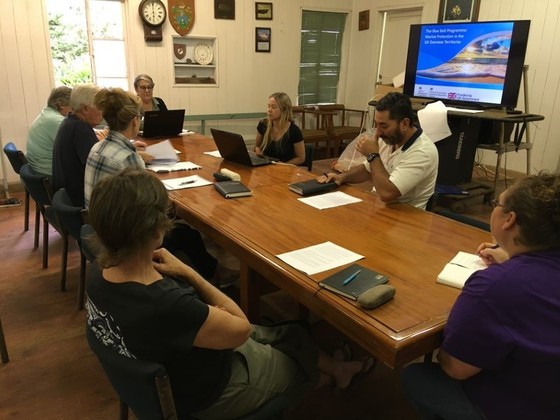 MMO’s Emily Hardman briefing the Pitcairn Island Council.
In August the Blue Belt Programme's Emily Hardman visited the Pitcairn Islands to help inform the development of their Marine Protected Area (MPA) management plan.
During the visit Emily introduced the Blue Belt Programme to the Island Council and the local community. She also provided training in MPA management planning to staff from the Environmental, Conservation & Natural Resources Division. The team also held a workshop to find out what the community values about their marine environment, what threats they think there are, how these threats could be minimised and what the community actually wants the MPA to achieve.
This information is now being used to inform development of the MPA Management Plan. During the trip, a consultation was also held on the proposed whale watching code of conduct, information was gathered about the island’s capability to respond to a marine pollution incident and training was provided on intelligence recording to help identify any illegal fishing within the MPA.
Preparations are underway for a second trip in March 2019 focused on collecting high definition videos and still images to describe the benthic communities around Pitcairn Island. The data from this upcoming trip will be used to advise on the management of human activities, go towards developing a marine monitoring plan for the island, and act as a baseline data set to assess the effectiveness of management activities.
Updates from St Helena
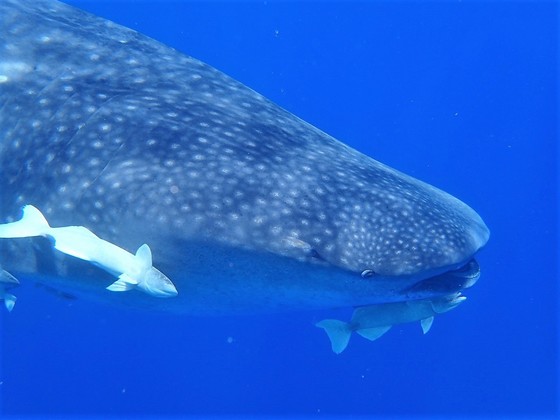 Blue Belt Programme initiatives aim to minimise the negative impacts associated with human activities towards marine megafauna such as whale sharks.
The Blue Belt Programme is currently working to manage a range of human activities in St Helena waters.
The team have reviewed the existing management frameworks around marine tourism, sand extraction and waste inputs to the marine environment. Their recommendations have been passed to the St Helena Government to ensure activities are compatible with the Marine Management Plan. The Blue Belt Programme is now working with St Helena Government to develop management strategies based on these recommendations and to provide advice on the establishment and implementation of these new systems.
The Blue Belt Programme has also been supporting the St Helena Government with revisions to the Environmental Policy for Marine Species Interaction Activities and the Marine Tour Operator Environmental Accreditation Scheme. These initiatives aim to minimise the negative impacts associated with human activities towards marine megafauna such as whale sharks and humpback whales.
In other updates from the island, the Blue Belt Programme has recruited an on island co-ordinator, Elizabeth Clingham. Elizabeth has valuable experience working in the marine sector on St Helena and will work closely with Cefas, MMO and St Helena Government to support delivery of the programme's objectives.
Cefas' Serena Wright is currently visiting St Helena with colleagues from Stanford University and St Helena Government to undertake further tagging work on the island for the collaborative Tuna Tagging Programme, which is partially funded by a separate contract with the International Commission for the Conservation of Atlantic Tunas (ICCAT). Over 2000 fish have been tagged in the project, which aims to collect information on tuna stocks in the Atlantic to provide improved and updated scientific advice.
South Georgia & the South Sandwich Islands MPA enhancements
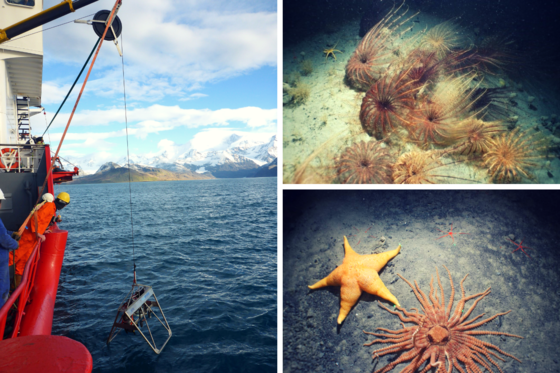 Left: Testing the deep water camera system off Cumberland Bay, South Georgia during the last expedition in April. Right: images of sealillies and two different types of starfish taken around 260 m depth.
The Blue Belt Programme has supported the review of research and monitoring meetings conducted by the Government of South Georgia & the South Sandwich Islands in 2017/2018.
Based on the outcome of the review the Overseas Territory Government announced an extension to existing MPA measures and regulations in December.
Following the successful trials with the deep-water camera system in April 2018 using Pharos SG, the review highlighted the need for further benthic research in the South Sandwich Islands. The Blue Belt Programme will be conducting a deep-water camera and benthic sampling survey in February, for Discovery Expedition 99, joined by a team of scientists from Essex, Bristol and Oxford Universities.
In this relatively unexplored area, the research will examine the distribution of benthic species and diversity, extending from the northern, relatively, warmer water islands, south to the islands situated in colder Antarctic waters. The work will help understand how the species composition changes with depth within each temperature regime.
Fieldwork in British Indian Ocean Territory (BIOT)
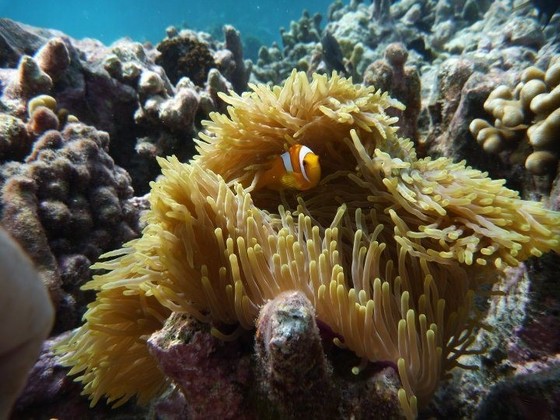 A clown fish photographed in British Indian Ocean Territory.
Following on from the workshop in March 2018, the Blue Belt team has been supporting the BIOT Administration to develop the Conservation Management Plan. This will help them to guide future conservation efforts in the territory and will act as a route map to maintain and restore the natural environment. The work has progressed well and it is hoped that the plan will be published soon.
Preparations are now being made to undertake fieldwork in BIOT in late February 2019 to undertake water quality monitoring around Diego Garcia. The fieldwork will be contributing to a basic understanding of the marine water quality and the impacts of human activities.
Samples will be collected within the lagoon and along the western coast of Diego Garcia and tested for nutrients, dissolved oxygen, microbiological toxicity and other physical and chemical parameters. The results will enable the establishment of a long-term monitoring programme to capture any impacts arising from pollution events or algal blooms.
Planning underway for a marine protected area on Ascension Island
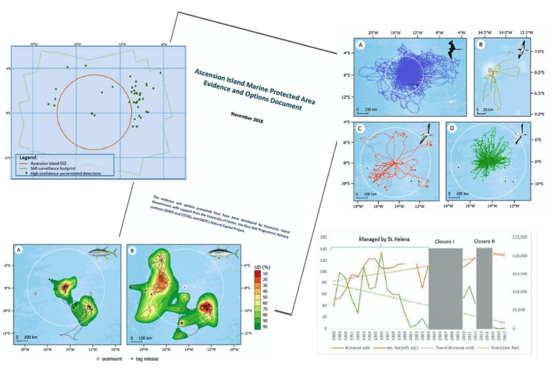 The team have been working on the Ascension Island Marine Protected Area Evidence and Options Document.
Blue Belt Programme partners have supported the Ascension Island Government with the production of an Ascension Island Marine Protected Area Evidence and Options Document.
This document presents information used to formulate potential Marine Protected Area design options and to assess the associated ecological implications and economic costs. It includes information on marine biodiversity research, an economic assessment of the current longline fishery, and an assessment of the level and costs of future fisheries surveillance and enforcement. The team will continue to support the Ascension Island Government and the Island Councillors as they decide upon the most appropriate marine protection option for the island.
In parallel, the team have undertaken an assessment of existing marine protection legislation in order to help ensure it is fit for purpose. Future work will also include the development of an Ascension Island Marine Management plan which, together with the legal framework, is key to the successful designation of an Ascension Island Marine Protected Area.
Updates from Tristan da Cunha
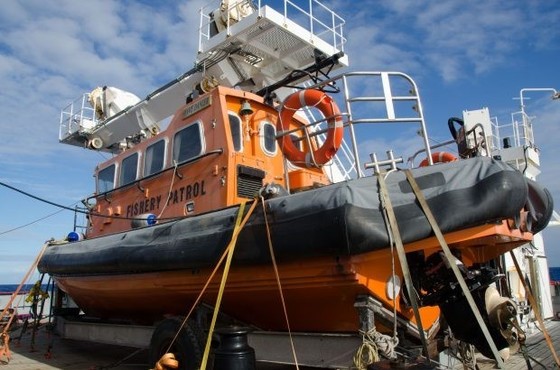 The fisheries patrol vessel came to the UK aboard the RRS James Clark Ross.
The Tristan da Cunha fisheries patrol vessel, Wave Dancer, refurbishment is due to commence in early 2019. James Glass, Tristan Director of Fisheries, explains the importance of the vessel as “the only boat that can get to the outer islands in adverse weather conditions in an emergency, it supports visiting scientists carrying out fieldwork, and acts as a search and rescue boat”. As part of the refurbishment Rodney Green, Assistant Director at Tristan’s Fisheries Department, is visiting the UK for bespoke training in vessel maintenance to manage the vessel once back on island. Sarah Glass-Green, Fisheries Data Clerk, will accompany Rodney to the UK and concentrate on developing a suite of data management systems with Blue Belt staff.
Following two years of data collection, sampling and processing, the stock assessment of the bluenose fishery that operates over the seamounts is now underway. Closer to shore, a review of inshore fishery management options is in preparation whilst the Conservation team on-island continue to deploy underwater cameras to assess marine biodiversity. The evidence collected and analysis from these activities is fundamental to the design options to be discussed with Tristan da Cunha Government over the coming months.
New MMO head of Blue Belt Programme appointed
Jo Stockill has been appointed the new Head of the MMO Blue Belt Programme. In addition to providing overall strategic leadership to the MMO team, Jo will be providing expert technical oversight of the programme's work.
Jo has worked with the MMO in the marine planning team for 5 years, leading delivery of the first English marine plans. She has 17 years’ experience in a variety of roles in the marine sector including conservation, marine protected areas, spatial planning, sustainability and natural resource management.
Speaking about her new role, Jo said: “I am passionate about the sea and have dedicated my career to making an impact to improve how the seas are managed and protected…the Government’s Blue Belt programme presents an exciting opportunity and I’m looking forward to leading the MMO part of the programme and the team at the MMO.” If you would like to contact Jo, email her on Joanna.Stockill@marinemanagement.org.uk.
Cross territory intelligence, evidence and enforcement
The Blue Belt Programme are collating intelligence led, risk-based enforcement options for the Overseas Territories by using and assessing a variety of different existing and new technologies. It is important to ensure that there are the right people and assets, in the right place, at the right time to ensure that the partners are properly briefed and tasked.
This ensures that limited enforcement resources are supported and driven by the proportionate risk and intelligence held on the area concerned. To achieve this the team first undertake a “threat profile” which measures a basket of indicators, using current technical knowledge, detectability and previous IUU activity. They assess this against the appropriate legislation relevant to the potential threat.
They also assess this information against known seasonal and spatial variations.Finally, we look at both historical and current information from satellite data, and check to see if the vessels have disabled or tampered with their on-board Automatic Identification Systems.
If any illegal activity is detected in the maritime zones of the Overseas Territories, the Blue Belt Programme will provide advice to enable the relevant Territory to decide whether to proceed with a prosecution. This may require international cooperation with both the flag states of vessels and also the Regional Fisheries Management Organisations (RFMOs).
Thank you for reading, to subscribe to future editions click here.
|