Welcome to HDRC’s e newsletter. This newsletter is intended for all stakeholders with Bradford Council and externally. The newsletter aims to share the HDRC’s journey throughout the lifetime of the programme showcasing the impact of the collaboration.
Health Determinants Research Collaboration (HDRC) Bradford is funded by the National Institute of Health and Care Research (NIHR) (part of the Department of Health and Social Care). We are hosted by Bradford City Council, in collaboration with our partners: Bradford Institute of Health Research, Bradford University, Leeds University and University of York.
HDRC’s aim is to help local authorities to become more research-active and to embed a culture of evidence-based decision making. Bradford HDRC is funded until Sept 2027 in the first instance.
Click to edit this placeholder text.
Message from the Director
We’ve had another busy and exciting few months working on all things evidence with teams across the council, our academic and system partners, and with diverse and energetic groups of Bradford District residents. Thanks to everyone who’s engaged, contributed and challenged.
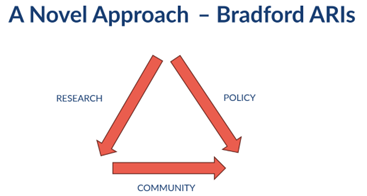
One particular highlight for the team was the National Prevention Research Conference in Birmingham (March 2026). Chris Trevelyan (Governance Lead) and Shabana Din (Coproduction and Partnerships Lead) were selected to present ‘A novel approach to co-producing and combining resident Community Areas of Research Interest (C-ARIs) and Bradford Council ARIs.’ This highlighted that although Areas of Research Interest were created to join the dots between research and policy, communities have been the missing link thus far.
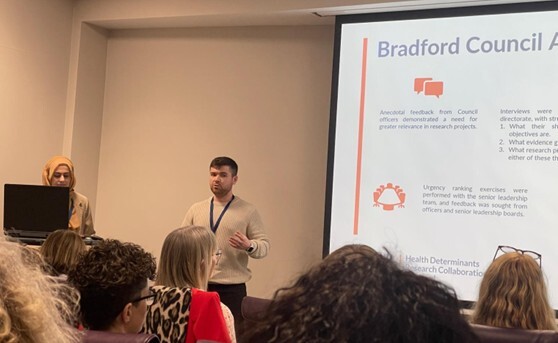 The presentation showcased HDRC Bradford’s approach, which used tailored and appropriate methods to gather priorities from different stakeholders, including local communities and council staff, before bringing these perspectives together into a single, shared set of Bradford District ARIs. This systemic approach demonstrated how distinct voices can be meaningfully combined to create a unified statement of research priorities.
Read on to learn more about the work we’ve been doing with colleagues and partners to put evidence at the heart of decisions across the council.
Dr Ellen Flint, Director, HDRC Bradford
Data
A Longitudinal Data Study on the Ages and Stages Questionnaire 3
Our Data study on the Ages and Stages Questionnaire 3 used linked data from Connected West Yorkshire (formerly Connected Bradford) to explore how children’s development at age 2 relates to school readiness at age 4–5. By connecting health (ASQ-3) and education (EYFSP) records, the study provides new local evidence on early development and later outcomes. Findings show a strong association between early developmental progress and school readiness, alongside clear inequalities linked to sex, ethnicity and deprivation. The work demonstrates the power of joined-up data to answer practical policy questions and support more targeted early years interventions. These insights will help inform how services identify and support children earlier to improve school readiness outcomes. Read our case study here:
Child of the North Data Showcase, Manchester.
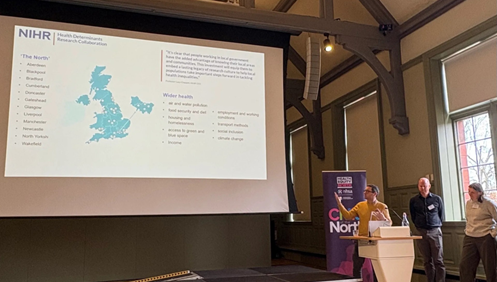
HDRC Data Manager Rob Shore and Data Scientist Dr Yanhua Xu recently spoke at the recent Child of the North Data Showcase in Manchester, alongside Newcastle HDRC, to highlight some of the great data projects across the 30 UK HDRCs.
Yanhua previewed some early findings from the HDRC's collaboration with Born in Bradford exploring how the Ages and Stages (ASQ-3) questionnaire (above) and DfE data can be used to understand school-readiness.
The day brought together policymakers, researchers, practitioners and system leaders from across health, education, local government, and the voluntary sector, all with a shared goal to improve outcomes for children and young people with special educational needs and disabilities.
HDRC Data Acceptance Workshops
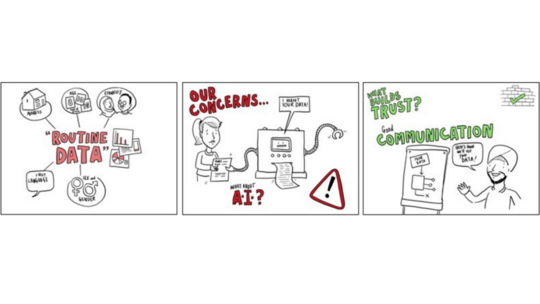
Exploring public acceptance of the use of routine data
HDRC Bradford and Age of Wonder research team launched the first in a series of four Data Acceptance workshops in April, aimed at developing practical guidance on how public sector organisations can better engage with the public about the use of routine data.
So far, over 120 people from diverse backgrounds have taken part. The study has a strong focus on young people, with the research team running sessions in schools and community centres. In total, 19 focus groups have been held, bringing together participants of different ages, experiences and perspectives.
The study places young people’s voices at its centre, exploring their attitudes, concerns and expectations about how data is:
Key themes identified so far include:
-
Transparency and institutional trust – confidence in organisations matters.
-
Participation and control – people are more willing to share data when they have a say in how it is used.
-
Clear public benefit – data use should result in visible improvements to services and people’s lives.
-
Communication and storytelling – sharing outcomes and insights in accessible, meaningful ways.
-
Privacy and security assurances – clear reassurance that data is protected and not sold to third parties.
Further workshops are planned as the research continues, and findings will inform guidance to support more open, trusted and effective public engagement around data use.
HDRC Bradford has worked with the Bradford Children and Families Trust and the Leeds Institute of Data Analytics to use linked routine data to better understand when and why looked‑after children go missing from care. By bringing together social care, placement and education data within the Connected Bradford Research Database, the project identified a small group of children at highest risk, revealed that placement environment plays a stronger role than individual characteristics, and highlighted key high‑risk periods - particularly the first weeks of a placement and immediately after a missing episode. These findings are already shaping more targeted early intervention, safer care planning and smarter commissioning. Read the case study and report.
New HDRC Data Scientist appointment
The HDRC Data team recently appointed Netochukwu Onyiaji as a Data Scientist. Neto had previously worked on collaborations with the HDRC and the Vulnerability & Policing Futures Research Centre during in his previous role at the University of Leeds and its Leeds Institute for Data Analytics (LIDA) scheme. Netochukwu’s research interests lie at the intersection of mathematics, data science, and social impact. These include exploring statistical methods, AI, and Machine Learning techniques to identify patterns, predict trends, and generate insights that can inform policy decisions and community interventions.

Policy news
Making evidence work: How “embedded researchers” support local government?
Researchers from HDRC Bradford based at University of York and Born In Bradford have co-written a new paper examining how embedded researchers can bridge gaps between academic evidence and council action.
Based on their direct experience of working within Council teams, the researchers found that evidence gains "traction" through four practical relational strategies:
-
Tailored Communication: Adapting research to fit the specific "rhythm" and context of council business.
-
Boundary Spanning: Connecting different departments and partners to break down silos.
-
Visibility & Accessibility: Being "part of the team" for real-time advice and informal problem-solving.
-
Reflective Space: Creating time for and supporting busy staff to think critically about how research applies to their team or service area.
How do we know it’s working?
The paper identifies "Markers of Change" - early signs that evidence-based changes are happening:
-
Trust grows: Researchers are invited to the table early during Council initiatives to help and support.
-
Mindsets: Staff proactively request evidence reviews and different kinds of data for new strategies or evaluation.
-
Critical thinking: Teams feel confident discussing the strengths and limits of local data and research when making decisions.
Get Involved To explore how embedded research can support your team’s decision-making, contact the HDRC at hdrc@bradford.gov.uk.
The Policy Hub's 'Co-producing Bradford's Just Transition' project (in collaboration with the University of York, Wellcome-funded The Valuing Voices Project, and The York Policy Engine) has recently informed two national-level government reports:
- The House of Commons Environmental Audit Committee's The Seventh Carbon Budget (available at this link)
- The Public engagement with the energy transition Post Note (available at this link)
Research-lead Dr Kelli Kennedy reflected on this stating, 'It's so rewarding to see how the important learnings from Bradford residents and Bradford Council have been taken onboard at the national level. Place-based research is critical to the climate transition and we're thrilled to see Bradford influencing the UK's direction towards net zero.'
Read more about the project here.
Working with Living Well Schools to develop school uniform policies
The HDRC Bradford Policy Hub team has worked with the Living Well Schools team at Bradford Council to analyse school uniform policies across the district, providing the first comprehensive picture of affordability, second-hand provision, and branding requirements.
Their findings strengthened funding for a new school support role, informed policy improvements, and supported wider local and national action on reducing costs for families.
Co-production
Infant and Early years Feeding Strategy
The Public Health Team at Bradford Council is developing a new Infant and Early Years Feeding Strategy and wanted to ensure it genuinely reflects the needs, views and lived experiences of local families. Recognising the value of community voices, the team partnered with the HDRC Bradford to explore how the strategy could be co-produced, embedding meaningful community involvement throughout the development process by working closely with public contributors.
This marked the first time public contributors, led by the Public Health team, had been fully integrated into this type of project. The approach built on HDRC Bradford’s established Public Consultation model already used within Bradford Council, alongside a strong evidence base demonstrating the importance of meaningful public involvement.
You can read more about this approach and its impact in our case study.
PHAWM
Participatory Harm Auditing Workbenches and Methodologies (PHAWM) is a new study funded by ‘Responsible AI UK’ on participatory AI auditing. The project aims to empower a diverse set of non-AI experts (practitioners, public, and users) to undertake audits of the positive and negative effects of predictive and generative AI. Bradford Council’s Youth Ambassadors will support this work to user test an AI auditing tool that looks at the potential harms and bias of AI platforms in use. HDRC Bradford will also be supporting some of the training elements of the study.
An initial session has be delivered by the PHAWM team and covered essential topics such as AI safety, responsible use, potential misuse, and how to recognise and challenge misinformation and other risks. This session has raised awareness of version 1 of the AI auditing tool and plan ongoing review mechanisms.
2.6 - What impact are the digital determinants of health having on young people in Bradford District?
4.4 - How do we build trust with communities that display concern or hesitancy towards interventions? Shabana/Rahima sending through webinar dates (19th May workshop)
Community of Research
Our latest Community of Research session opened with a presentation from Juliana Novaes Bueno De Camargo who is studying a PhD at the University of Leeds, who shared findings from her study on adult social care in Bradford. Using linked population data, the research highlighted important insights into the needs and experiences of older residents and how data-driven approaches can support more effective service planning.
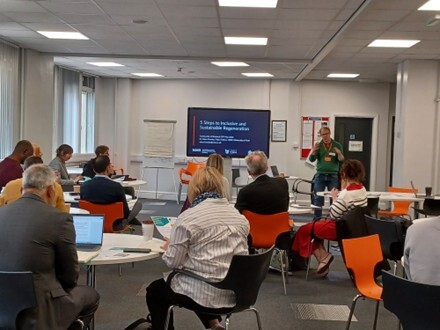
Our embedded researcher Dr Adam Formby from the University of York then explored how inclusive and sustainable regeneration can positively impact local economies and public health outcomes. The presentation emphasised the importance of designing regeneration initiatives that benefit all communities and contribute to long-term wellbeing. It was great to see as always some informal networking after the session which reinforced the value of research partnerships.
Training and Development
Climate Fresk and Biodiversity collage workshops
In June and July, HDRC Bradford will be offering the high-impact “Climate Fresk” and “Biodiversity Collage” workshops to Bradford Council officers. These are two linked, interactive and engaging introductions to the science behind climate change and biodiversity loss. The sessions will hosted by embedded researchers from the University of York, Bradford Council Sustainability Service and HDRC Bradford.
Workshop 1: Climate Fresk – Tuesday 16 June 2026
Where: Bradford Arts Centre When: 9:30am–12:30pm (refreshments and lunch included!)
A fun, visual, game-style workshop that helps you understand climate change in a clear and accessible way. You’ll explore how human actions affect the climate and take part in a reflection session to help you turn learning into positive action.
Workshop 2: Biodiversity Collage – Tuesday 14 July 2026
Where: Bradford Arts Centre When: 9:30am–12:30pm (refreshments and lunch included!)
This session focuses on why nature and biodiversity matter. Through group activities and discussion, you’ll learn about ecosystems, how human activity affects them, and why protecting biodiversity is essential.
Interested? Places are limited, please email kath.clark@bradford.gov.uk to find out more and book your place.
Funding Call
This call is open to individuals who have a contract of employment with a:
- non-NHS provider, commissioned by a local authority to deliver a public health service or function
- voluntary, community and social enterprises (VCSEs) in England that receive a grant or are commissioned to deliver public health services by a local authority
Applications are to be submitted at an individual level.
Webinar: Unlocking the Power of Routine Data: Part 1
An introduction and common pitfalls: Dr Megan Wood offers guidance on how to get the most from routine (already collected) data. In the webinar, Megan will cover how data you already have can be used to gather new insights, the benefits and challenges to be aware of, and top tips on how to get started.
Part 2 of this event will share an overview of Connected Bradford, a platform providing secure access for researchers to linked data.
See Events to see details of these webinars
Introduction to Research Methods course
We have recently hosted our latest free ‘Introduction to Research Methods’ course, in partnership with Shipley College, with some fantastic feedback.
The latest cohort learnt about qualitative and quantitative research methods and analysis, evaluation, co-production, planning research studies and evidence based decision making.
This is a rolling 6-week programme taking place in City Hall, Bradford.
“This course was extremely entertaining and full of useful information which can be implemented during research.”
More about HDRCs
Health Determinants Research Collaborations (HDRCs) boost research capacity and capability within local government. They aim to embed a culture of always using evidence when making decisions. HDRCs use research findings to understand how decisions impact on health and health inequalities. They also carry out research where evidence isn’t already available.
Bradford Council is one of 13 local authorities in 22/23 across the country that have been awarded funding from the NIHR (National Institute of Health Research) to boost research capacity and capability within local government. In October 2023 NIHR awarded a further 11 authorities with HDRC status and 6 with development funding.
Health Determinant Research Collaboration (HDRC) Bradford is part of the National Institute of Health and Care Research (NIHR) and hosted by Bradford Council, in collaboration with our partners, Bradford Institute of Health Research, Bradford University, Leeds University and University of York. The views expressed are those of the author(s) and not necessarily those of the NIHR or the Department of Health and Social Care.
|