Welcome to HDRC’s e newsletter. This newsletter is intended for all stakeholders with Bradford Council and externally. The newsletter aims to share the HDRC’s journey throughout the lifetime of the programme showcasing the impact of the collaboration.
Health Determinants Research Collaboration (HDRC) Bradford is funded by the National Institute of Health and Care Research (NIHR) (part of the Department of Health and Social Care). We are hosted by Bradford Council, in collaboration with our partners: Bradford Institute of Health Research, Bradford University, Leeds University and University of York.
HDRC’s aim is to help local authorities to become more research-active and to embed a culture of evidence-based decision making. Bradford HDRC is funded until Sept 2027 in the first instance.
A message from the Director
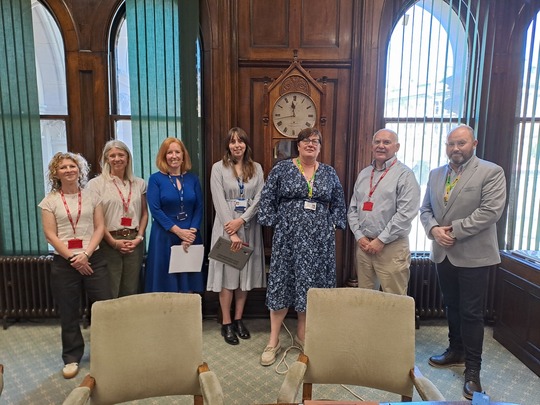 From L to R, Genevieve Baker and Theresa Elmers (NIHR Knowlege Mobilisation team), Fiona Phillips (Public Health Consultant, HDRC Bradford), Dr Ellen Flint (Director, HDRC Bradford), Lorraine O'Donnell (Chief Exec, Bradford Council), Brian Ferguson, (Director, NIHR), David Shepherd (Strategic Director of Place, Bradford Council)
In May we hosted visitors from our funding body, NIHR (pictured above). With help from colleagues, we have worked with across the council, we demonstrated the value research, data and evidence has been adding to policy and practice. The team led by Professor Brian Ferguson appreciated the time and effort from everyone involved and offered very positive feedback.
It was great to see so many research-engaged colleagues at May’s Community of Researchers event. We hosted a brilliant presentation from Dr Anna Barker and Dr Helen Forman (University of Leeds) on their impactful research investigating how to design safety into our parks, particularly for women and girls.
Colleagues in Place are already well engaged with and shaping this evidence base, and Dr Saira Ali and team took us out for a walk around the transformed environs of City Hall to discuss the fantastic results of evidence-informed urban transformation.
We now have a new website with lots more information including case studies, news stories, training resources and more. Be sure to take a look and keep coming back for regular updates. https://www.bradford.gov.uk/hdrc
Policy Hub projects
Our new website hosts our other recent work and our case studies which explore how our research has been used to develop evidence informed policy and practice. The case studies draw out some general lessons which are informing our developing understanding of both evidence informed policy and practice, and embedded research. They are based on embedded research conducted across different policy and practice fields: supported housing, alcohol and drugs, and minoritised carers.
More recently, we have worked closely with the public health team in Bradford to summarise evidence about what a strategic public health prevention approach to reducing alcohol and drugs harms involves in local practice.
This approach is recognised as needed, as according to the Advisory Council on the Misuse of Drugs (ACMD) the UK does not have a functioning drug and alcohol prevention programme. A clear framework and shared language and understanding is needed to underpin successful strategic prevention.
The Hub team completed a rapid review, focusing on evidence that was the most ‘rich in detail’. This produced a definition of prevention as an ongoing process of protecting people from, and minimising the health harms of, alcohol and drug use throughout their lives including in recovery. This requires a focus on changing living conditions and enabling people to have control in their lives and to thrive. Based on the review, a ‘BETRR prevention’ framework has been developed to guide policy and practice. This focuses on five intervention pathways to prevention:
1) access to life’s essentials; 2) education, development, literacy and skills; 3) power and control; 4) disruption of supply chains and regulation; and 5) partnership working.
In the last newsletter, we provided a brief outline of our current research projects, one on net zero and the Council’s climate action plan and one on the Southern Gateway regeneration project. Both projects are progressing as planned. The net zero project is at the stage of recruiting community researchers and setting up three community workshops. The Southern Gateway project is at the stage of completing a rapid evidence review of the impact of regeneration schemes on health and wellbeing outcomes. Both projects are rooted in co-production and participatory research approaches and are generating lots of insights into how these approaches can underpin a range of research methods across a range of policy fields.
Additionally, our research on supported housing, specifically on supported exempt accommodation, has been picked up nationally. Short policy briefs have been prepared by Hub researchers for the National Housing Federation and for the All Party Parliamentary Group on Ending Homelessness, which are available on the resources section of our website.
Successful funding bids
Hub researchers have successfully bid for funding for two policy-focused research projects, each funded for approximately £20,000 by the Born in Bradford Centre for Social Change at University of York. The two projects are:
‘Understanding how to support Young People’s Transitions into Adulthood: An Analysis of Age of Wonder Data and Participatory Engagement,’ working with the Council's Employment and Skills team and Born in Bradford: Age of Wonder, and
‘Co-producing Bradford’s Just Transition to Net Zero,’ working with community peer researchers in Bradford.
Building on existing research, both projects have a strong focus on co-production and participatory research and draw on this to develop evidence informed policy and practice.
Food for thought
Our colleagues at The York Policy Engine have researched new links between food inequalities and mental health:
Food for Thought is a five-year longitudinal mixed-methods research programme exploring food inequalities and mental health. It is funded by the Welcome Trust and based at the University of York. We are learning about people’s experiences of accessing the food they need and how this impacts their mental health, and looking at how aspects of people’s identity, such as their income, ethnicity, and gender, affect food and mental health. To do this, we are talking to people in Bradford, London, and York about the everyday struggles and challenges they are facing. We are also using large-scale, statistical data to understand how other people are impacted by trying to maintain a healthy diet on a low income.
In Bradford, we have found that many residents living on a low income are struggling to access healthy food on a regular basis. These struggles are amplified by factors such as unemployment, disabilities and health conditions, single parenthood, and ethnicity. As a result, many Bradford residents are experiencing worsened physical and mental health due to weight changes and nutrient deficiencies, as well as increased feelings of stress, anxiety, and depression.
We recommend that the following local-level action can help to reduce food insecurity in Bradford:
Food insecurity is predominantly rooted in people’s lack of income, so direct financial support such as cash payments and supermarket vouchers can help individuals buy the food they need without relying on food aid.
Keep Housing Affordable and Safe We have found that high housing costs are a big part of why households are struggling. We maintain that housing costs and standards must remain a key part of Bradford’s anti-poverty strategy.
Community food aid provisions should be supported by local authorities to ensure culturally appropriate food is always available, and to continue to operate as welcoming spaces where individuals can socialise and be signposted to any other relevant services.
Our recent publications address food insecurity among asylum seekers nationally and in Bradford, healthcare access among asylum seekers nationally and in Bradford, and how Bradford residents have been impacted by experiences of food insecurity and accessing food aid. Forthcoming publications address food inequalities in community food aid, and the link between food insecurity and racial discrimination.
Flexible Working Review
Creating a healthier, more inclusive economy is a key economic and public health challenge. Flexible working – the influence and control people have over work scheduling, including where, when & how much work is carried out to meet wellbeing needs – is one way of achieving this. While every UK employee has a legal right to request flexible working from their first day in work, little is known about inequalities in access to it - despite the economic (e.g. staff retention, motivation, productivity) and health benefits (e.g. people can provide care, attend medical appointments, manage disabilities and health conditions, which can all improve physical and mental wellbeing).
Members of the HDRC Evidence into Policy and Practice Hub recently worked with the West Yorkshire Scientific Advisory Group to explore UK evidence on how different groups of employees (by occupation, disability, ethnicity, gender) access or experience flexible working. There is limited evidence, but inequalities are consistently found. These reflect systemic issues within the UK economy (i.e. occupational hierarchies, gendered norms about care, racism, disability discrimination, ‘ideal worker’ culture that values overwork, flexibility stigma). The work identified five ways that regional and local policy can promote more inclusive access to flexible working. For West Yorkshire and Bradford, this might include monitoring and evaluating the roll out of the WY Fair Work Charter in relation to inequality and investing in (e.g. via local procurement processes), championing, and supporting enterprises in which the bargaining positions of employees around flexibility tend to be more equalised (e.g. cooperatives and employee-owned firms).
Bradford Council welcomes Public Contributors
The Bradford HDRC team welcomes public contributors to its co-production steering group. Dr John Samuel and Nabeela Khan joined the steering group as members in December 2024 and attended their first steering group meeting in February 2025 at the Grange Interlink Community centre. Their role is to ensure resident voice is embedded within the decision making of the HDRC.
Read more on our website.
Exploring acceptance and trust of routine collected data
The HDRC is working with members of the public across the District to explore acceptance and trust in the use of routinely collected data. The collaborative project with Born in Bradford's (BiB) Age of Wonder programme is funded by the NIHR and is now recruiting to focus groups to explore this topic and gather feedback on data communications. We’re particularly looking to engage young people, parents, and school staff from across Bradford.
Purple Air Sensors case study
The Data team in partnership with Born In Bradford and the University of Leeds recently completed a review of the Clean Air Zone's Purple Air sensors to Evaluate the usefulness of the sensors as a low-cost alternative to standard research-grade sensors used for national air quality monitoring.
The study involved placing sensors at 12 sites, collecting data, and performing detailed exploratory analysis using R statistical software.
The analysis provided insights into sensor measurements, pollutant trends, and patterns across different schools and sensor types and established a foundation for future research questions and policy decisions regarding air quality and health inequalities in Bradford.
Read the full case study on our website.

A gentle introduction to R and RStudio
A ‘Gentle Introduction to R and RStudio’ training course has been co-designed and delivered by Dr Chantel Davies, a Data Scientist within the HDRC, and Olasehinde Shobande, a Data Analyst in BIHR. The training was hosted online via Teams, in collaboration with the Training and Capacity Lead, Rahima Ali, in March 2025 to a group of data champions in the Council.
The IT department have provided a service request number to the HDRC specifically to auto-install R, RStudio and rtools on Council laptops, removing the burden from staff to raise their own requests.
Eleven staff members attended the training, representing 7 departments or teams.
Concomitantly, Chantel has built a downloadable R training package, ‘bradtrainr’, for Council staff containing (currently) one tutorial teaching data visualisation and relevant accessibility principles.
To accompany the live training, a series of closed-caption videos with transcripts have been produced, with links to further reading and training materials hosted on external websites. The training videos, package, and transcripts will be hosted on the Council’s internal training suite for colleagues to access.
Chantel Davies has also recently delivered a session on data visualisation to a health data group within the Data Science community, now available to view on YouTube. Follow this link Health Metrics: Introduction to Data Visualisation (health_metrics01 10) to the ‘Introduction to’ presentation where Chantel uses existing health data to describe how to create visualisations with R.
Using LEGO® as a community participatory method
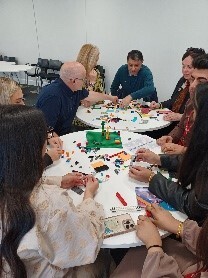
In April 2025, HDRC Bradford offered a co-produced ‘Using LEGO® as a Community Participatory Method’ workshop, in collaboration with Dr Emilia Trapasso (Postdoctoral Research Fellow in Public Engagement Research Associate, Healthy Urban Places) at University of Liverpool, and Cathy Knamiller (Senior Research Fellow) at Born in Bradford. The workshop was a resounding success, providing Local Authority staff, Researchers and VCS with the tools and insights necessary to better serve their diverse communities. The positive feedback and meaningful takeaways from the workshop highlight the importance of engaging with communities using different methods in both public service and research. Read the full case study on our website.
|
Forthcoming Training Opportunities:
HDRC Bradford Training - From Ads to Ailments: The Commercial Impact on Health
Tuesday 24th June 2025 12.00-12.45
Ever wondered why companies spend so much on advertising? In this lunchtime webinar Fiona Phillips, Consultant in Public Health with the Health Determinants Research Collaboration (HDRC) will explore how the tactics of some businesses are designed to impact our health and how choice is influenced. The session will also explore how industry has infiltrated the support market and what we need to be aware of when looking for resources for health campaigns.
Join the meeting
HDRC Q&A Session- What do you want to know about Research and Academia?
Thursday 17th July 2025 12.00-13.00
If you have any questions regarding research and academia, why not come along to HDRC Q&A drop-in sessions. Join the meeting now
Act Early
ActEarly is a research consortium working closely with HDRC Bradford to align research efforts with policy making. ActEarly have produced an animation to summarise what they have been working on. Please click here to view the animation and visit www.actearly.org.uk for more information on the initiative and research hub.
Ethics Study in Local Authorities
HDRC staff were happy to be interviewed as part of this qualitative study on ethics governance in local authorities. The project was conducted by the Islington Council Public Health team with support from colleagues at Cornwall and Middlesbrough councils, and will feed into national research-capacity building work being led by the NIHR:
More about HDRCs
Health Determinants Research Collaborations (HDRCs) boost research capacity and capability within local government. They aim to embed a culture of always using evidence when making decisions. HDRCs use research findings to understand how decisions impact on health and health inequalities. They also carry out research where evidence isn’t already available.
Bradford Council is one of 13 local authorities in 22/23 across the country that have been awarded funding from the NIHR (National Institute of Health Research) to boost research capacity and capability within local government. In October 2023 NIHR awarded a further 11 authorities with HDRC status and 6 with development funding.
Health Determinant Research Collaboration (HDRC) Bradford is part of the National Institute of Health and Care Research (NIHR) and hosted by Bradford Council, in collaboration with our partners, Bradford Institute of Health Research, Bradford University, Leeds University and University of York.
The views expressed are those of the author(s) and not necessarily those of the NIHR or the Department of Health and Social Care.
|