Welcome to HDRC’s e newsletter. This newsletter is intended for all stakeholders with Bradford Council and externally. The newsletter aims to share the HDRC’s journey throughout the lifetime of the programme showcasing the impact of the collaboration.
Health Determinants Research Collaboration (HDRC) Bradford is funded by the National Institute of Health and Care Research (NIHR) (part of the Department of Health and Social Care). We are hosted by Bradford City Council, in collaboration with our partners: Bradford Institute of Health Research, Bradford University, Leeds University and University of York.
Our aim is to help local authorities to become more research-active and to embed a culture of evidence-based decision making. Bradford HDRC is funded until Sept 2027 in the first instance.
A message from the Director

It is great to be back at work from maternity leave and catching up on all the fascinating and important projects the HDRC team and partners across the council and wider system have been delivering (read all about some of these below!).
So much progress has been made towards our goal of putting evidence at the heart of decisions to reduce health inequalities for the people of Bradford... and there is so much more to come!
Ellen Flint – HDRC Director
|
New research approval process being trialled
The HDRC is launching a new Research Approval Process (RAP) for Bradford Council whereby requests to conduct research involving Council services, staff and service users will be reviewed by a RAP panel who will make a decision on whether the ask aligns with Council priorities.
The new process is being trialled within our Adult Social Care directorate, which historically receives the most research requests from Universities and other academic bodies. The team found that many requests were going directly to Council offers, placing a burden on them to assess whether the request was appropriate, ethical and whether the directorate had the resource available to accommodate the research.
The RAP will relieve that burden by ensuring that all requests go to a panel made up of HDRC and non-HDRC staff with a background or interest in research, who will then assess the merits of the request and liaise directly with the researchers.
Findings from the trial period will be used to shape the process so that it can be rolled out across the rest of the council in due time. Watch this space for updates.
Data acceptance Public Health Research Programme
In our last newsletter we shared the good news that Rob Shore had won £300,000. The HDRC's data acceptance Public Health Research Programme has been granted ethics approval from the NHS Research Ethics Committee to begin recruitment for focus groups. The study is currently developing examples of how routine data is collected, deidentified and used for decision-making and research. It recently shared examples across the Council's social media channels and will soon be publishing posters, leaflets and video explainers. Focus groups and scoping reviews will begin in February and be co-led by Bradford's young people to explore attitudes towards data sharing consent, use, barriers and data visualisation.
Attending the ADPH Sector Led Improvement Conference with the HDRC
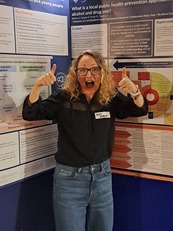
In November, some of the team attended an annual conference in Sheffield run by the Association of the Directors of Public Health Yorkshire and the Humber. The theme of the conference was to explore public health’s past to identify lessons that can be used to help the region plan for the future.
We presented a series of posters in collaboration with our partners showcasing our work on various topics which can be viewed at the links below:
|
Working with students
HDRC hosts PhD students
The Data Science team will be hosting PhD students in 2025 as part of an Engineering & Physical Sciences Research Council (EPSRC) Centre for Doctoral Training (CDTs) partnership with City, University of London and University of Warwick. The HDRC will host a series of internships, each lasting three to six months. The programme aims to improve diversity in data science and develop creative approaches to effective data analysis and innovative visual methods. The partnership will also co-create events, training, data challenges, and seminars.
Bradford Council hosts masters' students
Last summer, we coordinated placements within Bradford Council for five Masters in Public Health Students from Bradford University. The placements enabled the students to undertake their dissertations on a range of topics from vaping, through to supporting people into employment, and the effectiveness of drug and alcohol services. Students reported getting very good support from the Council staff they were assigned to work with and all five passed with good grades. For Council officers it provided free resource to carry out a piece of original research that could inform how they work. The current cohort of Masters students will be looking to undertake their dissertations in summer 2025. If you feel you could host a student to undertake a piece of research in your team please get in touch.
Policy Hub projects
The Hub team are starting two new projects which will be the focus of their work over the coming year.
This is an ambitious regeneration programme which aims to transform socio-economic and health outcomes over a ten-year period for the whole of the southern part of Bradford. The regeneration programme has multiple strands but is based around the building of a new rail station. The Hub team is supporting the Council and its partners in developing a framework of inclusive regeneration. This will be based on a methodology of participatory evidence synthesis. This yields findings that are similar to more “traditional” evidence reviews but takes more account of broader information and insights about what could work in different contexts by combining evidence reviews with evidence from policy makers and residents on what works locally.
Policy workshops and qualitative interviews will be conducted with key stakeholders with expertise and experience in inclusive regeneration to identify to explore theories of change, policy mechanisms and map against evidence. Additionally, co-production work with youth ambassadors will explore how they see regeneration, health inequalities and what they would hope to see in the regeneration development.
This programme supports the Council in achieving its aims of becoming a net zero local authority through developing its climate action plan. The Hub research team will support the development and training of a team of community researchers who will then run a series of community workshops with residents and community groups exploring community priorities, capacity and involvement. A further phase will run workshops with community groups, the Council and key stakeholders to support co-production of the district Climate Action Plan.
Launch of the co production multi-disciplinary steering group
We recently set up a multi-disciplinary steering group to guide the work of its co-production strand and held it’s first meeting in December 2024. The steering group includes local representatives with expertise or experience in research, community engagement, public involvement & coproduction, public health and the wider determinants of health, both within and external to the local authority. Additionally, we are also selecting for two public contributors to join this group to ensure we have genuine representation of resident voice.
The purpose of this steering group is to guide the work of our co-production and partnerships strand helping it to achieve its aims to strengthen community voice within research and evidence- led decision making in the local authority around the wider determinants of health. We will do this by developing the necessary partnerships, infrastructure, governance, and resources to co-produce research and evidence with communities, working in ways that bring maximum benefits to the public. The group aims to ensure that all members and community representatives work collaboratively to shape, advance and evaluate the work in a manner that is inclusive, equal and transparent.
Co-producing local authority research and evidence with communities will increase the relevance, acceptability and benefits of research for communities in Bradford District, as well as reducing inequalities in population health.
Children and Young People’s Takeover Event
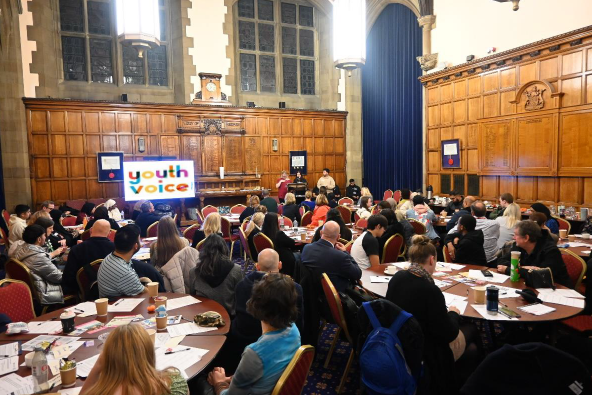
In November 2024, young people from eight youth voice groups across Bradford District, attended a takeover event of the Children, Young People and Families Executive Board at City Hall. The purpose of the event was to provide a platform for youth representatives to share their priorities, lived experiences and ideas for improving outcomes with decision makers to influence future policies and practice. The event was planned and delivered by the Bradford Youth Ambassadors, the Child Friendly lead and the Youth Service, in collaboration with the HDRC and Employment and Skills colleagues.
Prior to the event, our co-production strand worked with the Youth Ambassadors to identify the priorities children and young people related to the wider determinants of health. The priority themes identified were:
-
Education and skills development
-
Safe homes, places and communities,
-
Physical and mental health
-
Equality and discrimination
We then worked with Bradford’s Youth Ambassadors to develop additional research questions focusing on the priority themes. The Youth Ambassadors were supported by Bradford District’s Child Friendly programme lead and Youth Service colleagues to undertake research visits to local youth voice groups. During these visits, the Youth Ambassadors gathered information about the groups’ priorities within the identified themes, and ideas for solutions to the challenges young people face. Their findings were collated into 1-page documents which could be discussed at the takeover event.
During the event, board members were split into groups based on the four event themes. Youth groups rotated around the rooms to share their priorities and ideas around each theme with the board members, before reconvening to reflect on the topics discussed.
Further work around the priorities identified will be taken forward in collaboration with other boards and partners who have committed to have their own ‘takeover’ approaches and embed youth voice into decision making as a result of this project.
We would like to thank Bradford Council’s Youth Ambassadors, Youth Service, Child Friendly Bradford District programme lead, and Employment and Skills colleagues for making this event possible and enabling the HDRC to improve our understanding of young people’s priorities for wellbeing.
We were delighted to hear that the Youth Ambassadors recently won the Service Excellence Award for ‘Children at the Heart of What We Do’ and we send our congratulations to them.
Lunchtime webinars open to all
HDRC Bradford Training - Using LEGO® as a Community Participatory Method
Monday 28 April 2025 9.30-1.00pm
Join us for an innovative LEGO® workshop designed to inspire creativity and inclusivity in research and community engagement. Discover how LEGO® can be a powerful tool for answering research questions and fostering meaningful connections with people of all ages. Led by a certified LEGO® Serious Play® facilitator, this hands-on workshop offers a unique opportunity to:
-
Unleash your inner LEGO® master builder by creating solo and group builds.
-
Use LEGO® bricks as metaphors to explore ideas and insights.
-
Participate in dynamic discussions that deepen understanding and collaboration.
Experience the methods first-hand as a participant while exploring how to incorporate these techniques into your own research projects, public engagement initiatives, and collaborations across sectors. Whether you're a researcher, educator, or community organiser, this workshop will equip you with creative tools to connect with diverse groups and gather valuable perspectives in an inclusive and imaginative way. Spaces are limited, so don’t miss your chance to build, learn, and grow with LEGO®!
HDRC Bradford Training - Reflecting on research in practice - Learning the art of doing Science- Thursday 6 February 13.00-13.35
Join us for this short lunchtime webinar where Elizabeth Westwood will explore the process of undertaking research in community settings, drawing on reflections from qualitative research recently completed in Bradford. She will cover aspects of logistics, ethics, and etiquette, considering why research in practice is sometimes a winding and bumpy road to additional questions, rather than a fast track to ground-breaking results, and what can be learned along the way.
Meeting ID: 379 310 467 106
HDRC Lunchtime Webinar: Exploring public acceptance of the use of administrative data and a co-produced local data system
Tuesday 4 March 2025 - 12.00PM-13.00PM
An introduction to a new HDRC Public Health Research Programme funded by the NIHR. The project aims to work directly with the public to co-produce case studies of routine data use and a national framework on how to engage with and work with our communities on how routine data should be used to inform decision making. The 24-month project also aims to establish a public participation panel to aid decision making on how and why routine data is used in Bradford.
More about HDRCs
Health Determinants Research Collaborations (HDRCs) boost research capacity and capability within local government. They aim to embed a culture of always using evidence when making decisions. HDRCs use research findings to understand how decisions impact on health and health inequalities. They also carry out research where evidence isn’t already available.
Bradford Council is one of 13 local authorities in 22/23 across the country that have been awarded funding from the NIHR (National Institute of Health Research) to boost research capacity and capability within local government. In October 2023 NIHR awarded a further 11 authorities with HDRC status and 6 with development funding.
Health Determinant Research Collaboration (HDRC) Bradford is part of the National Institute of Health and Care Research (NIHR) and hosted by Bradford City Council, in collaboration with our partners, Bradford Institute of Health Research, Bradford University, Leeds University and University of York.
The views expressed are those of the author(s) and not necessarily those of the NIHR or the Department of Health and Social Care.
|