|
Welcome to the Early Education and Childcare Quality Officer (EECQO) team's newsfeed. At the end of every month, the team share key information, and important updates collated during the month from other agencies, which they hope you find useful in your setting.
This month's newsfeed has a main focus on safeguarding
The first section of the newsfeed provides updates from the EECQO's and other Bradford Council teams

Spotlight on safeguarding
This month the spotlight on safeguarding focuses on;
Allegation management
An allegation is where anyone (including a child) alleges that a person living, working, or looking after children at the premises (whether the allegations relate to harm or abuse committed on the premises or elsewhere) has:
- Behaved in a way that has harmed a child or may have harmed a child.
- Possibly committed a criminal offence against or related to a child, or
- Behaved towards a child or children in a way that indicates they may pose a risk of harm to children.
Allegations must be taken seriously and dealt with sensitively and promptly.
Responding to an allegation made against a childminder.
- Listen to and record the allegation.
- Refer to the allegation management policy and procedure.
- Contact Ofsted immediately and follow their guidance using serious childcare incident report online
- Ofsted will inform the Local Authority Designated Officer of the allegation.
- Email LADO@bradford.gov.uk to inform the LADO that an allegation has been made, (Bradford’s LADO does not take self-referrals, Ofsted has to do this on the childminder’s behalf)
Responding to an allegation made against a member of staff; volunteer/student; or household members in a childminding setting.
- Listen to and record the allegation.
- Refer to the setting’s allegation management policy and procedure.
- Contact the Duty Local Authority Designated Officer (LADO) immediately for advice and guidance by phone 01274 435600
Alternatively, an email can be sent to LADO@bradford.gov.uk asking for the LADO to phone back. Include in the email, name and role of person emailing, name of the setting, and a contact number. Please note if the LADO is not available when ringing 01274 435600, an email will have to be sent instead, as detailed above.
Safer Bradford has more information on ‘Allegations Management and Safer Recruitment’ and the ‘flowchart for allegations against staff, carers and volunteers’
|
Bradford District Safeguarding Children Partnership protocols
Neglect protocol
Neglect can be really difficult to spot. Having one of the signs doesn't necessarily mean a child is being neglected. But multiple signs noticed that last for a while, may show there's a serious problem.
Bradford has a Neglect Toolkit available to help practitioners identify factors which may indicate that a child or young person is being neglected. The toolkit is a guide only and it should not replace professional judgment or be the deciding factor in decision making.
The toolkit supports the practitioner to consider what they have observed, enable reflection on their observations, assess any potential harm and assist their decision making about what needs to happen next. Practitioners should be appropriately probing in assessing the circumstances and should be curious and questioning about information provided to them by families.
To read the neglect toolkit and access other neglect resources visit Safer Bradford - Resources
Please note the toolkit review date is July 2024.
Non-mobile protocol and preventing non-accidental injuries
One of the Bradford District Safeguarding Children Partnership's key priorities is preventing non-accidental injuries to non-mobile babies. These injuries often stem from moments of frustration and a lack of support. By understanding new parents' stresses, raising awareness and providing access to vital resources, we can significantly reduce the number of such injuries.
Evidence suggests that it is rare for a non-mobile baby/child, for example one that is not yet crawling to sustain accidental bruising. Therefore, all such bruising in non-mobile babies should be viewed by practitioners as an indicator of possible physical abuse and, as such, should be thoroughly investigated by following the referral process.
Bradford has a ‘multi-agency assessment of non-mobile babies with injuries, including bruises, burns and scalds.’
What does non mobile mean?
- ‘Non mobile’ covers up to the crawling stage (pre-cruising) but remember once crawling they are still vulnerable.
‘Once start cruising tends to get bruising’
- Some babies can roll from a very early age, this does not constitute self-mobility.
- Older children with SEND that are non-mobile, (not listed in the protocol), but you must treat with same level of concern.
- If a non-mobile child is presented in your setting with any injury, you MUST REFER, even if there is a plausible explanation given.
Have you read the multi-agency assessment of non-mobile babies with injuries, including bruises, burns and scalds protocol?
Are all practitioners aware of the protocol and referral process?
Does your safeguarding policy and procedure include information about non-mobile babies and the procedure?
Visit Safer Bradford – Children for the ‘Assessment of non-mobile babies with injuries, including bruises, burns and scalds.’ The protocol can be found on right hand side listed as ‘Injuries in non-mobile babies’
Dealing with and coping with crying
In this Safer Bradford – Children section there is an ICON leaflet advice for dealing with coping with crying babies#pdf. The ICON initiative offers practical advice to help parents understand and manage this aspect of parenting.
There are further information and resources including a section for professionals, and parents visit the ICON website
Swaddling and safe sleeping
Swaddling can be a comforting method for soothing a baby, but it's crucial to do it safely.
Never put a swaddled baby to sleep on their front or side. The safest sleeping position for a baby (swaddled or not) is on their back
The Lullaby Trust offers valuable guidance on safe swaddling and the proper use of slings and has a variety of resources, training and advice on safer sleep advice, bereavement and also has a section for professionals.
|

Safeguarding children around electronic devices
What do you know about other electronic devices that have sharing capabilities?
You may be familiar with computers, tablets, mobile phones and smart watches, but are you familiar with other devices such as Air Tags?
Air tags are designed to track objects, for example these could be used to keep track of a child’s favourite toy, or can be attached to a backpack with a favourite toy inside. It's important that parents make you aware if they are using Air Tags, and that your safeguarding policy is clear about the use of other electronic devices in your setting too.
Air Tags also contain a very small button battery which can seriously hurt or kill a child if they swallow one.
Child Accident Prevention Trust have Button Battery Safety information
|
Theme confirmed for the November provider network
The focus for the November provider network will be SEND. Please note it is not a repeat of our 2023 provider network.
The session intends to improve your knowledge and awareness of ‘visuals for communication’ and ‘meeting sensory needs’
You will gain an understanding of how visuals can be used and adapted in your setting to help children communicate wants and needs. The Access and Inclusion Officer will cover briefly what sensory needs are, how they may be identified, and share strategies to help you meet a range of sensory needs in your setting. Book your place now. It is free to attend online using Microsoft Teams.
There are two dates to choose from, choose one date:
Book here for 26th November 2024 6.30 - 8pm
Book here for 28th November 2024 6.30 - 8pm
|
‘Focus on’ documents
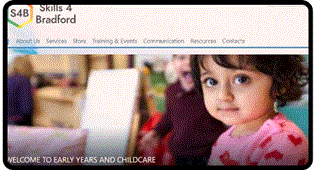
There are currently thirteen ‘focus on’ documents available on the EECQO Skills 4 Bradford |Focus Documents page. There’s a varied range of topics, including communication and language, child development, safeguarding, food allergies/allergens, treasure baskets and much more. The ‘focus on SEND’ has been updated this month. Why don’t you take a look and see what advice and support there is for your setting.
|
This next section shares updates from the Department for Education

Early Years and Childcare Careers
Upload any current or upcoming vacancies available in your setting for FREE
The Early Years and Childcare national recruitment 'do something big' campaign is live. The campaign aims to raise the profile of the sector and showcase the important contribution made by early years professionals in preparing young children for school and beyond. It is a multi-channel broadcast campaign, running across TV, cinema, social media, online, radio and out of home advertising to boost interest in the sector and support the recruitment of talented staff.
The recruitment campaign for early years and childcare includes a platform for employers to advertise on.
Upload any current or upcoming vacancies available in your setting, please watch these video tutorials to help create an employer account and post jobs.
Create an employer account here You should use the term ‘early years’ in the title of your job adverts and select ‘Education jobs’ for the job category.
The aim of the campaign is to promote early years and childcare careers by highlighting the huge difference early years professionals make to young children and how rewarding working in the sector can be.
The campaign, with its own dedicated website, will direct potential applicants to use the platform.
Find a Job vacancy platform to search for early years, childcare and wraparound roles in their area.
|
Stronger Practice Hub: two events
1. Thinking together with children and nature
Delivered by Debi Keyte-Hartland, an Early Education Associate Consultant. The webinar will look at the role of the educator in generating contexts for thinking together with children and nature in whatever outdoor space you may have.
Book your free place for Tuesday 9 July 2024 16:00 till 17:00 Here on Eventbrite
2. Oral health and early years update
Learn about oral health practices, dietary advice, toothbrushing, teething, weaning, data and much more.
Join the live webinar on Tuesday 16 July 13:00 till 16:00 pm Book tickets here on Eventbrite
|
Keep yourself well informed
There are lots of sources for information guidance and support available online. This is not an exhaustive list and please note we are not endorsing any specific organisations:

NSPCC's
safeguarding and child protection newsletter
|
Child Accident Prevention Trust
Download and share the Child Safety Week Parents’ Pack which contains bite-sized facts and safety tips on the main accident risks to children.
Top 5 serious preventable accidents to under 5s
Did you know that most serious accidents to under 5s happen at home? Fortunately, some of the worst accidents are the simplest to stop. CAPT have top tips and resources to help families learn how:
Strangulation and suffocation Did you know nappy sacks can kill small babies? They naturally grasp things and pull them to their mouths, but then find it difficult to let go. Flimsy nappy sacks can easily cling to a baby’s face as they breathe in and cause suffocation or choking.
Falls While most falls aren’t serious – active children often fall over – some falls can lead to death or long-term disability. So it’s important to learn what you can do to prevent serious falls.
Poisoning Suspected poisoning is one of the most common reasons for young children to be taken to A&E. Discover ways to reduce the risks and keep children safe with free resources.
Burns and scalds Want to help prevent burns and scalds to children? There are lots of free resources to help you create a talking point, run an engaging workshop or provide essential advice to the families you work with.
Drowning It’s scary to think about but drowning doesn’t happen like it does in the movies. A drowning child doesn’t splash about or cry for help. They slip quietly under the water, often unnoticed. But, once you understand how and where drowning happens, there are things you can do to prevent it.
Please help get the message out to parents.
|
|