COP26: What happens next?

It was hailed as a watershed moment for the world, a last ditch chance to limit global warming to 1.5°C, but did COP26 live up to expectations and what does this mean for our District?
The Conference of Parties (COP) ended last Sunday (14 November) on a muted note, over the wording on an agreement over the future use of coal being watered down to ‘phasing down’, instead of ‘phasing out’, and a long ‘to do list’ for every attendee to take back to the office.
Among the pledges made by the UK were: pledging to halt deforestation by 2030, providing £290m to help poorer countries cope with climate change, speeding up the development of green technology by 2030, net zero goals for finance companies, 75 per cent of UK farmers engaging in low carbon practices by 2030 and stopping the sale of non-electric vehicles by 2040.
While all the COP delegates go through their pledges and try to work out how to put them into action, we will continue to get on with working to make a sustainable, net zero District and forge ahead with our ongoing projects.
We will also continue to share this work in this newsletter and that of partner organisations and community groups.
|
White Rose Forest launches action plan
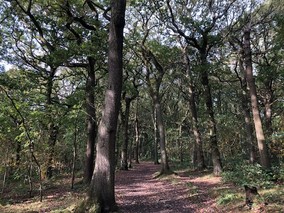
Seven million trees, the equivalent of 4,900 football pitches or 3,500 hectares, could be planted in North and West Yorkshire over the next four years as part of an Action Plan launched today (17 Nov) by the White Rose Forest partnership – of which Bradford Council is a partner.
The White Rose Action Plan 2021-25 sets out how tree planting can be accelerated across the region over the next four years to build up to a sustained annual target of approximately 3,000 hectares per year from 2025 onwards.
According to Beyond 2025, a piece of research by the partnership, North and West Yorkshire has the capacity to increase tree canopy cover from 11 per cent (recorded in 2018) to 19 per cent by 2050. This would mean planting approximately 160 million trees over the next 29 years.
The UK Government has committed to reaching net-zero carbon emissions by 2050 and tree planting is currently the most effective method we have to remove carbon from the air. The White Rose Forest partnership commissioned the United Bank of Carbon team at the University of Leeds to scientifically assess how much CO2 could be removed from the atmosphere through tree planting across North and West Yorkshire. The results suggest that if we increase tree cover to 19 per cent by 2050, 931 kilotonnes of CO2 could be sequestered annually, equating to 50 per cent of the remaining residual carbon emissions within the region.
The White Rose Forest is supported by a partnership of experts from the Forestry Commission, national park authorities, local government, charities, community groups and businesses in North and West Yorkshire who have all contributed to the Action Plan. The Plan is backed by increased funding for tree planting, following the launch of the Government’s Nature for Climate fund in 2020.
The Mayor of West Yorkshire, Tracy Brabin, helped to launch the White Rose Forest Action Plan today (17 Nov) at The Arium in Leeds, where over half a million young saplings are currently being grown by Leeds City Council for the White Rose Forest.
The White Rose Forest team is available to provide a wide range of expert planning, funding and planting support and would like to hear from any landowners or farmers who are interested in tree planting on their land. As set out in the Action Plan, the White Rose Forest can now provide a wide range of funding options for projects of all sizes in North and West Yorkshire.
To read the White Rose Forest Action Plan 2021-25 please visit www.whiteroseforest.org/actionplan
|
Major tree-planting scheme at East Riddlesden Hall
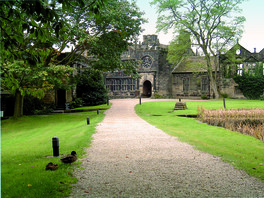
A blossom tree trail is to form the first part of a largescale tree-planting scheme in the grounds of Keighley’s East Riddlesden Hall.
Further planting at the 17th century National Trust property will take place in the lower fields, to introduce ‘wet woodland’ alongside the River Aire – which will help reduce the risk of flooding to downstream communities.
Work on the blossom trail is starting this month with around a dozen trees being planted, which will be a mix of decorative and native species, including cherry and crab apple.
The aim is to produce a focal point for visitors, whilst also supporting nature and helping tackle climate change.
The trees will be planted in memory of those who have lost their lives during the coronavirus pandemic.
East Riddlesden Hall’s blossom project is one of 46 planting initiatives taking place on National Trust land this winter. It is led by so-called National Trust Yorkshire Water Common Cause Partnership rangers.
A special trail map will be produced to help visitors find their way around the trees and learn more about them.
It’s hoped that the first trees in the lower-fields project will be planted this winter, with further planting taking place in following years. Around 4,000 will be planted in total.
The trees will form part of the White Rose Forest.
|
Trees for Streets
In case you missed it, we are also part of the Tree for Streets scheme, a national street tree sponsorship scheme.
This project is run by Trees for Cities, a national urban tree charity, and is funded by the Government’s Green Recovery Challenge Fund. Its goal is to support the planting of more than a quarter of a million street trees nationwide over the next ten years, by supplementing council tree planting budgets.
Trees for Streets offers an online platform for people to sponsor a tree in their street or neighbourhood, by making a donation, and sending a request to their local council with a few simple details. The council then assesses the chosen location, and if it is suitable, arrangements will be made to plant a tree in the winter, the best time to plant young trees.
To find out more or get involved, go to the Bradford Trees for Streets webpage.
Countryfile revisits Bradford
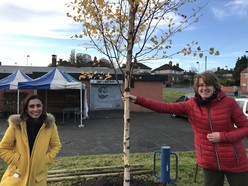
The BBC’s Countryfile programme revisited Bradford earlier this month as part of its ongoing Plant Britain campaign.
The team returned to Horton Park to look at the progress of local tree planting projects being run with the local community by Lottery funded Better Place Bradford, part of Better Start Bradford, and Bradford Council.
There was also a visit from Dr Phil Wheeler of the Open University who got people measuring the trees they had planted and carried out an experiment with a couple of volunteers to show how trees help to reduce the impact of flooding.
Countryfile first came to Bradford in October 2020 to look at the work being done to plant trees at Horton Park Primary School and on the Canterbury estate.
This month's visit featured on a programme broadcast on Sunday, 7 November and is available to watch now on BBC iPlayer. The Bradford sequence is roughly 23 minutes into the programme.
Photo: Anita Rani and Council Leader Cllr Susan Hinchcliffe during Countryfile's filming in October 2020.
|
National award for Clean Air Plan

We have received a national recognition for our Clean Air Plan.
We won the Climate Response category of the 2021 Local Government Chronicle Awards for the Clean Air Plan for Bradford.
The Clean Air Plan, sets out how we will meet the Government directive for a Clean Air Zone for the district. The CAZ will cut levels of air pollution from heavily congested roads. Vehicles that do not meet clean air standards will be charged for entering the zone. This will include vans, taxis, lorries, buses and coaches. There will be no charge for private cars.
The zone will include Bradford city centre, from and including the outer ring road, extending up the Canal Road corridor and Manningham Lane into Shipley and Saltaire.
As well as having health benefits, the zone will reduce levels of Carbon and Nitrogen Dioxide in the air, which are also greenhouse gases.
For further information regarding the Bradford Clean Air Zone please go to the Breathe Better Bradford webpage.
|
Yorkshire and Humber Climate Plan – 50 actions to drive change

The Yorkshire and Humber Climate Commission launched its Climate Action Plan for the region last week, at the Yorkshire Post Climate Change Summit.
The Plan is the result of input from over 500 people and calls for meaningful climate leadership from larger institutions in government and the public and private sectors to deliver “significant, tangible contributions” to help tackle the climate and ecological emergency.
The Plan outlines 50 actions, which are designed to help build the region’s resilience against climate disasters and to achieve its net zero target by 2038, with ‘significant progress’ by 2030.
The actions cover a wide range of topics, including raising awareness of climate risk; preparing the food and farming sector; promoting nature based solutions to the changing climate; putting plans in place to mitigate rising sea levels; decarbonisation and energy efficiency; promoting alternative low emission forms of travel and putting climate at the heart of planning decisions.
The Yorkshire and Humber Climate Commission was launched in March 2021 and is an independent advisory group that brings together public, private and third sector organisations to support, guide and track the delivery of ambitious climate actions across the region.
It has received funding from the Yorkshire and Humber Leaders Board, the Environment Agency, Yorkshire Water, Northern Powergrid, Northern Gas Networks, and the University of Leeds. In-kind contributions were provided by the Trades Union Congress and Yorkshire Universities.
|
New low emissions vacuum cleaners to clean streets
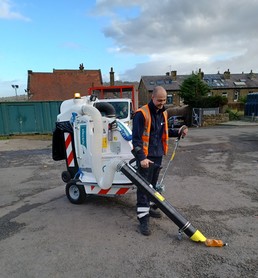
Our street cleaning service is now using electric vacuum cleaning machines to suck up litter and mess.
We have acquired four Glutton Electric Vacuums, to be used in Bingley, Ilkley, Keighley and Shipley, and moved to other villages and towns across the district, when required. These are in addition to four which are already being used in Bradford.
The new machines run on chargeable batteries which last eight to 16 hours, depending on usage and have strong enough suction power to suck up 1kg in one go.
The Gluttons will enable us to collect leaves, cigarette butts, large accumulations of litter and smaller items throughout the day. They can be used safely in areas with a high footfall and use silent electric motors. Their filters make sure there is no dust blown out which can happen with traditional pavement sweepers.
These machines are part of an additional £600,000 increased investment into the Street Cleansing Service. They are used in other authorities across the country and on mainland Europe and can be used on a variety of surface-types, including. concrete, tarmac, paving, lawns, cinder tracks and sand.
The new versions come with built-in water-tanks and sprays, so that jetting or disinfecting can be done where required, or they can be used to wash down street furniture.
|
Shipley Town Council supports HALE bus project
Shipley Town Council’s Climate Emergency and Environment Committee is donating £2,000 towards the cost of community health group HALE’s new bus project.
HALE (Heath Action Local Engagement) uses its Mobile Outreach Vehicle to deliver important health messages and run health engagement activities for vulnerable and hard to reach communities. It recently supported Bradford Care Alliance to carry out community flu and Covid 19 vaccinations.
The funding it has received from the Town Council and Clean Air Zone fund will help the group to its their existing bus to meet the requirements of the Clean Air Zone.
Family Day of Action for Nature at East Morton

East Morton Village Society is holding a Family Day of Action for Nature on Saturday 27 November.
The event has been supported by funding from our Climate Change Grant. Families are invited to come along and:
- Plant a hedge on the Rec
- Make bird and bat boxes
- Build a large insect hotel in the wood
- Meet others in East Morton interested in responding to climate change.
It’s recommended that people come prepared to enjoy the outdoors and bring gardening gloves. The event will help everyone to learn a bit more about helping nature and reducing their carbon footprint.
The event will run from 10am-4pm at the back of Morton Village Institute on the recreation ground. Refreshments will be available.
A Big Green Family Day is also planned for spring, with activities , stalls and talks. The bird boxes being made this month will be put up around the village and wildflower seeds will be sown.
These events form part of a year- long East Morton Action Against Climate Change programme organised through the Village Society and funded by a Council Climate Change Grant.
|
Do you know what to do in a flood?

The Environment Agency is launching its Flood Action Campaign next week (from Monday 22-28 November) – Prepare. Act. Survive.
The campaign aims to help people in flood risk areas to know what to do in a flood.
The EA has three levels of alert when an area is at risk of flooding:
Flood alert, which raises the need to prepare for a flood by taking actions such as preparing a bag with medicines and insurance documents
Flood warning – the need to act by turning off gas, water and electricity, moving things upstairs or to safety and moving family, pets and the car to safety
Severe flood warning – survive – call 999 if in immediate danger, follow advice from emergency services and keep yourself and your family safe.
We will be sharing the EA’s social media messages during the campaign next week.
|
|