One City Park- game changing next step in pipeline of ambition
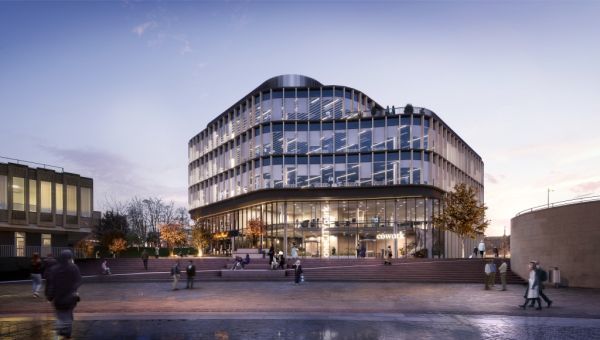
One City Park, a new state-of-the-art office building in Bradford city centre’s City Park, will be developed in partnership with award winning developers Muse as one of a raft of new regeneration projects.
Looking out across City Park and its popular Mirror Pool to the iconic City Hall, the innovative development will transform the commercial office market combining 9,100 sq m of commercial space with 5,240 sq m of Grade A office accommodation. The building will be BREEAM ‘Excellent’ rated, ensuring it is environmentally sustainable. Subject to planning, work will begin on site in 2021 with expected completion in 2023.
One City Park marks the next step in the growth and regeneration of the district reinforcing the city centre as a fantastic business location. A host of other projects are in the pipeline of ambition:
- Work on Bradford Live, the 4,000 capacity music and entertainment venue in the former Odeon, will start in the summer. The restoration will drive £10.4m economic regeneration by providing jobs, training, and 200+ events annually.
- Demolition of buildings on Darley Street will make way for our new £21m market.
- £80m bid to the Government’s Transforming Cities Fund to improve transport links across the city, including a new Park and Ride at the top of the M606, modernisation of Bradford Interchange and a cycleway connecting the city centre with Thornton.
- Progression of our City Village plans to develop Bradford city centre as an exemplar residential community with 1,000 new homes and a revitalised independent shopping area.
- Plans to maximise the impact of Stronger Towns funding for Keighley and Shipley.
- Investment of £1.4m to support the City of Culture 2025 bid.
|
Bradford Council has published its budget proposals for 2020/21 (see item 5 of the Executive meeting agenda).
The proposals include a series of priority investments that support inclusive economic growth, early help for our most vulnerable people, improved health and well being, measures to help tackle the climate emergency and resources to sustain important services and improve outcomes across our communities. Headline investments include:
- over £21m support for Children’s Services
- £1.6m to meet demographic pressures in Adult Social Care
- £1m additional support for action on the Climate Emergency including:
- work with businesses to reduce waste and increase recycling
- moorland flood alleviation and carbon stores
- community based environmental and energy projects
- expansion of 20mph zones
- a range of capital investments which will also reduce costs, carbon and congestion
- £0.7m for an enhanced health and wellbeing offer in libraries
- £0.7m to tackle obesity
- £0.55m for mental health
- extra funding for homelessness
- resources for Keighley and Shipley Stronger Towns programme
- £0.5m deferral of savings in Youth Services
- £0.5m deferral of Council call centre saving pending new model for Welfare Advice
- £0.5m to support re-modelling of the Museums service
It is proposed that council tax is increased by 1.99%. Together with the social care precept of 2% the total increase would be 3.99%, equivalent to £1.05 a week for a Band D property.
The proposals have been developed against a backdrop of considerable uncertainty about the future of local government finance, nine years of austerity and increasing demand and the need to continue to deliver savings. It is only through careful and robust financial management and action to change the way that the Council does things over recent years that it is possible to propose new investments.
With resources continuing to be squeezed the risk remains of the Council being able only to provide statutory services and having to cut back on the non-statutory services that play a big part in reducing cost and demand pressures on other services like social care, the NHS and the Police.
The Council will set its budget on 20 February 2020.
|
Dr Sankar Sivarajah, Head of Business Analytics, Circular Economy and Supply Chain Research Centre, University of Bradford.
What happens to products which we no longer require? Whether fabrics, electronics or plastic bottles, they form part of a linear model or a ‘throwaway society’ which follows the path of make, use, then dispose, impacting on the environment. According to a recent World Bank report, global annual waste will jump to 3.4 billion tonnes over the next 30 years, a 70 per cent rise by 2050.
This begs the question – how many of these products have been put back into the system, reducing waste and giving life to further products and services? Circular Economy (CE) does exactly that. CE allows resources to be used for as long as possible, extracting maximum value and recovering and regenerating products and materials at the end of their service life, presenting solutions to challenges, such as single-use plastic waste and lack of producer responsibility.
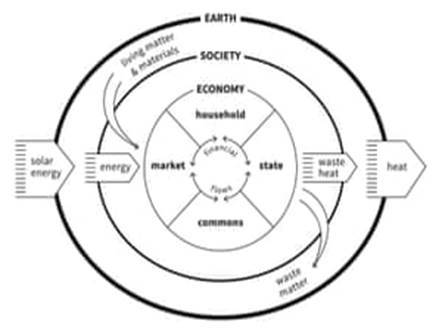 Yorkshire was recently touted as the Silicon Valley for the CE – and the University of Bradford is playing a central role in research and awareness around this concept. CE sits at the heart of one of research centres, the Business Analytics, Circular Economy and Supply Chain (BACES) Research Centre, which is focused on world-class research and best practice in business analytics, CE and supply chain by bringing together interdisciplinary academic and industrial team. We are also a pioneer university, having worked closely with the Ellen MacArthur Foundation and having co-created a unique online MBA and a postgraduate certificate in partnership with them - the Innovation, Enterprise and Circular Economy Distance Learning MBA.
Earlier this year, we brought together a large cohort of international students and industry speakers from around the world at our international summer school, ‘Into the Humansphere; International Summer School on Sustainability in Business (IMS3B)’ where we explored, debate, design and solve challenges connected to sustainability in business and the CE.
The University of Bradford is proud that Bradford has been recognised as the most improved city in the UK for good growth, largely attributed to continued improvements, driven by falling unemployment and more new businesses. The rise of Bradford’s entrepreneurial spirit offers further impetus for us as a university to help businesses and entrepreneurs to think of new and sustainable ways to operate, speeding the transition from a linear economy to a more regenerative economic model. Our research, and the solutions that follow, will support Bradford’s drive to a circular economy, enabling the city to be recognised as most improved and a leader in the field.

In 2000, the district’s 2020 Vision envisaged a connected district with modern transport infrastructure , where digital would be improving lives and creating business opportunities.
Twenty years down the line, Bradford continues to be the biggest UK city without a main line rail station. That’s why we are campaigning hard for a city centre Northern Powerhouse Rail stop which would transform journey times to Leeds and Manchester and unlock huge economic potential adding up to £15bn to the Northern economy.
Improvements to the roads network, for example the Bingley by-pass and at Saltaire roundabout, have alleviated some of the pressure on our town centres but the district still experiences significant levels of traffic congestion, prompting improvement work at Hard Ings, Keighley and more recently, proposals to improve some of the city centre’s worst junctions and develop a South Bradford link road.
Leeds Bradford Airport continues to grow, handling 4.1m passengers in 2018. Key developments over the last 20 years include the arrival of low cost operator Jet2 in 2003 and the introduction of direct flights to Pakistan. The Tour de France acted as a catalyst for a growth in cycling and in 2016 the Cycle Superhighway between Leeds and Bradford opened, but we have still to see significant modal shift from cars to other forms of transport. For example, 45,000 people travel between Bradford and Leeds, the largest flow of commuters between any two UK cities, but 74% choose to travel by car.
On the digital front we have, of course, experienced rapid technological advances – 20 years ago we were using dial-up technologies and internet use was limited. Now we have 24/7 access to the web on our phones.
The West Yorkshire and York Broadband programme started in 2013 and will deliver broadband at >30mbs to 98% of West Yorkshire by 2021. Working with Leeds City Region partners Bradford is improving digital skills and business opportunities. The Advanced Digital Institute is a leading innovator in digital health while the University of Bradford supports the growth of health businesses through the Digital Health Enterprise Zone. The informatics department at Bradford Teaching Hospitals NHS Foundation Trust are the current Digital Health Awards Team of the Year and Born in Bradford has been using data analytics to improve outcomes for children and families for over a decade.
|
In brief
Safer Bradford
A new Safer Bradford website has been launched which brings together information and resources from our safeguarding partnerships which protect adults, children and communities. The site provides details of how to report concerns about the safety of children and adults and about antisocial behaviour.
Have your say
There’s still time to have your say on the future of the district’s library services. A period of engagement is open until Friday, 20 December giving residents the chance to say what they want out of a library network and to help shape proposals to be drawn up in the New Year. Find out more and have your say here.
Facts and stats
Keep up to date with the latest facts and stats on Bradford District at the District Dashboard and Understanding Bradford District.
|