New global space weather hazard index launched and more UK mines needed to secure critical minerals

Having trouble viewing this email? View it as a Web page.

BGS Latest News
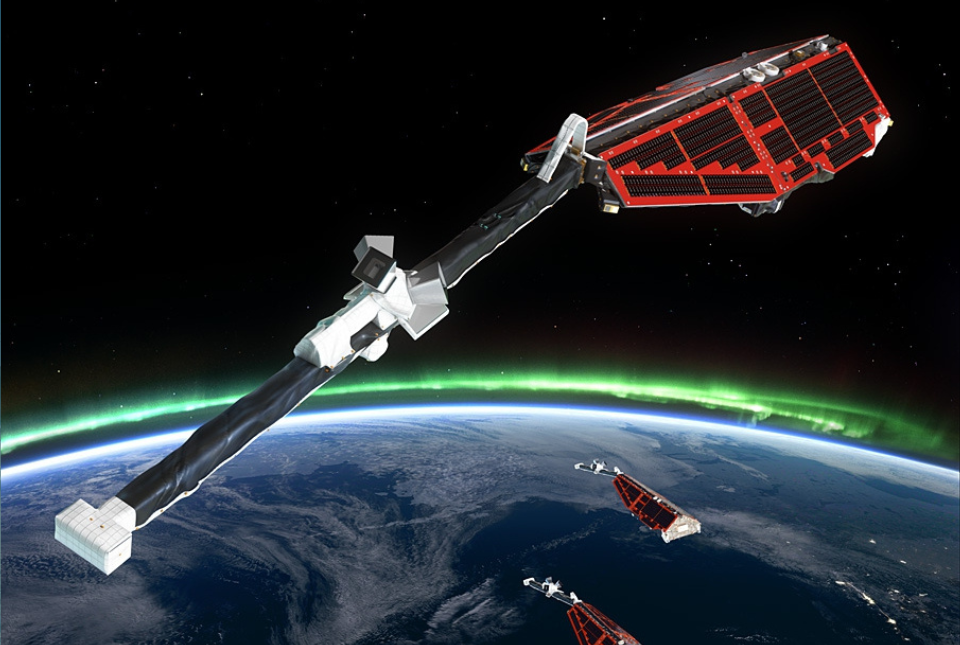
Artist's impression of the three Swarm satellite orbital configuration. © ESA/AOES Medialab.

New global space weather hazard index launched

A new space weather variation hazard index, developed by BGS researchers using data from the European Space Agency (ESA)'s Swarm satellite constellation, provides a near-real time, global picture of geomagnetic variations to spot the local effects of space weather.

Space weather can pose significant hazards to satellites and Earth-based technologies. The satellites will capture geomagnetic anomalies related to space weather all over the world. 

Damage caused in Thailand by the Indian Ocean tsunami. A large lifeboat sits on the side of the road, after being washed ashore.

Twenty years on: the Indian Ocean earthquake and tsunami

On Boxing Day 2004, a magnitude 9.2 to 9.3 earthquake struck northern Sumatra and triggered a tsunami with waves reaching 30 m in height.

Prof David Tappin reflects on the disaster, one of the largest in modern history, which claimed the lives of more than 220 000 people and discusses what we have learnt in the decades since.

A headshot of Gavin Mudd, who is wearing a shirt.

More UK mines needed to secure critical minerals

BGS was featured in the Financial Times this month following the release of the UK 2024 Criticality Assessment. Dr Gavin Mudd, director of the UK Critical Mineral Intelligence Centre, discusses the need to consider subsidies for new UK mines, in order to prevent supply bottlenecks for critical minerals. 

*This is an external link and the full article may appear behind a paywall. A related article featuring Dr Mudd was recently published and is available for free on the BGS website.

In other news

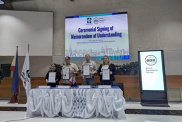
BGS staff stand with PHIVOLCS staff behind a desk. They each hold a signed MoU document.

New Memorandum of Understanding paves the way for more collaborative research in the Philippines

BGS has signed a Memorandum of Understanding (MoU) with the Philippine Institute of Volcanology and Seismology (PHIVOLCS) to strengthen collaboration in research and innovation and to share knowledge on geological hazards. The partnership will focus on research on multi-hazard preparedness within the country.


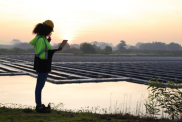
A worker stands using a laptop on the site of a floating solar farm.

NERC data delivers solutions for society’s challenges

Long-term Natural Environment Research Council (NERC) investment in data boosts the UK economy, builds resilience and protects the environment.

NERC-funded environmental data delivers benefits to national and regional governments, businesses, communities and critical national infrastructure, including cost reduction, increasing resilience to natural hazards and driving international climate action. 


Upcoming events

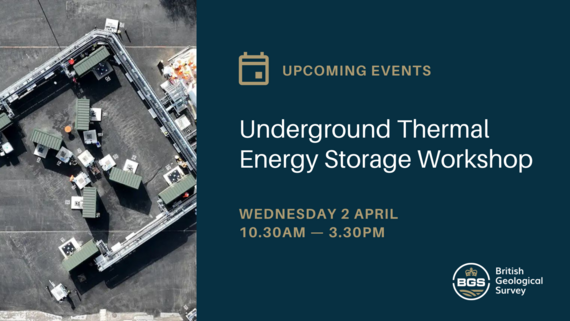
Underground Thermal Energy Storage Workshop

Underground Thermal Energy Storage Workshop

April 2 - 10.30 to 15.30 UK (BST) time
Newcastle University, Newcastle upon Tyne NE1 7RU

We are hosting a workshop on underground thermal energy storage (UTES). The aim is to bring together representatives from all sectors that have an interest in the efficiency and sustainability of UTES schemes, including but not limited to industry, regulators, government, local councils, heat pump installation, utility companies and academia.

Further information, including details on how to register can be found on the website


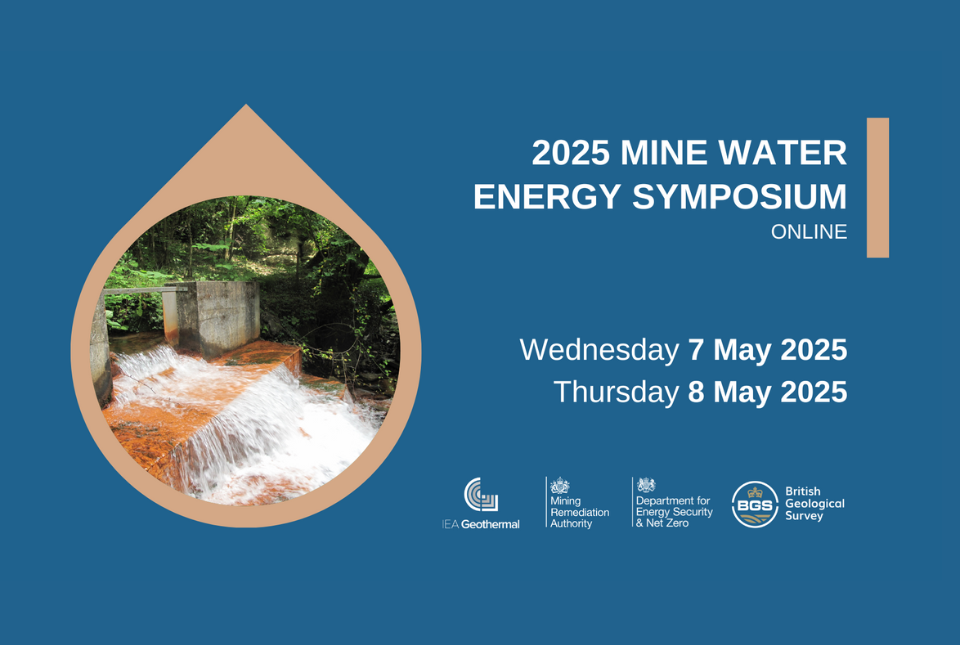
A graphic for the mine water energy symposium, featuring water escaping from a disused mine

IEA Geothermal Mine Water Energy Symposium 2025

May 7 - 13:00 to 17:00 UK (BST) time
May 8 - 09:00 to 13:00 UK (BST) time
Online event

We are pleased to announce an open call for contributions for the IEA Geothermal Mine Water Energy Symposium 2025. The symposium will be held over two days, 7 and 8 May and will be a free online event. Please register via the IEA website.

Online presentations (10 to 15 minutes in length) covering all aspects of mine water geothermal energy are welcome. The deadline for your proposed presentation (100 to 250 words maximum) is 16:00 Friday 28 February 2025. International presenters who can share their experience in mine water geothermal from around the world.

Requests for more information and offers of presentations should be sent to minewaterthermal_iea@bgs.ac.uk.