'Fall in new infections is very welcome'

Colin Cox, Cumbria’s Director of Public Health (pictured), said:
“We’ve known we would pass 1000 deaths though seeing it in the official figures is stark and my thoughts are with everyone who has lost a loved one.
“While the fall in new infections is very welcome, infection rates are still high and the position in our hospitals remains extremely serious, with numbers continuing to grow in the south of the county. It’s not just that people are being hospitalised, it’s that more of them are very seriously ill and staying in hospital for long periods. That puts a huge strain on hospital services and hospital staff. They are coping, just, but it’s not sustainable.
“I understand how tired people are of lockdown, I am too. With where we are now it is still too soon to ease up. I encourage everyone to stick with it, keep making those tough decisions to put off meeting friends and family for a while longer. We have to get infections rates right down to avoid yet another resurgence.”
|
Latest report summary
The weekly COVID-19 situation report can be found at www.cumbria.gov.uk/stopthespread. It shows that for week ending 29 January:
-
There were 1,321 new cases in Cumbria (a decrease of 599, -31%, from 1,920 cases in the previous week);
-
For the seventh week in a row Carlisle had the greatest number of new cases (+380 new cases). In Allerdale, 309 new positive cases were recorded, down from 371 the previous week.
-
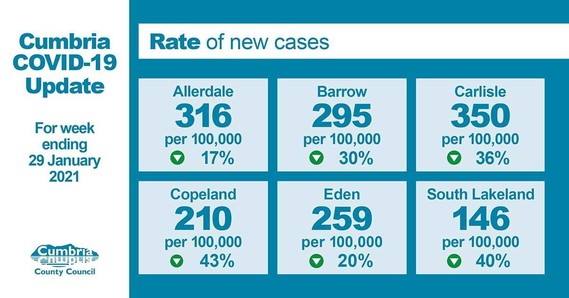
Carlisle also had the highest rate of new cases for the fifth week in a row (350 new cases per 100k population);
-
Rates in Carlisle, Allerdale and Barrow-in-Furness were above the national average rate (England = 268 new cases per 100k population);
-
Rates in Carlisle and Allerdale were also above the regional average rate (North West = 299 new cases per 100k population);
-
New cases decreased from the previous week in all Cumbrian districts, with the smallest proportional decrease in Allerdale (-17%) and the biggest proportional decrease in Copeland (-43%).
-
New hospital admissions for people with COVID-19 fell in the north of the county but increased in the south.
Emergency support in Cumbria
Cumbria County Council’s emergency support helpline has reached more than 27,000 people seeking support, guidance or information since its launch in March last year.
The helpline has been receiving requests for support from vulnerable or isolated people who aren’t able to rely on friends, family or neighbours and may be struggling for essential supplies.
The most common requests are for medication and prescription collections, food supplies and from family members who are isolating or shielding themselves and who would normally provide care to relatives.
People can contact the helpline seven days a week and in a variety of ways, including via telephone, online or by email:
The helpline operates Monday to Friday 9am to 5pm and 10am to 2pm at weekends and Bank Holidays. The service also accepts referrals from members of the public who may be concerned about people in their community.
£50m Covid-19 grants to local businesses
Our business grants team has paid out over £13m of government grants to local businesses in recent weeks to support them through the coronavirus restrictions.
This is in addition to £37m which the team paid out last summer which brings the total grant funding to Allerdale’s business community in response to the current pandemic to over £50m.
The figure, which is for the period up to 29 January 2021, includes £2.9m to eligible businesses that have been told to close since January 5 as a result of the introduction of the national lockdown, and an additional £5.8m in a one-off payment to the retail, leisure and hospitality sector.
More details on all the grants available, how they are being paid, and details of how to apply can be found on our website by clicking the below link.
Self-isolation payments
If you are working, on a low-income and are required to self-isolate, you could be eligible for a £500 payment
Under the scheme, payments of £500 will be available for individuals who have received notification from NHS Test and Trace to self-isolate.
The Test and Trace Support Payment is available to those receiving Universal Credit; Working Tax Credit; Income-Based Employment and Support Allowance; Income-Based Jobseeker’s Allowance; Income Support; Housing Benefit; and/or Pension Credit.
If you have been told by NHS Test and Trace to self-isolate, are working or self-employed and will lose income, you may be entitled to a Test and Trace Support Payment.
Anyone that meets the eligibility criteria and is told to self-isolate will be able to claim. You can make a claim for the Test and Trace Support Payment scheme or a discretionary payment up to 28 days after the first day of your period of self-isolation.
|