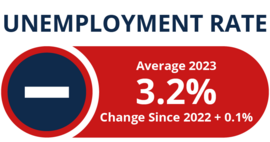
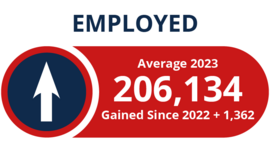
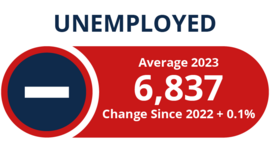
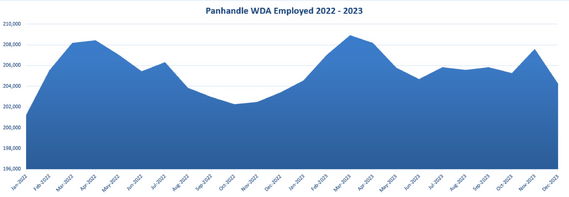
The 2023 WDA data reveals the government sector as the dominant employer, accounting for 19% of all jobs. This includes federal, state, and local government positions across various departments, agencies, and institutions.
Coming in second at 15%, the private education and health services sector continues to be a significant driver of job growth in the WDA. This sector encompasses a wide range of professions, from healthcare providers and teachers to administrative personnel and support staff. The aging population and increasing demand for quality healthcare services are expected to fuel further growth in this sector, creating promising opportunities for employers in the years to come.
Manufacturing holds a strong presence in the WDA, accounting for 13% of all jobs. This sector encompasses diverse industries, including food processing, advanced manufacturing, and energy production. The WDA's strategic location and access to resources make it an attractive hub for manufacturing companies, further solidifying this sector's importance to the regional economy.
While the information sector represents only 1% of all WDA jobs, its potential for growth should not be overlooked. The increasing reliance on technology across industries creates a demand for skilled professionals in areas like cybersecurity, data analysis, and software development. Employers investing in attracting and retaining talent in these fields will be well-positioned to adapt to the evolving digital landscape.
The Texas labor market reached historic highs in 2023, breaking records in employment growth and civilian labor force. In December, the state’s seasonally adjusted job count reached 14,103,300 jobs, an increase of 19,100 over the month—marking 27 consecutive months of new series employment highs.
Texas' employment growth rate continued to outpace the nation by a full percentage point, with 2.7 percent annual growth in the state from December 2022 to December 2023, compared to the nation’s 1.7 percent.
The Texas seasonally adjusted civilian labor force grew over the month by 11,100 people to reach 15,203,900 in December. This marked a 12 consecutive monthly increase and included the addition of 18,400 Texans employed. The seasonally adjusted unemployment rate dropped from 4.1 percent in November to 4.0 percent in December.
“Texas’ record-breaking employment growth remains a clear sign of the state’s economic strength,” said TWC Chairman Bryan Daniel. “We finished 2023 with thousands more jobs in the state than at any other time in history.”
Statewide, seven of 11 major industries in Texas achieved series highs. Trade, Transportation, and Utilities saw significant growth with 7,100 jobs added, while 6,800 jobs were added in Private Education and Health Services and Leisure and Hospitality, respectively.
“The month-over-month increase in jobs is good news for every Texan,” said TWC Commissioner Representing Labor Alberto Treviño III. “This continued growth shows that job seekers are taking advantage of career opportunities in the Lone Star State. TWC has the resources, services, and training to upskill job seekers and meet the demands of Texas employers.”
The Midland Metropolitan Statistical Area (MSA) maintained the lowest unemployment rate among Texas MSAs with a not seasonally adjusted rate of 2.1 percent in December, followed by the Amarillo MSA at 2.5 percent, and College Station-Bryan at 2.6 percent.
"The data shows Texas employers continue to grow and thrive as all major industries in the state expanded over the year,” said TWC Commissioner Representing Employers Joe Esparza. “To continue this growth, TWC and our 28 Workforce Solutions partners offer an array of resources for businesses to upskill, create new jobs and keep pace with the rapidly growing Texas economy.”
Employment estimates released by TWC are produced in cooperation with the U.S. Department of Labor’s Bureau of Labor Statistics (BLS).
|