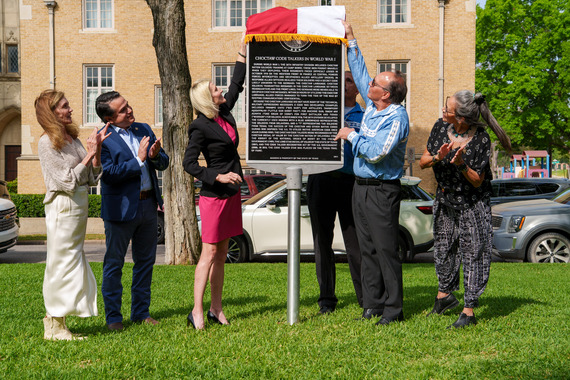
 THC Commissioner Cathy McKnight, Fort Worth Mayor Pro Tem Carlos Flores, Fort Worth Place 7 Council Member Macy Hill, Choctaw Nation of Oklahoma Chief Gary Batton and President of the Choctaw Code Talkers Association and descendent Nuchi Nashoba unveil the marker April 1, 2026.
New historic marker honors Choctaw infantry whose native language helped win World War I
A new Texas Historical Commission (THC) marker dedicated April 1 at Veterans Memorial Park in Fort Worth honors the Choctaw Code Talkers — soldiers of the 36th Infantry Division whose use of their native language propelled the Allied victory on the Western Front.
The ceremony brought together leadership from the Choctaw Nation of Oklahoma, the 56th Infantry Brigade Combat Team, the City of Fort Worth and the THC at a fitting location: the former grounds of Camp Bowie, where the Choctaw soldiers trained before deployment to the frontlines of France in 1918. They faced an occupying German army successfully intercepting and decoding Allied radio and telephone communications. A group of Choctaw soldiers embedded with the 36th Infantry Division began transmitting tactical messages in their native language — one the enemy could never decipher. The resulting "Choctaw Telephone Squad" played a significant role in the Meuse-Argonne Offensive, particularly at the Battle of Blanc Mont Ridge, helping the Allies breach the Hindenburg Line in the war's final weeks.
"This marker is a doorway to a chapter of Texas and American history that defines the spirit of our state," said Texas Historical Commissioner Catherine McKnight. "Though many of these men were not Texans by birth, they became part of the fabric of our National Guard. Their ingenuity and bravery remind us of the power of cultural heritage."
During the ceremony, Nuchi Nashoba, President of the Choctaw Code Talkers Association and great-granddaughter of Code Talker Ben Carterby, offered personal remarks about uncovering her family's history — one kept so closely guarded that many veterans, including her great-grandfather, rarely spoke of it even to their own families.
Choctaw Nation Chief Gary Batton spoke to the complexity of the Code Talkers' service. "It was a time when our people could not even vote; we were not even recognized as citizens," Chief Batton said. "But our people stepped up for the greater good. To us, it wasn't a 'code' — it was our language and our culture being used to do the right thing for God and country."
The marker at Veterans Memorial Park (4120 Camp Bowie Blvd) marks the area that was once part of Camp Bowie, a major military training installation where more than
100,000 soldiers prepared for deployment to Europe — and where the original Choctaw Code Talkers first integrated into the 142nd Infantry Regiment The marker text was developed in collaboration with Choctaw Nation representatives. It joins other historic markers and monuments at the site dedicated to the camp, its trainees and their service and sacrifice for their country - whether it recognized them or not.
These Official Texas Historical Markers, along with more than 17,000 others serve to add texture to our state’s history and heritage. About the Texas Historical Commission
The Texas Historical Commission is the state's official historic preservation agency. It preserves, operates, and manages 42 state historic sites, the Texas Heritage Trails Program, Texas Main Street Program, Texas Historic Courthouse Preservation Program, and many more heritage tourism and historic preservation initiatives across the state. The Texas Historical Commission's mission is to protect and preserve the state’s historic and prehistoric resources for the use, education, enjoyment, and economic benefit of present and future generations. For more information, visit thc.texas.gov.
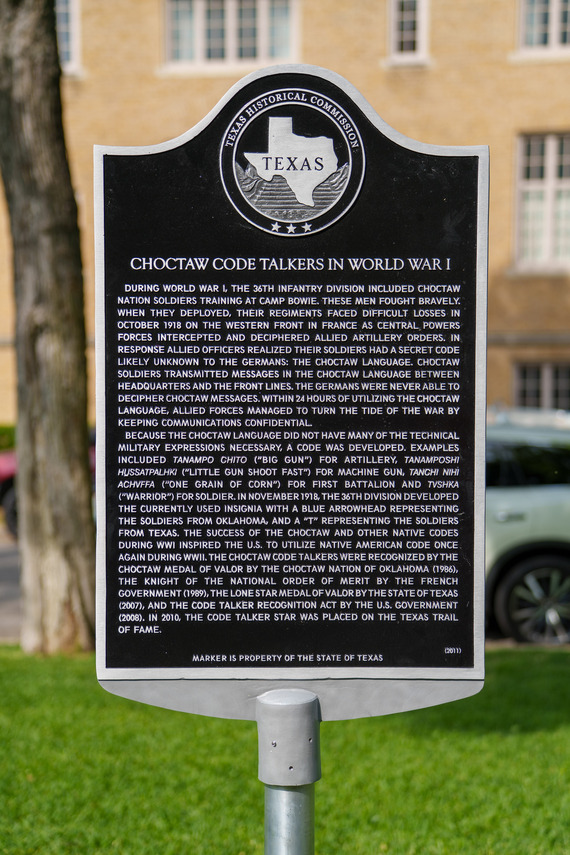
Editors and producers – full text of Veterans Memorial Park “Choctaw Code Talkers in World War I” and marker photo below.
During World War I, the 36th Infantry division included Choctaw Nation soldiers training at Fort Bowie. These men fought bravely. When they deployed, their regiments faced difficult losses in October 1918 on the Western Front in France as Central Powers forces intercepted and deciphered Allied artillery orders. Allied officers realized their soldiers had a secret code likely unknown to the Germans–the Choctaw language. Choctaw soldiers transmitted messages in the Choctaw language between headquarters and the front lines. The Germans were never able to decipher Choctaw messages. Within 24 hours of utilizing the Choctaw language, Allied forces managed to turn the tide of the war by keeping communications confidential. Because the Choctaw language did not have many of the technical military expressions necessary, a code was developed. Examples included tanampo chito (“big gun”) for artillery, tanamposhi hussatpalhki (“little gun shoot fast”) for machine gun, tanchi nihi achvffa (“one grain of corn”) for first battalion and tvshka (“warrior”) for soldier. In November 1918, the 36th division developed the currently used insignia with a blue arrowhead representing the soldiers from Oklahoma, and a “T” representing the soldiers from Texas. The success of the Choctaw and other native codes during WWI inspired the U.S. to utilize Native American code once again during WWII. The Choctaw code talkers were recognized by the Choctaw Medal of Valor by the Choctaw Nation of Oklahoma (1986), the Knight of the National Order of Merit by the French government (1989), the Lone Star Medal of Valor by the State of Texas (2007), and the Code Talker Recognition Act by the U.S. Government (2008). In 2010, the Code Talker Star was placed on the Texas Trail of Fame.
|