Chairman Aaron Kinsey Looks Ahead to the State Board of Education’s 2027 Agenda
Board priorities will center on mathematics achievement, workforce preparation, educator quality, student protection and responsible classroom technology.
AUSTIN, Texas – November 20, 2026 - State Board of Education Chairman Aaron Kinsey, District 15, today outlined priorities for the Board’s work in Calendar Year 2027 following the November 3, 2026, midterm elections and a period of significant change in the Board’s composition.
"Texans have entrusted the State Board of Education with decisions that directly affect the education and future of more than five million public school students. Whatever our political differences, every member comes to the table representing a distinct part of this state. We are stronger when we listen to one another, debate honestly and seek common ground on behalf of Texas students," said Chairman Aaron Kinsey.
2027 Policy Priorities
-
Mathematics standards and student achievement. Begin the review and revision of the Mathematics TEKS and ensure that standards, instructional materials, assessment and implementation support work together to improve student outcomes.
-
Career and Technical Education. Strengthen pathways connecting secondary education with college, credentials and high-demand careers, including opportunities to integrate rigorous, relevant mathematics into CTE programs.
-
Special Education. Keep the needs and outcomes of students receiving special education services central to standards, instructional policy, educator support and implementation.
-
Educator preparation and training. Monitor the outcomes of major reforms recently implemented in educator preparation, training and accountability, while maintaining high expectations for the professionals entering Texas classrooms.
-
Protecting students in the classroom. Continue the Board’s attention to student safety, educator conduct and the duty of educators and school systems to protect students entrusted to their care.
-
Technology in Texas classrooms. Examine how artificial intelligence and other rapidly changing technologies can appropriately support instruction and educator effectiveness while safeguarding student well-being, privacy and academic integrity.
"I intend to continue leading this Board with a clear focus on the education standards and policies that matter most to Texas families, educators and employers, and most importantly, to the students whose futures are shaped by our decisions," said Chairman Aaron Kinsey. "In the coming year, our work must stay grounded in kitchen-table issues: whether children can read and do math at grade level, whether students are prepared for college and high-demand careers, whether teachers are prepared and supported to succeed, whether students are protected in the classroom, and whether technology is helping rather than distracting from teaching and learning."
Mathematics will be an early priority
Among the most consequential items before the Board is the review and revision of Texas mathematics standards. Texas’ statewide K-12 mathematics TEKS were last comprehensively revised and adopted in 2012. At its November 2026 meeting, the Board adopted an earlier schedule for beginning the mathematics TEKS review and revision process. This action stems from a report released this week by the SBOE Ad Hoc Committee on Mathematics Instruction Framework, whose charges directed members to recommend curriculum standards, teacher training and district implementation supports that will position Texas as a national leader in mathematics education. The updated schedule aligns standards development with the creation of corresponding Instructional Materials Review and Approval quality rubrics and a future mathematics instructional-materials review cycle, while providing educators, school systems, families, publishers and other stakeholders advance notice and time to participate.
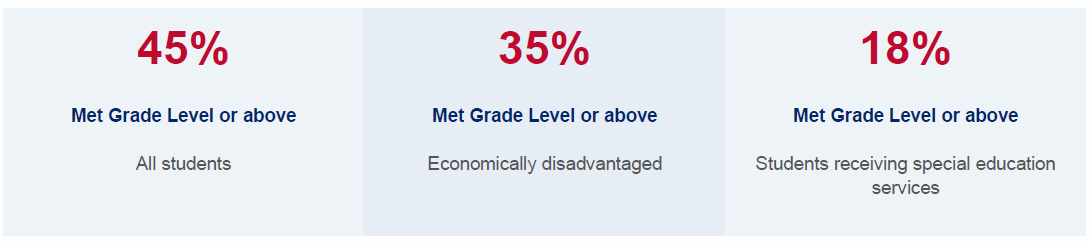 In 2026, 45 percent of Texas students in grades 3-8 and Algebra I achieved Meets Grade Level or above in mathematics. That was an improvement from 43 percent in 2025, but it remained below the 50 percent recorded in 2019. The results also reflect persistent gaps: 35 percent of economically disadvantaged students, 32 percent of emergent bilingual students and 18 percent of students receiving special education services achieved Meets Grade Level or above.
"Our math results tell us that incremental progress is not enough. When fewer than half of our students meet grade-level expectations in mathematics, we have an obligation to examine the standards, the sequence of learning, the support provided to educators and the materials placed in classrooms. Moving this work forward gives Texas an opportunity to approach mathematics comprehensively and thoughtfully, with parents, educators and employers at the table," said Chairman Aaron Kinsey.
Fifteen districts, one responsibility to Texas students
The State Board of Education is composed of 15 members elected from districts that span every region of Texas. As returning and newly elected members prepare for 2027, Chairman Kinsey emphasized that effective representation does not require unanimity. It requires members to bring their constituents’ views forward, engage differences respectfully and work toward principled solutions where common ground is possible.
ABOUT THE STATE BOARD OF EDUCATION
The State Board of Education sets policies and standards for Texas public schools as provided by state law. The 15-member elected Board establishes curriculum standards and graduation requirements, reviews and adopts instructional materials, oversees the Texas Permanent School Fund, appoints board members to military reservation and special school districts, provides final review of rules proposed by the State Board for Educator Certification, and reviews the commissioner of education’s proposed awards of new charter schools with authority to veto a recommended applicant.
For more information, visit sboe.texas.gov.
###
|