Communications from Across the Agency
Federal Rescission of CTE Methods of Administration Requirements
The Texas Education Agency provided notice in a recent To the Administrator Addressed regarding the rescission by the U.S. Department of Education, Office for Civil Rights, of the federal Methods of Administration (MOA) requirements historically associated with CTE programs. While the federal MOA monitoring structure has been discontinued, it is important to emphasize that recipients of federal funding remain responsible for complying with applicable civil rights laws and the use of the nondiscrimination statement. Equitable access to and participation in CTE programs will continue to be monitored through existing federal Perkins accountability requirements and the Comprehensive Local Needs Assessment (CLNA) process, which require recipients to evaluate and address access, participation, and performance gaps among special populations and other student groups.
CTE Contact Hours for Block Schedules
After engaging in ongoing discussions across multiple programmatic and fiscal areas to support consistent implementation of statutory and attendance accounting requirements, the agency has determined that, for the 2026-2027 school year, school systems will use the averaging method of calculating CTE contact hours for block schedules.
The agency continuously reviews its resources, processes, and guidance documents to promote clarity and support consistent implementation statewide. As with any area of attendance accounting, districts should continue to monitor communications from TEA and work with their SIS vendors regarding any future updates that may affect local reporting processes.
We appreciate your continued partnership and commitment to accurate CTE data reporting.
Updated Educational Aide I Certification Requirements
Effective August 2, 2026, amendments to the Educational Aide I certification requirements align eligibility with the completion requirements for the Education and Training program of study. The Educational Aide I certificate serves as the aligned industry-based certification for this program of study and provides eligible students with the opportunity to earn a recognized credential.
Under the updated rule, a candidate may qualify for the Educational Aide I certificate by:
-
Being enrolled as a high school student; and
-
Being a CTE Completer in the Education and Training program of study, defined as completing, passing, and receiving credit for three or more Education and Training courses for a total of four or more credits from the list of courses in subparagraphs (A)-(H), including at least one Level 3 or Level 4 course.
Students in the Class of 2027 may continue to qualify under the previous requirements. Beginning with the Class of 2028, students must meet the amended requirements. School systems should use the 2026-2027 school year to align advising practices, course sequencing, and graduation planning with the new requirements.
Analytic Tool: IBC Analytic Tool Now Available
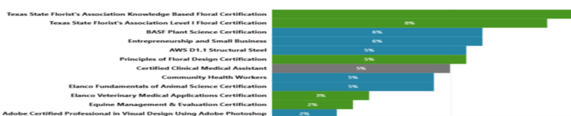
The IBC Analytic Tool is now available, providing enhanced access to certification attainment data, including analysis of certifications earned and Industry-Based Certification tiers. Stakeholders can filter by region, district, and campus, as well as student demographics. The IBC Analytic Tool reports all Industry-Based Certifications (IBC) earned by the Class of 2025 annual graduates, regardless of the graduates’ CTE status. The counts of IBCs earned, as shown in this report, may differ from the IBCs that count for college, career, and military readiness (CCMR) credit in accountability, as shown in the 2026 CCMR accountability report. This difference is because IBCs only count for CCMR credit in 2026 accountability if a graduate is a Concentrator or Completer in an aligned program of study.
As a reminder, TPRS now contains data related to IBC Tiers. In the CCMR Report, under the Career Ready Graduates section, stakeholders may review the percentages of 2025 annual graduates who earned an approved Tier 1, Tier 2, or Tier 3 IBC and Concentrator or higher in an aligned program of study. Please note that TPRS does not include data corrected through PEIMS Working Submissions used in accountability reports and calculations. Please refer to the TPRS Glossary for additional details and methodology related to this data.
Previously Shared
Career and Military Readiness in College, Career, and Military Readiness (CCMR) Deep Dive Webinar Series
The CCMR Deep Dive webinars and associated note catchers are posted on the College, Career, and Military Preparation website:
This webinar series provides overviews of career and military readiness indicators and outlines early planning actions school systems can take, such as course sequencing, student advising, partner coordination, and documentation practices, to strengthen future CCMR outcomes.
These sessions are intentionally focused on implementation considerations, not just policy awareness. They are designed to help school systems examine their current systems, identify gaps in access or alignment, and plan for incremental improvements across multiple years. The webinars are most effective when viewed as a team. We strongly encourage school systems to convene a team to engage in this learning together to support local decision-making. Participants should walk away with clear next steps for the school system or campus CCMR strategy.
Engagement Opportunity
Monthly Office Hours
Do you have CTE questions? Click on this link to submit your questions about CTE programming or other questions related to CTE. Then, join us for the upcoming CTE office hours on Wednesday, September 9, 2026, from 10:00–11:00 a.m. CDT, where we will provide answers. You may join by clicking on this link.
Back to top
|