Welcome
Hello, TTAP participants!
TEA is excited to officially welcome all of you to the SY24-25 Texas Through-year Assessment Pilot (TTAP)! Approximately 90 local educational agencies (LEAs) are participating in TTAP during the 2024-25 school year. We appreciate your commitment and look forward to partnering with you as we explore an innovative design for summative assessments in Texas.
TTAP is a through-year assessment model pilot, required by House Bill 3906, serving as a possible replacement for the State of Texas Assessments of Academic Readiness (STAAR®) assessment summative tests in future years. A through-year assessment model refers to a progress monitoring system that provides students multiple opportunities throughout the school year to demonstrate their mastery of standards and to contribute to their end-of-year summative performance level. Five test titles are available during the 2024-2025 pilot year, including the addition of grade 3 and grade 8 math:
• Grade 3 math
• Grade 6 math
• Grade 7 math
• Grade 8 math
• Grade 8 social studies
We appreciate the time you dedicate to your students each day, and we look forward to collaborating with you this school year!
Team Introductions
We would first like to introduce you to the TTAP team that will be supporting you this school year:
Jamie Kwan, Director of Assessment Initiatives
 |
|
Classroom experience: Algebra and geometry teacher at Dallas ISD
Why I am excited about TTAP: It has the potential to impact the Texas assessment program in various ways and bring more assessment usage awareness to districts across the state!
Fun Fact: I serve as a mentor in an outdoor youth mentorship program called Explore Austin!
|
Emily Winward, TTAP Coordinator
 |
|
Classroom experience: Grades 2 and 3 at Liberty Hill ISD
Why I am excited about TTAP: TTAP allows teachers to track student learning progress throughout the school year and gives students multiple chances to show what they have learned.
Fun Fact: I got to perform in the Macy’s Thanksgiving Day parade in 2012 during my time on the Strutters Dance Team at Texas State University.
|
You can reach the TTAP team at TTAP@TEA.Texas.gov
Program Updates
Blueprints
TTAP test blueprints have been adjusted to be equal in length for opportunities 1, 2, and 3. This update occurred so that each testing opportunity now meets the reliability standard, in the event that a through-year assessment were to be used for accountability purposes down the line. Test blueprints showing the breakdown by reporting category, number of questions, and number of points are available as a resource to all participants on the TTAP participant webpage. Additional information will be shared during beginning-of-year orientation.
Scale Score
Starting this school year, there is a new reporting scale for all TTAP math assessments in order to make room for the new grade 3 title. To maintain meaning across years, scores from the 2023–24 school year have also been rescored using the new scale. Performance levels have not been adjusted and maintain the same meaning across years. However, old scale scores for TTAP math assessments should not be compared to score reports on the new scale unless participants download new versions of the 2023-24 school year reports that use the updated reporting scale.
Note that no comparison between scale scores from the 2022-23 and 2023-24 school year reports should be made as the scales for these years are different.
TTAP Participant Webpage
This private webpage is meant to serve as a repository for all resources available specifically for pilot participants. It will be updated throughout the school year, as the resources housed on this page will be made available on a rolling basis. The TTAP participant webpage can be accessed only through a specific link (https://tea.texas.gov/student-assessment/assessment-initiatives/texas-through-year-assessment-pilot-coordinator-resources), while the general TTAP webpage remains available to house public-facing information.
Schedule of Events
On the TTAP webpages mentioned above, you will find a variety of resources including a Schedule of Events. This two-page document includes key dates for training, testing, and score report windows. We suggest printing this document and keeping it as a regular resource throughout the pilot.
Test Administration Information (TAI)
The TTAP TAI contains important information for all TTAP administrators and is available on the TTAP webpage. Any staff members who will be serving as a test administrator should familiarize themselves with the TTAP TAI prior to the testing windows.
We are excited to provide participants with training throughout the year to assist with score report interpretation and data literacy. All TTAP trainings and supplemental videos can be accessed in the Learning Management System (LMS). Users can navigate to "My Learning" in the left panel and select "TTAP Trainings" to access all published pilot trainings using the passcode “TTAP-24-25”.
The TTAP Educator Overview is a mandatory orientation that will provide teachers and campus administrators with a summary of what they can expect from the pilot. We are offering two live sessions that participants can register for using the links below:
• Thursday, October 17 (3:30-4:30PM, CT)
• Wednesday, October 23 (4:00-5:00PM, CT)
• While it is encouraged for participants to attend the live sessions, an asynchronous version will be available in the LMS between October 7–25.
A full list of training requirements by role can be found in the table below.
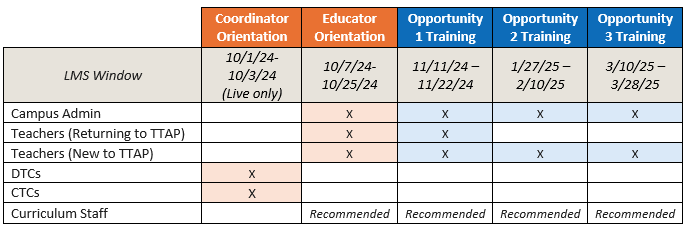 As shown in the table, teachers who are new to the pilot and all campus administrators will be required to attend the beginning-of-year TTAP Educator orientation along with one training session around each testing opportunity. This is to ensure there is leadership on each campus to guide teachers through interpreting score reports.
Teachers who have previously participated in the pilot will now only be responsible for the orientation and the Opportunity 1 training. Any modules that were not completed during the 2023-24 school year must also be made up this year.
Additionally, three optional supplemental videos will be available to participants in the LMS this school year. These are short, content-specific trainings that can be accessed at any time. More information will be provided during the TTAP Educator Orientation.
Representatives from participating TTAP districts have recently publicly shared their experience with the pilot over the last two school years. Below, we’d like to highlight some of these recent comments regarding the program.
Midway ISD
“Our teachers found that the culmination of data from the three opportunities where students tested really was well-aligned with the STAAR scores that we received this year in grade 5 science. …It feels like through the conversations we’ve had with teachers and students, that it’s really focused on the growth of a student within a school year because it’s taken those three times throughout the year. …Essentially, it seems that when it is a smaller test spread throughout the year, there seems to be less stress overall on the school system for the day.”
International Leadership of Texas
“We believe that the through-the-year assessment gives a potential to move the power of state assessments away from an autopsy into a tool that can be used to drive instructional practices all year round. It is our experience that having beginning, middle, and end of year small assessments has helped to reduce the stress of the assessment process for both students and teachers. …We appreciate and are very impressed with the ongoing professional development that the TTAP pilot has provided to both administrators and teachers to help them to understand how to use the assessment more effectively and how to have a much stronger understanding of how to analyze the data and immediately apply it to the next phase of instruction. …We have seen teachers engaged at a much higher level with their data with this assessment than with any other tool.”
Stafford MSD
“Our experience with TTAP has highlighted several significant benefits. …TTAP enables students to practice writing short constructed responses in an exam-like setting thereby improving their writing skills in a high-stakes environment. …we receive detailed reports on student progress, aiding us in tailoring instructions and interventions to better meet individual student needs. In comparison with STAAR Interim assessments, while interims provide immediate access to test questions which is beneficial to instructional planning, they offer few assessment opportunities and lack a writing component critical for comprehensive student preparation.”
We are looking for teachers and campus administrators to serve on the TTAP Advisory Committee! This small group of educators will represent the diversity of districts involved in TTAP and play a consequential role in shaping the future of the pilot. Former TTAP advisory committees have provided feedback on topics such as administration logistics, the addition of new test titles, teacher focus groups, score reporting, training requirements, and participant resources. Their guidance and expertise have played a significant role in the following:
• new parent-facing score report videos
• training content
• score report resource development
• adjusted training requirements
The committee’s expertise will continue to help to make improvements to score reports, training, and overall testing experiences. There will be 4-5, 60–90-minute sessions held virtually between the winter and the spring.
The advisory committee application is open until Friday, October 18 and we will confirm the committee members by late October.
Throughout the duration of the pilot, Texas Education Agency staff have had the opportunity to visit 5 participating districts following TTAP testing opportunities. The purpose of these visits is to better understand how districts are using their participation in TTAP to inform instructional practices, and to gather feedback about the pilot in comparison with the current year-end summative. Site visits allow us to hear directly from teachers, students, and staff from districts of all different sizes around the state.
TEA is hoping to visit three districts this school year after each administration window to hear from participants and learn how TTAP data is being utilized.
Have your district testing coordinator complete the nomination form above if you would like TEA to consider your district for a site visit this school year!

Year 3 Frequently Asked Questions
|
Q: How much time should a typical student need to take each test?
A: All TTAP assessments should be completed in one sitting, and testing times are determined locally. Each Opportunity is projected to take roughly 80–120 minutes to complete. When scheduling, testing personnel should also consider the time it will take to set up the testing environment and administer test instructions. To maximize instructional time, we encourage districts to set aside no more than 2.5 hours for each testing session in the fall and winter.
Q: What information will I get about item performance?
A: Item-level information will be reported after each testing opportunity, including the student expectation, the number of points earned out of the total points possible, and the difficulty level of the item. While item difficulty will continue to be reported on ISRs, different difficulty labels will be used this school year. Note that students may not see items at all performance levels as TTAP is an adaptive test, matching students to items based on their demonstrated ability.
Draft Range Performance Level Descriptors, or RPLDs, will be available for the first time this year to provide additional guidance on these item difficulty levels for each student expectation. A supplemental training over this resource will be posted in the fall.
Visit the TTAP webpage for more FAQs.
Common Links
Texas Assessment: Includes links to the Learning Management System (LMS), which hosts all training modules and associated materials, and the Centralized Reporting System (CRS), where TTAP student data is stored.
TTAP Participant Webpage: Serves as a repository for all resources available specifically for pilot participants, such as blueprints and score report resources.
TTAP Webpage: Houses all publicly available information on TTAP, including program overview and resources such as FAQs.
Texas Testing Support: Provides assistance on all technical questions about the platform or student registration and rostering in TIDE.
 |
|
Upcoming Key Dates |
|
October 1-3, 2024
|
TTAP Coordinator Orientation
|
|
October 1–31, 2024
|
TIDE Rostering Period
|
|
October 7–25, 2024
|
TTAP Educator Orientation (LMS window)
|
|
October 17 & 23, 2024
|
TTAP Educator Orientation (Live sessions)
|
|