|
Thank you for subscribing to the TEA science newsletter. Today's newsletter provides information related to:
-
TEKS In Focus
-
Proclamation 2024 Update
-
Instructional Materials Review and Adoption
-
TEKS Implementation on STAAR
-
Virtual Professional Development Opportunity
- Funding Opportunity from the National Academies of Science, Engineering, and Medicine
How helpful is the information in this newsletter?
1
|
2
|
3
|
4
|
5
|
|
not helpful
|
somewhat helpful
|
helpful
|
mostly helpful
|
very helpful
|
 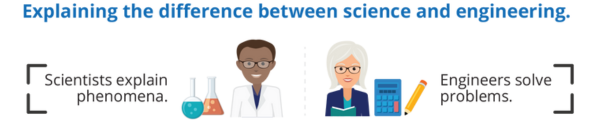 Each month, the TEKS in Focus feature will focus on concepts or student expectations from the 2024 Texas Essential Knowledge and Skills (TEKS). The new science TEKS introduce standards focused on bringing engineering into the science classroom. Students should be able to identify the differences between science and engineering purposes. The table below highlights changes made to TEKS involving engaging in scientific argument using evidence. The new expectations increase the variety of purposes for which students use evidence to support claims and reasoning; adding the expectation that students engage in discussion and debate using evidence to support claims. Additionally, as engineers, students use evidence to claim that a solution is the most effective solution among many.
Focus: Using Evidence for Scientific Argumentation
| |
Current Science TEKS
|
TEKS Implementing in 2024
|
|
Elementary
|
5.2.D analyze and interpret information to construct reasonable explanations from direct (observable) and indirect (inferred) evidence;
5.3.A analyze, evaluate, and critique scientific explanations by using evidence, logical reasoning, and experimental and observational testing;
|
5.3.A develop explanations and propose solutions supported by data and models;
5.3.C listen actively to others' explanations to identify relevant evidence and engage respectfully in scientific discussion.
|
|
Middle School
|
6.2.E analyze data to formulate reasonable explanations, communicate valid conclusions supported by the data, and predict trends.
6.3.A analyze, evaluate, and critique scientific explanations by using empirical evidence, logical reasoning, and experimental and observational testing, so as to encourage critical thinking by the student;
|
6.3.A develop explanations and propose solutions supported by data and models and consistent with scientific ideas, principles, and theories;
6.3.C engage respectfully in scientific argumentation using applied scientific explanations and empirical evidence.
|
|
High School
|
PHYS.2.I communicate valid conclusions supported by the data through various methods such as lab reports, labeled drawings, graphic organizers, journals, summaries, oral reports, and technology-based reports; and
PHYS.3.A analyze, evaluate, and critique scientific explanations by using empirical evidence, logical reasoning, and experimental and observational testing, so as to encourage critical thinking by the student;
|
PHYS.3.A develop explanations and propose solutions supported by data and models and consistent with scientific ideas, principles, and theories;
PHYS.3.C engage respectfully in scientific argumentation using applied scientific explanations and empirical evidence.
|
Changes in Using Evidence for Scientific Argumentation
Students currently use evidence to support scientific conclusions. The science TEKS to be implemented in 2024 expand student expectations to include using evidence as engineers to support claims about their solutions, such as how they meet criteria and constraints, budget, efficiency, or longevity. Students should consider the purpose of their argument and ensure that the evidence they use effectively supports the claim. Are students using evidence to explain a phenomenon or to justify why their design is the most effective? Key to distinguishing scientific practice from engineering design is the purpose of the work; scientists explain phenomena, and engineers design solutions to problems to positively impact society.
Both scientists and engineers rely on evidence to support claims made during scientific argumentation. Scientific argumentation is the process of respectfully discussing and debating claims based on evidence. Scientific progress is made when scientists critique each other's interpretation of data, and the scientific community comes to a consensus about a topic. It is through this debate and discussion that scientific ideas, theories, and laws are acknowledged and accepted. Engineers engage in argumentation with their design team as a tool to improve their designs and document the effectiveness of their products. An engineering design team may use arguments about cost-effectiveness, risk, aesthetics, and user preferences to select design elements for their solution.
Adjusting Practice
To create the conditions for respectful discussion and debate, it is important to develop norms and model processes that place emphasis on claims using evidence. Stating claims with emphasis on evidence helps remove bias, thus encouraging healthy argumentation. Sentence frames and organizers, such as a Claim-Evidence-Reasoning model, can provide scaffolded support. In addition, it is helpful to create an explicit culture where classmates may critique ideas and interpretations of data but not people.
--------------------------------------------------------------------------------------------------
Purpose of TEKS in Focus: Each month, a concept or strand of student expectations is highlighted to enhance vertical TEKS alignment, rigor, and collective efficacy. The area of focus is not intended to suggest sequencing or pacing but rather to support an overall understanding of the changes to the TEKS. The information supplied can be considered when content is relevant to classroom needs.
Please submit an Instructional Materials Help Desk ticket if you need assistance.
TEA seeks educators and subject-matter experts across Texas to serve as instructional materials reviewers for the new IMRA review process.
Selected reviewers will earn extra income while making a statewide impact. Reviewers will work in small teams to conduct quality reviews and collaborate with other educators to produce ratings and reports for assigned reading language arts, phonics, and mathematics products.
If you or your colleagues want to participate in the IMRA review process, please apply today! To learn more about the IMRA process, visit our website.
TEKS Implementation and STAAR
Student Assessment Development has posted a video on the implementation of the new science TEKS into STAAR available on the agency's YouTube channel. It’s also posted on the STAAR Science Resource page of the TEA website under “Additional Resources.” (STAAR Science Resources | Texas Education Agency)
As a courtesy to our readers, the following additional information has been included.
A Time Before Texas is an online exhibit exploring cutting edge science and ancient wisdom to help students imagine what life was like for the first people to call Texas home 16,000–10,000 years ago. Presented videos and activities cover a wide range of cross-curricular concepts in science, social studies, and language arts. This online exhibit introduces students to the science of archaeology and a variety of related STEM career opportunities. The concepts and information in this exhibit were primarily developed with middle school audiences in mind but can be adapted for upper elementary though high school students.
In addition to the education guide and downloadable activities, in partnership with Texas Science & Natural History Museum, TxDOT and Humanities Texas, MuseWork Exhibits will provide a FREE three-hour virtual professional development training (3 TEA-approved CPE hours) to help educators navigate the resources. For more information and to register for the PD please visit our website.
The Gulf Research Program is seeking proposals that engage children and youth in place-based educational activities that foster the development of scientific and environmental skills, competencies, and capabilities critical to solving complex issues in the Gulf now and in the future. Proposals will be accepted that support educational, service, and/or coordination activities for K-8 children and youth. Applications close April 10, 2024 @ 5pm EST.
 |
|
For more information and to review the full Request for Applications, please scan the QR code to visit our website. Click to edit this placeholder text. |
Thank you for your commitment to serving Texas students.
Science Team
Curriculum Standards and Student Support Division
Curriculum Help Desk
(512) 463-9581
|