Thank you for subscribing to the TEA science newsletter. Today's newsletter provides information related to:
-
Help Desk access
-
New Resource: Recurring Themes and Concepts Printables
-
TEKS in Focus
-
Texas Virtual School Network (TXVSN)
-
Technology Applications
-
Presidential Award for Excellence in Mathematics and Science Teaching (PAEMST)
-
Call for NOAA’s Gulf of Mexico Bay-Watershed Education & Training Grant
Updated TEA Curriculum Help Desk
The Curriculum Division is excited to introduce our new and improved help desk!
As of the spring of 2023, TEA’s Curriculum Standards and Student Support Division has shifted to a new and more efficient help desk platform. For any questions related to science TEKS or other curriculum questions, please use our new platform.
Steps to use the new TEA help desk platform:
New Resource: Recurring Themes and Concepts Printables
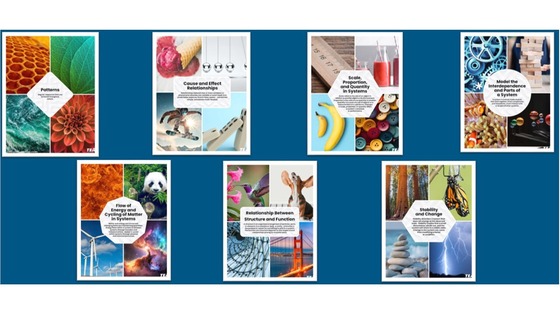
The 2024 science TEKS include specific student expectations for recurring themes and concepts for kindergarten through grade 8. High school science courses have recurring themes and concepts within the introduction of the course TEKS. The are available on the science page of the TEA website for anyone to download and print. (Available in both 8.5x11 and 18x24 pdf.)
 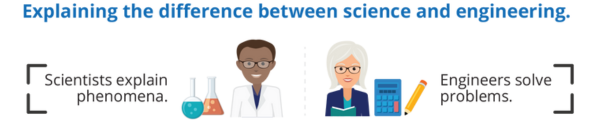
Each month, the TEKS in Focus feature focuses on concepts or student expectations from the 2024 science Texas Essential Knowledge and Skills (TEKS). The new science TEKS introduce standards focused on bringing engineering into the science classroom. Students should be able to identify the differences between science and engineering purposes. The table below highlights changes made to TEKS involving planning and carrying out investigations. Students currently use investigations to explain phenomena and test hypotheses of the natural world. The new student expectations increase the variety of situations in which students use investigations; adding the expectation that students use investigations to design solutions to engineering problems. Engineers use data from investigations to specify parameters and to test their prototypes. Investigations help engineers identify how effective their designs are against a range of conditions.
| |
Current Science TEKS
|
TEKS Implementing in 2024
|
|
Elementary
|
3.2.A plan and implement descriptive investigations, including asking and answering questions, making inferences, and selecting and using equipment or technology needed, to solve a specific problem in the natural world;
|
3.1.B use scientific practices to plan and conduct descriptive investigations and use engineering practices to design solutions to problems;
|
|
Middle School
|
7.2.A plan and implement comparative and descriptive investigations by making observations, asking well defined questions, and using appropriate equipment and technology;
7.2.B design and implement experimental investigations by making observations, asking well defined questions, formulating testable hypotheses, and using appropriate equipment and technology;
|
7.1.B use scientific practices to plan and conduct descriptive, comparative, and experimental investigations and use engineering practices to design solutions to problems;
|
|
High School
|
PHYS.2.D design and implement investigative procedures, including making observations, asking well defined questions, formulating testable hypotheses, identifying variables, selecting appropriate equipment and technology, evaluating numerical answers for reasonableness, and identifying causes and effects of uncertainties in measured data;
|
PHYS.1.B apply scientific practices to plan and conduct descriptive, comparative, and experimental investigations, and use engineering practices to design solutions to problems;
|
Changes in Planning and Carrying Out Investigations
The science TEKS to be implemented in 2024 expand student expectations to include using investigations to design solutions to problems as engineers. Key to distinguishing scientific practice from engineering design is the purpose of the work; scientists design investigations to develop explanations of phenomena and test hypotheses, and engineers design investigations to test prototypes of their proposed solutions. Both scientists and engineers must identify variables, decide what will be measured and recorded, and analyze data. Engineers use investigations to test their designs related to solving an engineering problem.
Adjusting Practice
The use of scientific investigations integrates with the use of engineering designs to solve problems. Students may be asked to investigate a phenomenon to develop an understanding of the related science concept and then be asked to apply this understanding to design and test a solution to a problem related to the phenomenon. Students also may be asked to design and test a solution to a problem that uncovers a scientific phenomenon to be investigated for understanding. Identifying the language within the purpose of the investigation assists students in identifying their roles as scientists and engineers.
------------------------------------------------------------------------------------------------------------------------
Purpose of TEKS in Focus: Each month, a concept or strand of student expectations is highlighted to enhance vertical TEKS alignment, rigor, and collective efficacy. The area of focus is not intended to suggest sequencing or pacing but rather to support an overall understanding of the changes to the TEKS. The information supplied can be considered when content is relevant to classroom needs.
 |
|
Texas Virtual School Network (TXVN)
Need help meeting a student’s course needs?
The Texas Virtual School Network (TXVSN) can help meet students’ needs through TEA-approved online courses. The TXVSN statewide course catalog provides schools and students access to high school, Advanced Placement, career and technical education, and dual credit courses for initial credit or credit recovery. The course catalog provides all the required science courses needed to meet a student's graduation requirement.
The TXVSN courses are aligned to the Texas Essential Knowledge and Skills (TEKS) and taught by Texas-certified teachers trained in best practices in online instruction. Schools can use the TXVSN courses to create flexibility in a student’s schedule, allow a student to accelerate their learning, or address local teacher shortages. Students enrolled in a TXVSN course can generate funding regardless of whether the student is physically present at school while participating in the course. For more information about the courses offered through the TXVSN, please visit the TXVSN website or contact the TXVSN Help Desk.
|
New Technology Applications Newsletter
Based on input from educators and stakeholders, TEA has begun publication of a new technology applications newsletter. Readers may find a variety of technology applications-specific information that will be addressed throughout the year, such as–
-
the revised Texas Essential Knowledge and Skills (TEKS) for technology applications;
-
timely topics with frequently asked questions (FAQs);
-
relevant information and useful information from external technology applications organizations; and
-
other news related to technology applications.
To sign up for the new technology applications newsletter, please complete the following steps:
-
Enter your email address and click submit.
-
Select “Technology Applications” under the Academics tab.
-
Click “Submit” at the bottom of the page.
Presidential Award for Excellence in Mathematics and Science Teaching (PAEMST)
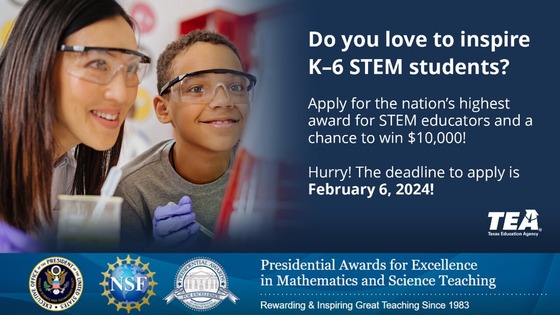 Are you a K–6 STEM teacher who loves to learn and inspire students? Apply for the nation’s highest award for STEM educators and a chance to win $10,000.
Awardees also have a chance to attend an awards event and network with other great STEM teachers for free. They also receive a signed certificate from the president of the United States.
Don’t miss this opportunity to let others know you’re a STEM superstar. The deadline to apply is February 6, 2024.
Learn how to apply and get an overview of the program by attending an application webinar. Applicants can also request a PAEMST mentor for support through the application process. Visit the Presidential Awards for Excellence in Mathematics and Science Teaching (PAEMST) website for more information.
As a courtesy to our readers, the following additional information has been included.
NOAA: Call for Applications
The NOAA Fisheries Southeast Regional Office is seeking applications to the FY24 Gulf of Mexico Bay-Watershed Education and Training (Gulf B-WET) competition. The Notice of Funding Opportunity can be found at Grants.gov under funding opportunity number NOAA-NMFS-SE-2024-2008255, or at this direct link: https://grants.gov/search-results-detail/350934?showPackages=1.
Applications must be received by 11:59 p.m. Eastern Time on February 5, 2024 to be considered. An informational webinar about the FY24 Gulf B-WET funding announcement will be held via Google Meet on Wednesday, December 6, 2023 from 9-10 am CT | 10-11 am ET. Join here: https://meet.google.com/kik-qtem-ezz.
The Gulf B-WET program promotes place-based experiential learning for K–12 students and related professional development for teachers in the five Gulf states. Funded projects will develop or promote Meaningful Watershed Educational Experiences (MWEEs), a learner-centered framework that focuses on investigations into local environmental issues, leads to informed action, and increases environmental literacy. The following priorities will be considered:
-
Professional Development for Teachers related to Meaningful Watershed Educational Experiences: supports high quality professional development for teachers allowing them to gain confidence in the value of MWEEs and strategies for conducting MWEEs with students (up to $100,000 for up to 24 months.)
-
Exemplary Programs combining Teacher Professional Development with Meaningful Watershed Educational Experiences for their students: supports professional development for teachers and teacher implementation of the MWEE with students. Students will investigate environmental issues, identify actions to address those issues, and act as stewards for watersheds and related ocean and coastal ecosystems (up to $100,000 for up to 24 months.)
-
Systemic Meaningful Watershed Educational Experience Implementation: supports implementation of systemic MWEEs which reach the entire student population in one or more grades within a school district (up to $150,000 for up to 24 months.)
The Gulf B-WET program is interested in projects that serve marginalized groups, particularly minority communities. Eligible applicants are K-12 public and independent schools and school systems, institutions of higher education, nonprofit organizations, state or local government agencies, interstate agencies, and Indian tribal governments.
Thank you for your commitment to serving Texas students.
Science Team
Curriculum Standards and Student Support Division
Curriculum Help Desk
(512) 463-9581
|