|
Thank you for subscribing to the TEA science newsletter. Today's newsletter provides information related to:
- Science Safety Courses
- Science Safety Q&A
- TEKS in Focus
- PAEMST Updates
- Texas Medical Association’s Butler Awards
Science Safety Courses Available
The science safety courses are three one-hour courses designed to provide safety guidance to elementary, middle, and high school science educators. The courses are offered as a courtesy to educators and may not provide all the science safety guidance that schools and districts find necessary to meet laws and rules.
The courses are live in the TEA Learn catalog: https://register.tealearn.com/
Direct links:
Elementary
Middle
High School
For questions on how to use the TEALearn platform, please contact Emily Tipps, Learning Management System Lead at Emily.Tipps@tea.texas.gov.
Science Safety Q&A
At the beginning of the school year, the science team routinely receives questions about safety. Below are common questions and responses to some science safety questions.
1. Where can I find the laws and rules governing safety in the K-12 science classroom?
The laws & rules about safety are delineated in this PDF document: https://tea.texas.gov/academics/subject-areas/science/safety-laws-and-rules-2016.pdf
2. Which staff need science safety training, and how often do they need it?
Teachers of prekindergarten through high school and other district personnel must receive training on the Hazards Communications Act before working in the area or with hazardous materials. Teachers new to the profession must receive safety training before they work with or in an area containing hazardous chemicals; however, district personnel changing assignments only require training on hazardous materials not covered in their initial training and updates. Additional information is available in The Texas Education Agency Texas Safety Standards, which can be found on the TEA science web page.
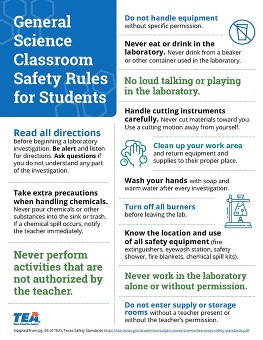
3. What are some general student rules for safety in the science classroom?
4. What required and recommended safety equipment should I have in my school or classroom?
Lists and descriptions of safety equipment can be found on p.43-68 in the Science Facilities Standards. Specifically —
- districts must provide safety goggles; students and teachers must wear them, TEC 38.005;
- fire extinguishers are required in laboratory rooms, 28 TAC 34.501-34.523; and
- districts must provide PPE appropriate to the grade level or course.
5. Where can I find guidance on chemical safety, storage, and disposal?
Each month the TEKS in Focus feature will highlight concepts or student expectations from the 2024 Texas Essential Knowledge and Skills (TEKS).
The new science TEKS introduce standards relating to engineering. Students should be able to identify the differences between science and engineering purposes. The science TEKS side-by-side in the table below highlights changes made to TEKS involving student questioning based on observing, modeling, and investigating. The new TEKS expand the variety of situations in which students ask questions; adding the expectation that students ask questions that solve problems to the current questioning of the natural world.
Focus on Asking Questions in Science TEKS
|
|
Current Science TEKS
|
2024 Science TEKS
|
|
Elementary
|
1.2.A ask questions about organisms, objects, and events observed in the natural world;
|
1.1.A ask questions and define problems based on observations or information from text, phenomena, models, or investigations;
|
|
Middle School
|
7.2.B design and implement experimental investigations by making observations, asking well defined questions, formulating testable hypotheses, and using appropriate equipment and technology;
|
7.1.A ask questions and define problems based on observations or information from text, phenomena, models, or investigations;
|
|
High School
|
B.2.E plan and implement descriptive, comparative, and experimental investigations, including asking questions, formulating testable hypotheses, and selecting equipment and technology;
|
B.1.A ask questions and define problems based on observations or information from text, phenomena, models, or investigations;
|
Changes in Questioning
Currently, students learn science by asking questions and finding answers about the natural world. The new science TEKS add engineering practices. The difference between science and engineering is the purpose of the work: scientists want to explain phenomena and engineers want to solve problems. Students will explore the natural world by asking questions about phenomena and defining engineering problems, learning science content along the way.
Adjusting Practice
As students observe various phenomena (either around them or through text, images, data, or investigations), teachers should encourage students to ask questions that lead to explaining phenomena or defining problems. Identifying the purpose of the questions assists learners in understanding the differences between scientists and engineers. Keeping a chart of questions organized by purpose can allow students to identify patterns and create space for discussion about the similarities and differences in the behaviors of scientists and engineers.
------------------------------------------------------------------
Purpose of TEKS in Focus: Each month, a concept or strand of student expectations is highlighted to enhance vertical TEKS alignment, rigor, and collective efficacy. The area of focus is not intended to suggest sequencing or pacing, but rather to support an overall understanding of the changes to the TEKS. The information provided can be considered when content is relevant to classroom needs.
PAEMST Updates
2024 Presidential Awards for Excellence in Mathematics and Science Teaching (PAEMST)
The 2023-2024 nomination and application windows for kindergarten through grade 6 mathematics and science teachers for the Presidential Awards for Excellence in Mathematics and Science Teaching (PAEMST) program are open. The PAEMST awards are the nation's highest honors for teachers of mathematics, science, computer science, engineering, technology applications, and math- or science-related career and technical education courses. Awardees serve as models for their colleagues, inspiration to their communities, and leaders in the improvement of mathematics and science education. Since 1983, more than 4,200 teachers have been recognized for their contributions in the classroom and to their profession.
Presidential awardees receive a certificate signed by the president of the United States, a trip to Washington, D.C., to attend a series of recognition events and professional development opportunities, and a $10,000 award from the National Science Foundation. Awardees also join an active network of outstanding educators from throughout the nation.
Teachers must be signed up (self-nominated) or nominated by another person for the 2024 competition by January 8, 2024. The application deadline is February 6, 2024. If you know great teachers, encourage them to join this prestigious network of professionals. In Texas, eligible teachers who submit a completed application by February 6, 2024, will receive 25 continuing professional education (CPE) hours. Sign up to apply or nominate an educator at www.paemst.org.
For questions, contact tx_paemst@tea.texas.gov or 512-463-9581.
As a courtesy to our readers, the following additional information has been included.
Texas Medical Association (TMA) Ernest and Sarah Butler Awards
Each year, the TMA recognizes and rewards Texas science teachers at the elementary, middle, and high school levels. The program is ecstatic over the previous years’ winners and is delighted to continue recognizing teachers who share their energy and enthusiasm for science. This year’s award categories and amounts:
-
Grand Prize: One Texas science teacher will receive $20,000 plus a $5,000 school resource grant.
-
Distinguished Awards: Three teachers (one at each level) will receive $7,000 and a $3,000 school resource grant.
-
Rookie Award: A teacher with less than seven years’ experience will receive $5,000 and a $2,000 school resource grant.
Nominations and self-nominations will be accepted until December 4, 2023. The application deadline is January 8, 2024. All areas of science are welcome!
Thank you for your commitment to serving Texas students.
Science Team
Curriculum Standards and Student Support Division
Curriculum Help Desk
(512) 463-9581
|