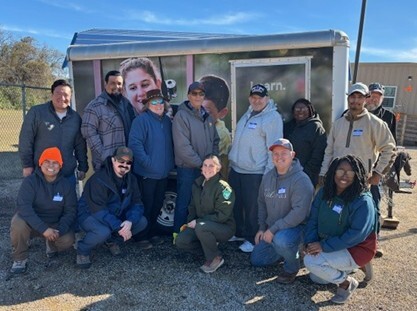
In This Issue:
By Adam Comer, Aquatic Education Manager
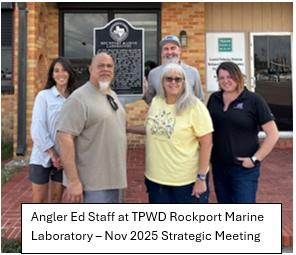
Welcome 2026.
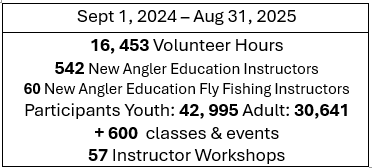
It’s my pleasure to share the latest program accomplishments and updates. The latest annual report is posted on the Instructors Accomplishments webpage. I’ve also included selected impact numbers below. We recently sent out our annual thank you package & report to all those that reported as an Angler Education volunteer in the past year.
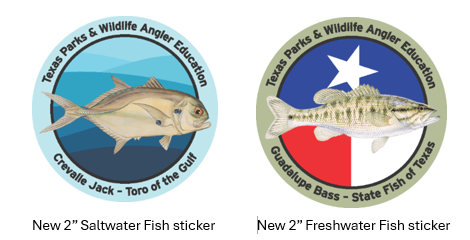
In October 2026, Angler Education hosted a poll on our Texas Angler Educators Facebook page, for followers to pick the next class & event fish stickers – a freshwater and saltwater version. We had a great turnout! Over 200 cast their vote and we’re happy to share the stickers below. The program will be phasing out the six-sticker sheets, and we plan to have an annual vote to pick new stickers each year to highlight a Texas freshwater and saltwater fish. The stickers will be available to Angler Education Instructors to request for their 2026 fishing class and event attendees.
We appreciate the way our volunteers support us during events, classes and even voting for our new stickers and literature!
Photo credits - staff.
Back to Top
By Lone Star Fly Fishers Club
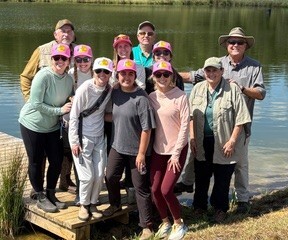
The trend in bachelor and bachelorette parties has taken a turn in recent times from the usual wine and dine at some nice and pricy venue to those with a completely different venue and theme, especially those with an outdoor twist. This is the story of one that involved a fly fishing club in East Texas, the Lone Star Fly Fishers, and a bridal party with participants who joined from hundreds of miles.
|
It all started when David Hudnall, president and contact point on the club’s website, received an inquiry from Kailee Coward of Waco, sister and maid of honor to the bride-to-be, Grace Coward. Kailee was on the hunt for something different: a bachelorette weekend that combined learning, laughter, and a lot of adventure. Since Grace had dabbled in fly fishing years before, Kailee decided to reach out to Lone Star Fly Fishers (www.lsffclub.org) in Tyler, after reading about the club's mission to grow the sport through education and participation. Other members of the bridal party in total agreement were bridesmaids Bailey Morris, Ashley Solomon, Gabby Sherwood, Ashley Wood, and Ashlee Buell.
David saw an opportunity to combine educational outreach with a group of enthusiastic newcomers who would enjoy the adventure while etching a lasting memory on their lives. Several phone calls later the event was set up for a Saturday in September. The destination was a club member’s east Texas ranch which had a large pond stocked with largemouth bass and copper-nose bream.
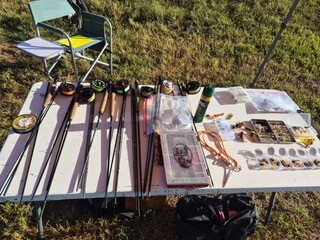
After early morning introductions and breakfast at a local diner, the group departed for the ranch only a few miles away. After setting up a sun canopy, chairs, fly fishing gear and icing down dehydration drinks, everyone was ready to learn about fly fishing. Several LSFF members are Texas Parks and Wildlife Department Angler Volunteer Fly Fishing Instructors, so the first part of the day was an introduction to the sport using the TPWD’s Fly Fishing 101 handbook. After that a brief look at entomology gave the girls an idea of what the soon to be shown flies were meant to imitate.
|
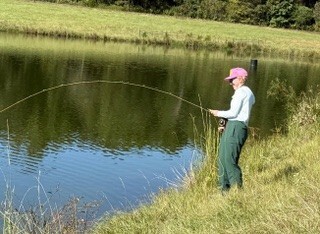
LSFF casting instruction volunteers stepped up next, and the girls were eager learners. Proper rod rigging of club supplied gear and the fundamental mechanics of the cast from the instructors resulted in a group of excited young ladies. Perhaps females take to instruction better than their counterpart males as soon all were proficient enough to introduce them to the water and fish. Each girl was presented an assortment of flies tied by LSFF members at our monthly Tyin’ Tuesday instructional event. Fly selections were made and the proper knot taught and just like that the pond was greeted by seven beautiful new fly fishers.
|
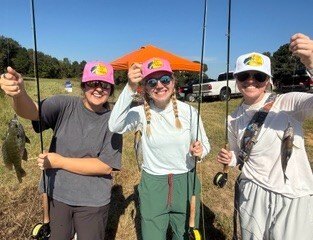
Unlike so many first fishing trips, all the girls caught at least one fish on the fly (many for the very first time in their lives!). After the fishing wrapped up, the ranch owner offered a glimpse into the broader world of fly fishing such as comparing pond fishing to the thrill of wading a cold mountain stream. The conversation struck a chord: one bridesmaid from Estes Park, Colorado, couldn't wait to take her new skills back home. Two others, based in the Texas Hill Country, were already eyeing the Guadalupe River, America's southernmost trout fishery, for their next adventure.
What started as an internet search for fly fishing instruction and application resulted in new friendships, an introduction to the great sport of fly fishing, and lasting memories for both the group of young ladies and members of Lone Star Fly Fishers.
For the members of the Lone Star Fly Fishers, it was another reminder of why they do what they do--sharing their love of the sport, the outdoors, and God's "piscatorial creation." And for Grace and her bridesmaids? A bachelorette party they'll never forget--proof that most times, the best memories are made through adventure!
|
Photo credits - Lone Star Fly Fishing Club
Back to Top

by Jim Bratton, TPWD Volunteer Angler Edu Area Chief Trainer
Beginning anglers often don’t think like a fish. They have never seen or felt how a fish can pick off a worm from a hook, never engaging the hook. I have found that using gummy worms is a great way to teach how to properly put a worm on a hook.
Most of the suppliers of fishing worms sell two different types of worms. One type of worm sold by retailers is the NIGHT CRAWLER. This worm is about the same diameter as a pencil and can be about 6 inches long. Frequently, when put on a hook, it sticks out both sides and is easily snacked on!
The second type of worm is usually sold under the name of RED WIGGLER. It has about an 1/8-inch diameter and is less than 2 inches in length.
I usually explain that many fishermen use worms to fish for Sunfish, and Sunfish can either nibble or suck a worm off a hook in a heartbeat. So, I teach the following method of loading worms on to a hook to try to defeat the fish from snacking.
|
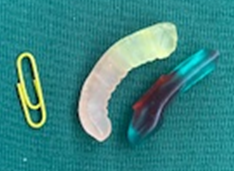
The picture shows the paper clip I use to make a hook; the larger gummy worm imitates the night crawler and the smaller worm the red wiggler. Bend the paper clip into a hook and start the hook in the first section of the worm. Then weave the worm on the hook using about 1 ½ inch of the worm.
|
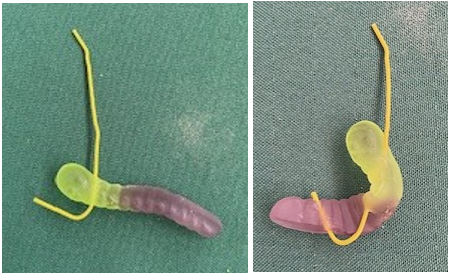
Depending on the size of the worm, you can keep putting the hook through until it is all on the hook. This method helps the hook to catch, instead of just feed fish. I have found that seeing this done with gummy worms, helps beginning anglers, young and old, learn how to put on bait.
|
Photo credits - Jim Bratton.
Back to Top
By Peyton Sharp, Special Olympics Athlete
I am 30 years old and there is more to me than meets the eye. When I was a baby, I was diagnosed with cerebral palsy secondary to bi-lateral schizencephaly. Because my brain isn’t formed like everyone else’s, it causes everyday things to be more difficult for me.
Like other teenagers, when I was in High School, I realized that I needed to find a career, however most jobs were not physically possible for me. My parents decided to buy me a 3-D printer. When we got the first one, I started making so many things and enjoyed it so much, we got another one.
|
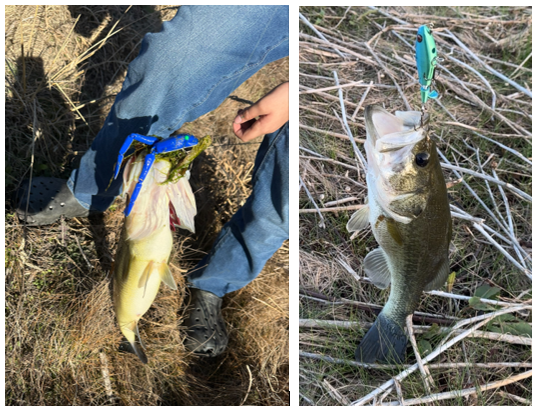
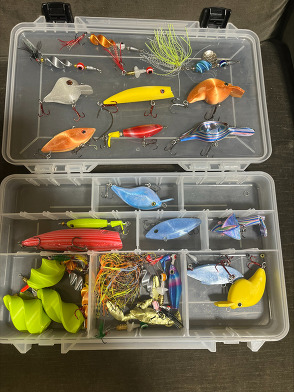
Now I have three of them and make all kinds of things. I make fishing lures for me and my family to go fishing. I actually just got back from a Texas Special Olympics Fishing Tournament, where I used my own lures. People who saw them were so impressed. You can see them in the pictures. One day, I am hoping to set up my own shop where people can buy what I make. Nothing can hold me back!
Photo credits - Greg and Peyton Sharp
Back to Top
By Michelle Huff, TPWD Volunteer Angler Education Instructor
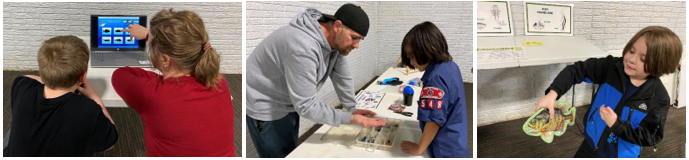
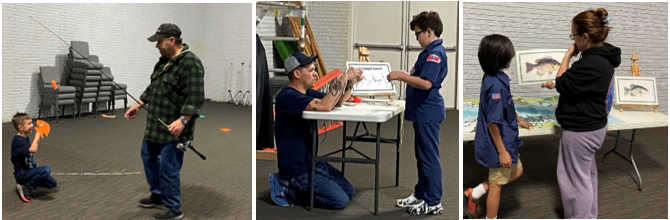
In the Spring of 2025, I had the opportunity to combine three things dear to me in order to bring a hands-on Beginner Angler Education experience to Cub Scout Pack 548…my degree and experience in education, my experience as a Scout leader for Scouting America, and my experience as a TPWD Angler Education Instructor.
|
Having a group of Cub Scouts that range in age from 5-10 years, I knew that what I was to provide for instruction for fishing needed to be hands on and engaging. With the idea of utilizing the Angler Educator Instructor Kit as well as the free printed resources available through TPWD, I devised a plan to create eight hands-on stations: Freshwater Fish Habitat and Species Identification, Name that Fish Game, Tackle, Knot Tying, Rules and Ethics in Fishing, Backyard Bass, Fishing Safety, and Take Home Printables.
In addition, each station was run by a parent volunteer, allowing them an opportunity to teach and interact with their Scout as well as an opportunity to gain knowledge and leadership experience. Finally, this model of learning also allowed me to float around the stations and assist as needed.
 |
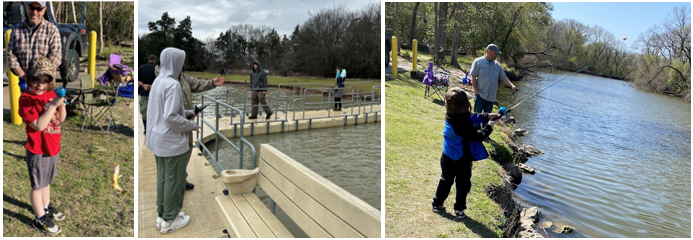
Following this one-hour learning event, our Cub Scout pack embarked on a weekend campout at Cooper Lake State Park-Doctor’s Creek on March 7-9, 2025. While our campout was a complete wash-out from cold and rain, we did manage to get in a little fishing practice. Unfortunately, we all walked away empty-handed. In the following weeks, however, I had Scouts reporting back in about their own fishing experiences with their families: a trip to Fort Parker State Park brought in some Crappie and a Large-mouth Bass from the Navasota River, a trip at a private pond resulted in a Scout reeling in a Bluegill, an afternoon at Samuel Farms East had two Scouts who reeled in some Bass, and a Scout who exclaimed how he hoped “those men have their fishing license because they aren’t fishing in a state park” when he saw some roadside fisherman. An understanding of Texas laws and regulations is always a good addition to an event!
Photo credit - Michelle Huff
Back to Top
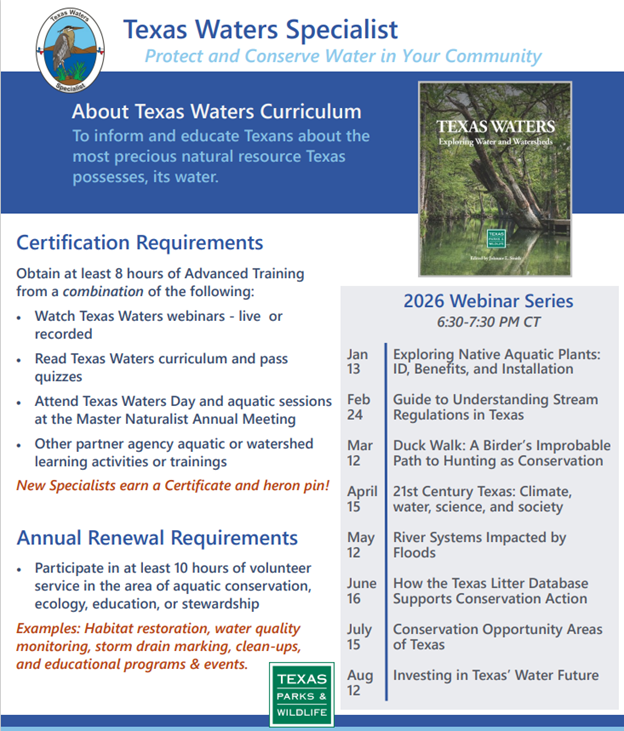
The Texas Waters curriculum informs and educates Texans dedicated to the beneficial management of aquatic resources and habitats within their communities. This program allows volunteers to obtain advanced training, become certified as a Texas Waters Specialist, and give back to their community by performing volunteer service in watershed and aquatic areas to always have drinkable, swimmable, and fishable waters.
|
As part of the program, Texas Water webinars are offered with topics ranging from aquatic species, water conservation and infrastructure, and restoration and stewardship. Webinars are FREE, held in the evening, and led by aquatic professionals. On May 12, TPWD Inland Fisheries staff will highlight observed flood impacts to fish communities, and discuss ongoing fisheries research, monitoring, and management efforts supporting system recovery. Register for this event and find more webinars on the Texas Water Specialist and Webinar flyer.
Back to Top
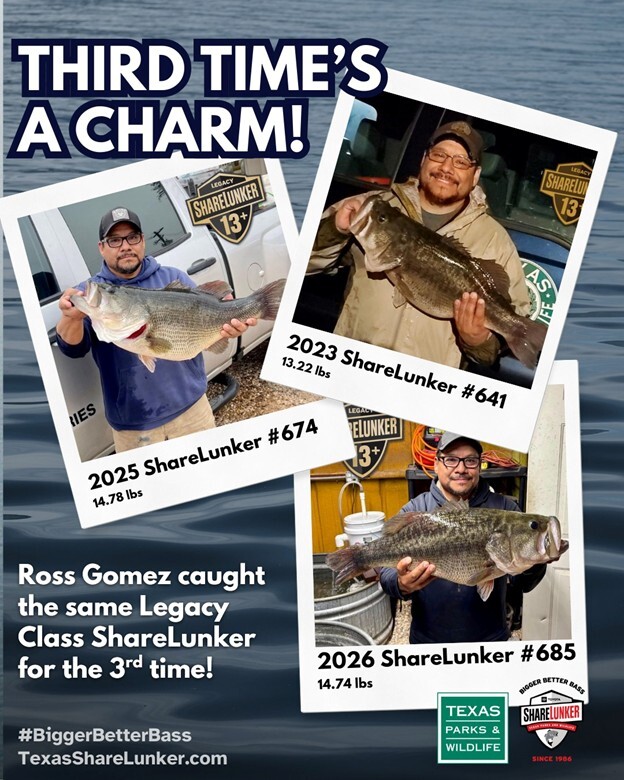
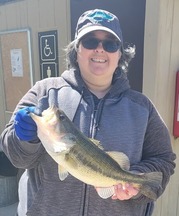
From now through March 31, Anglers who reel in a 13+lb largemouth bass can loan it to our Toyota ShareLunker Program to grow #BiggerBetterBass for stocking in Lakes around Texas.
Reel in an 8+ pounder? Enter your catch details to win a Catch Kit and chance at $5000 Bass Pro Shops shopping spree!
Track recent big bass catches at Texas ShareLunker Archives
Photo credit - staff
Back to Top
TPWD Staff and Area Chiefs (volunteer Train-the-Trainers) trained 602 new instructors from July to December 2025. Go to the website to check out the list and welcome our New Instructors - including one at our newly reopened North Texas Education Center!
Photo credit - staff
Back to Top
Angler Education Program | Texas Angler Educators Facebook
Learn to Fish Videos | Texas Aquatic Science | TPWD Fishing Information
Volunteer Portal | Staff Contacts
Angler Education Instructor Workshops, Fishing Events, Fly Fishing Events, Texas Freshwater Fisheries Center, Sea Center Texas
|