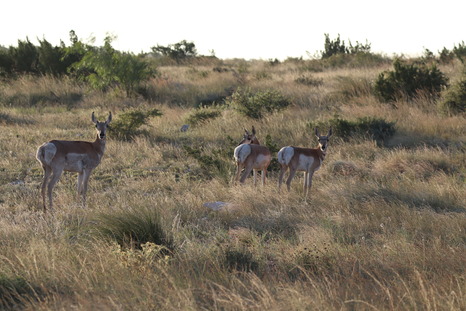
Pronghorn in the Edwards Plateau
By: Preston McKee, Wildlife Biologist - Tom Green, Irion, & Reagan Counties
Pronghorns are the only species left in the Antilocaprid family making them unique animals. They are the fastest land mammal in North America reaching speeds of 55 mph and sustaining high speeds for long periods. Pronghorns are the only animals with a true horn that shed each year, and their hair and bones are hollow to allow for heat dissipation and sustained running. Another unique feature is their eyes. Pronghorn can see 270 degrees, meaning that they can see behind them when looking forward. Along with their large field of view, their zoom of vision is comparable to humans using 8 power binoculars. All these adaptations that make pronghorn unique are key to their preferred habitat. Pronghorns have a very specific habitat which consists of open grasslands with diverse grass and forb species and low brush density. Open grasslands allow them to utilize their speed and vision to evade predators, as well as tall grass for fawning cover during the late spring. Dispersed within these open grasslands are patches of bare ground where warm and cool season forbs which are excellent, preferred food for pronghorn. Since rainfall is crucial for forb growth, large patches of bare soil will be present waiting to grow large quantities of forbs. Pronghorns need access to roughly 5 or more square miles of this quality habitat to maintain their population. A key management practice in pronghorn counties is modifying net wire fences to be pronghorn friendly allowing them to cross under. In the Western Edwards Plateau, there is an example of quality pronghorn habitat primarily in Irion and Reagan Counties.
Up-Coming Events & Workshops
Spotlight Habitat Management Practice: The Value of Bare Ground
By: Evan McCoy, Senior Wildlife Biologist
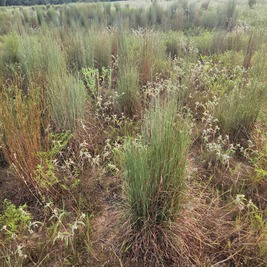
Many people think of optimal wildlife habitat as a continuous, thick layer of vegetation across the landscape. With the amount of rainfall that much of the Hill Country has received over the last two years, we saw a tremendous growth of plants that resulted in just this scenario. Some may see the amount of ground cover being directly proportional to good wildlife habitat. Producing plants is certainly a focus in most wildlife management plans so it is understandable that people are pleased by such an abundance of it. Many landowners express concern about isolated sites where plant growth appears sparse or nearly non-existent, and they usually want to know how they can fix it. This concern may stem from negative impacts of prolonged drought or overgrazing. While an excess of bare ground is frequently associated with poor range health, there are benefits that bare ground can provide for wildlife.
Bare ground can improve habitat diversity by allowing the growth of early successional, or pioneer, plant species that may not be present otherwise. This is typically forbs, or wildflowers, which are an important food for a variety of wildlife, and often limited due to heavy grass and brush cover. Exposing some soil also increases mobility for numerous small wildlife species such as reptiles and ground dwelling birds. Imagine something the size of a quail or a lizard and then determine if that animal would be able to effortlessly travel through the pasture. These open sites are also where these animals can access and forage on seeds and insects.
So, how much of nothing should one have? There should be a balance between vegetative cover and bare ground. The ideal ratio is strongly determined by the targeted wildlife species. Most of the landscape should meet an animal’s cover needs but contain an interspersion of bare soil. In most cases, these areas should not be completely void of vegetation but instead should be an area of exposed soil that is thinly covered with grasses and forbs.
There are a few common methods to create more open space. Light disking, where applicable, is a great way to selectively break up thick layers of grass and expose areas of bare soil. Occasional mowing or shredding, though lacking the soil disturbance benefit, can produce a similar effect. These treated strips can promote forbs, like croton and ragweed, which may improve wildlife mobility and provides a good seed source. Prescribed fire will reduce that thick accumulation of grasses that can dominate the range, and burning also limits brush growth and encroachment. A proper cattle grazing system is arguably the best practice for thinning vegetation due to both the grazing and hoof action it provides. If done properly, the result will be a mosaic of both moderate to light grazing sites throughout the ranch.
To manage for a diversity of wildlife, it is important to provide diversity on the rangeland. It may look nice to see a continuous layer of grass on your property, but animals need some variety in plant structure, composition and abundance. Applying the proper management can ensure that your property can be utilized by a wider range of wildlife.
|
Quail Roadside Surveys
By: Austin Stolte, Wildlife Biologist - Val Verde County
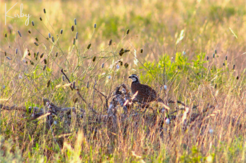
The Edwards Plateau is home to three species of quail: the bobwhite quail, which is found through most of the Hill Country, the scaled quail which is found in the western Hill Country, and the Montezuma which is found in specific habitat in Edwards, Real, and Val Verde Counties. Quail abundance in the Hill Country is quite variable depending predominantly on habitat quality preferred by each species of bird. Numbers fluctuate greatly from year to year and are largely driven by rainfall. To monitor these populations each year TPWD staff conduct quail roadside surveys in early August. For the roadside surveys, TPWD biologists focus mostly on bobwhite and scaled quail range. Although we love that Montezuma quail call the Hill Country home, their population is very low and because of their reclusive nature can be very difficult to survey. The roadside surveys are scattered across the region mostly on lesser traveled Farm to Market and county roads. Each established route is 20 miles in length and is driven slowly either at sunrise or sunset and birds are documented. Population metrics are recorded including covey size, age class, and sex. This data is then used by the Upland Game Bird Program to track eco-region population trends, chick recruitment, and predict seasonal hunting outlooks. It is important to note that this data collection method looks at quail population trends at an ecological scale and they are not a good predictor of quail population on a specific ranch. For those ranches wanting to learn more about localized quail numbers or quail management, you should contact your local biologist.
|

New World Screwworm
By: Robert Booker, Wildlife Biologist - Real & Edwards Counties
There are Texans that remember the last fight against New World Screwworm (NWS) when it affected the wildlife and livestock industry in the mid-to-late 1960’s.
New World Screwworms are larvae or maggots of the NWS fly, that cause a parasitic infection from feeding on living tissue of their host animal. NWS lay eggs in open wounds or orifices of live tissue. These eggs hatch into larvae and the maggots burrow or screw into living tissue with sharp mouth hooks. This destruction of living tissue is what makes them unique and feared. The wound can become larger, and an infestation can often cause serious, deadly damage. NWS can infest livestock, pets, wildlife, occasionally birds, and in some cases, people. New World Screwworm is zoonotic, which means it can affect people, and there have been several cases in Mexico and Central America within the last year.
During our last fight against NWS, leading members of the scientific community came up with methods using radiation to sterilize male NWS flies by the millions, which were released to breed with females which only mate once in their lifecycle. These sterilized male flies were dropped out of planes in a systematic grid pattern starting at the most northern areas of their range. These drops of sterile males steadily eradicated the flies, pushing their population further south to the historic southernmost line which was in vicinity of the Panama Canal. Here, they continually released sterile males keeping the NWS from making northward progression. This worked well, until recently.
In 2023, NWS detections in Panama exploded from an average of 25 cases per year to more than 6,500 cases in one year. Since then, screwworm has been detected in Costa Rica, Nicaragua, Honduras, Guatemala, Belize, El Salvador, and Mexico, north of the biological barrier that's successfully contained this pest to South America for decades. The most recent reports, from COPEG (Panama-United States Commission for the Eradication and Prevention of Screwworm), place the nearest cases in Veracruz, Mexico, with no confirmed cases in Texas.
There are multiple federal and state agencies working to get ahead of this issue with proactive solutions, such as closing the border to livestock crossings, and funding new sterile fly breeding and distribution facilities to be built in South Texas.
If you see live wildlife with live maggots, report it to your local TPWD biologist. Early detection is key. Quick reporting is crucial to the implementation of management actions and ultimately eradication of NWS should they enter the US.

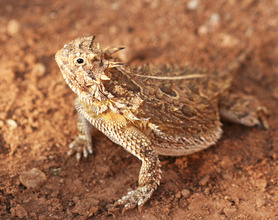
From the WMA: Texas Horned Lizard Research
By: Kirby Irvin, Coryell & Eastern Lampasas Counties
Texas is diverse in its landscapes and wildlife, and many species call this great state home. Arguably one of the most notable is the horny toad, formally known as the Texas Horned Lizard (Phrynosoma cornutum). Recognized by its fierce-looking horns and flat camouflaged body, the horny toad was once common across the arid and semiarid habitats of the south-central United States and Northern Mexico.
However, in 1977 the Texas Horned Lizard was listed as a threatened species in Texas as a result of major declines in their populations from habitat loss, urbanization, and the spread of fire ants. To better understand this decline and develop management strategies for the future, researchers and biologists teamed up to try and find solutions.
Beginning in 2015 at Mason Mountain Wildlife Management Area, the Texas Horned Lizard project started looking at ways to successfully restore horny toad populations. In the first two years 41 adult Texas Horned Lizards were released, each equipped with a backpack transmitter for monitoring purposes. Unfortunately, few lizards survived with the conclusion that translocating as adults was not a viable option.
With adult releases unsuccessful, the next possibility was to look at releasing hatchlings. Since 2017, thanks to cooperation from multiple partners, over 1,674 horny toad hatchlings have been released at Mason Mountain. Very few hatchlings have reached adulthood, as predation and competition from fire ants still pose challenges. Research is still ongoing looking at the efficacy of releasing hatchlings, as the solution to population restoration on a large scale has not yet been found.
|

Spotlight Animal: Spot-tailed Earless Lizard
By: Mike Miller, District 5 Leader
Since the turn of the twentieth century Texas has been in a state of change. Wildlife species that adapt to changing environmental conditions and land management practices tend to persist. The Plateau spot-tailed earless lizard (STEL) Holbrookia lacerata can stake its claim among the resilient. This small, ground-dwelling lizard is endemic to Central Texas semi-desert grasslands and occupies an area roughly the size of its historical range between the Balcones Escarpment and the Colorado River.
STEL are slightly flattened in appearance, have no external ears and have a series of dark spots found dorsally, along the underside of the tail and sometimes, between the legs. Adults are 4.5 to 6 inches from snout to tip of tail, with the tail making up about one-half of total length. Sexes and ages have a similar appearance except for gravid females that often have a light green appearance on the neck and back just before depositing eggs in the spring and summer. External egg incubation requires 4-5 weeks, and hatchlings are about 1.5 inches long, including the tail.
The lizards prefer open grassland habitats that are frequently disturbed by grazing and fire and are less likely to be found in dense brush and tree cover. STEL are diurnal and frequent bare soil areas where they bask on warm, sunny days to increase their internal body temperature. They spend most of their time underground, self-burying under loose soil or utilizing crevices and burrows for shelter. They are dietary generalists and sit-and-wait predators that prefer to eat grasshoppers and spiders while occasionally consuming beetles, ants and termites.
Its close relative, the Tamaulipan spot-tailed earless lizard (H. subcaudalis), resides in south Texas and northern Mexico and remains under consideration for federal protection under the Endangered Species Act.
|
Follow Hill Country Wildlife on:
|