Invasive carp found in waterbodies near you!
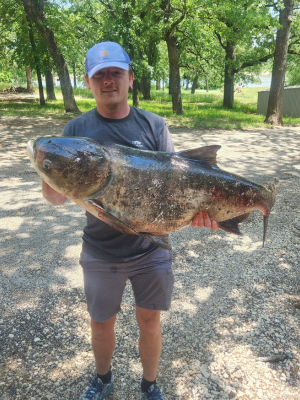
Invasive silver and bighead carp have been found in waterbodies near you. This is bad news because:
- These carp have the potential to cause significant changes in native fish populations by competing with other filter feeding fish such as shad and buffalo, and even larval sportfish.
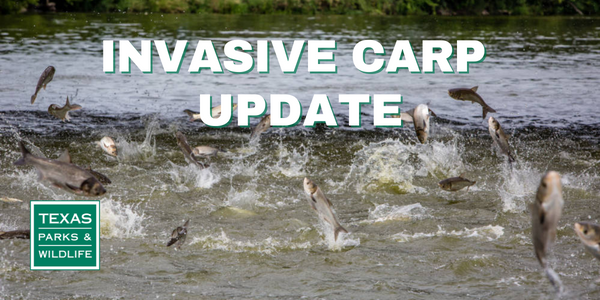
- Silver carp also pose a risk to humans, as they can jump up to 10 feet out of the water when startled by the sounds of watercraft, often jumping into boats, sometimes injuring boaters.
|
How You Can Help
Texas anglers can play an important part in preventing accidental movement of these invasive carp in our waters! The key is to use live bait only in the waterbodies where you catch it. Also, note that silver and bighead carp can look a lot like shad and other bait fish when they're young. Because of this, they can easily be introduced to new water bodies by accident if used as bait.
If you catch silver or bighead carp in Texas waters, please report the sighting with location information and photos to AquaticInvasives@tpwd.texas.gov. Thank you!
More About Invasive Carp in Texas
 Where to find invasive carp
Invasive silver carp and bighead carp have been found in the Red River and tributaries downstream of Lake Texoma. Bighead carp have also been found in waters downstream of Lake Wright Patman and Lake O’ the Pines.
What are invasive carp?
Invasive silver and bighead carp are not native to the U.S. They were introduced in other areas of the U.S. through escapes from fish hatcheries or aquaculture facilities and have spread throughout the Mississippi River Basin. They likely spread into Texas by swimming upstream from other infested areas, but they can also be transported to new areas as live bait.
How to identify them?
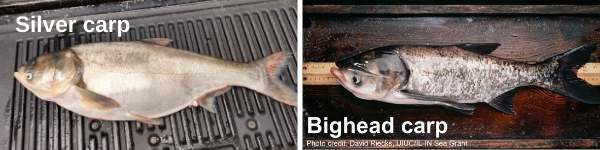
Young silver and bighead carp are similar in appearance to shad but can be distinguished by their low-set eyes (shad’s eyes are located near the top of their heads) and the lack of a long, whip-like segment on the dorsal fin. Silver and bighead carp are also similar in appearance to each other. Silver carp have silver bodies and a ridge, or keel, that runs the length of the belly from the anal fin all the way to the throat. Bighead carp have gray bodies and a keel that stops at the pelvic fin. Both species can grow quite large. Silver carp reach approximately 3 feet in length and nearly 60 pounds. Bighead carp reach up to 4.5 feet in length and nearly 90 pounds. Both species are easily confused with shad or even minnows when small.
What should I do to prevent their spread?
- Use live bait only where you catch it to prevent accidentally spreading these invasive carp to new water bodies such as Lake Texoma, Lake Wright Patman, and Lake O’ the Pines — where they could potentially become established and cause significant impacts.
- Kill any silver or bighead carp you catch.
- Report sightings with location and photos to AquaticInvasives@tpwd.texas.gov. Specimens may also be taken to a local fisheries management office.
Transporting invasive carp is illegal!
Both silver and bighead carp are prohibited exotic species and cannot be possessed or transported unless they’re killed or placed on ice. TPWD regulations also prohibit transport of any live nongame fish from the waters of the Red River below Lake Texoma, Big Cypress Bayou and Caddo Lake downstream of Lake O’ the Pines, or the Sulphur River below Lake Wright Patman.
Texas Parks and Wildlife Department would like to thank you for your attention to this matter and for your help in preventing invasive carp from further impacting Texas waters.
Angler Alert!
Non-native Black Carp have NOT yet been found in the Red River (including in Texas), but TPWD encourages anglers to keep an eye out for and report suspected catches of this invasive species that could move upstream from the Mississippi River in Louisiana. The Black Carp Citizen Science bounty reward program has recently been expanded to include the Red River in Texas to help alert us should these fish invade our waters.
Learn how to identify Black Carp, see bounty info and get contact details. (PDF)
See where Black Carp have already been found.
Let’s work together to monitor and prevent new invasions.
Your reports are important!
|