|
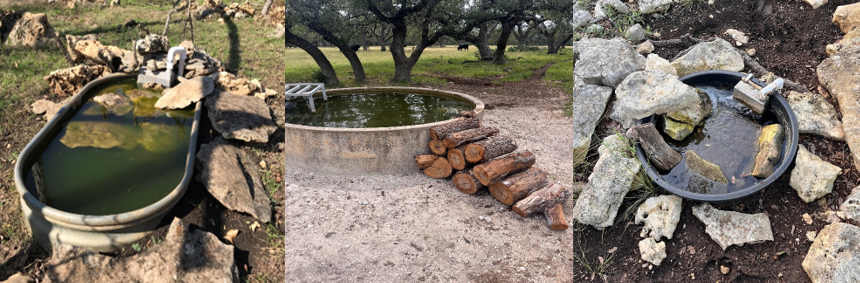
Water Trough Modification Examples
Modifying Water Troughs for Wildlife
By: Cody Stricker, Wildlife Biologist - Blanco & Kendall Counties
Providing supplemental water for wildlife on a property can be a very impactful management practice, especially during times of stress when conditions are hot and dry in the summer. However, not all troughs are created equal when it comes to making that water resource available to a variety of wildlife species. The ideal water trough set up for wildlife would provide water at or near ground level and would offer various depths to mimic how water occurs naturally on the landscape. This configuration would make water accessible to all sizes of wildlife, from a newly hatched turkey poult up to a mature white-tailed deer. However, most properties already have existing steep-sided concrete, galvanized, or plastic water troughs for livestock dotted across the landscape. Although their primary purpose is for livestock, these troughs can be easily modified to allow increased access for wildlife. The objectives of modifying livestock water troughs fit best in three main categories. The first is to offer an avenue of escape for an animal if it were to fall in while utilizing the trough. The second is to increase access to the water for small animals on tall troughs with steep sides. The third is to create varying depths to accommodate a greater diversity of species that can use the water. These objectives can be achieved in several ways with a wide-ranging spectrum of costs, level of difficulty, and type of material. Examples of modifications can be found here!
Up-Coming Events & Workshops
Spotlight Habitat Management Practice: Assessing Riparian Health on Rangelands
By: Joyce Moore, Senior Wildlife Biologist
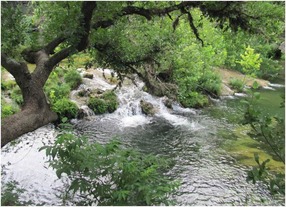
Hill Country streams travel through a variety of rangeland habitats as they meander; each identified by specialized bands of vegetation strongly influenced by the presence of water. This interface between drier uplands and wetter bottomland areas forms diverse riparian corridors—linear landscapes which effectively link usable habitats together. Unfortunately, the reality in many parts of Texas today is that these life-giving ‘arteries' often receive the harshest treatment.
Since the mid-1800’s, when domestic livestock reigned supreme, Texas rangelands have been heavily utilized. Back then, springs and creeks often provided the only available watering locations. Although modern wells and watering systems now provide supplement, riparian areas continue to attract a disproportionately higher percentage of use from both livestock and wildlife (Nelle 2016). The amount and diversity of vegetation remaining in these habitats determines how well the riparian system functions.
-
Vegetative Mgmt--In both upland and bottomland habitats, the goal of most conscientious range managers is to slow water velocity or runoff, with the goal of keeping water on the land longer. However, the tendency of animals to congregate along draws or stream bottoms often leads to excessive use of deep-rooted, bank-stabilizing riparian grasses and preferred woody browse through herbivory. In severe cases, trampling of streamside vegetation can also lead to the establishment of well-worn trails which exaggerate soil erosion and bank de-stabilization along the streambed. Livestock grazing systems which allow adequate rest and recovery periods for deep-rooted native bunchgrasses are recommended on ranch uplands, with success measured through improved water filtration and aquifer recharge. In bottomland areas, installation of riparian buffer fencing can often restrict/limit livestock access to more defined areas so that negative impacts are lessened. Likewise, populations of both native & exotic ungulates who do not recognize fence limitations, must also be controlled. This is accomplished through active population management programs, to include hunting &/or trapping.
-
Stream Stabilization--Water that moves quickly over bare soil forms ruts or gullies which can lead to severe streamside erosion. The removal of protective riparian vegetation through excessive grazing/mowing/trampling can leave streambanks vulnerable to destabilization and sloughing. The removal of large fallen woody debris can often increase water velocity in the stream itself, resulting in further bank destabilization and undermining of channel stability (Nelle 2016). Allowing tree trunks or large woody debris to remain within the streambed helps dissipate the energy of floodwaters, while also trapping sediment. It allows stabilization of water flows and aids the ability of the stream to heal itself.
-
Spring Cleanout & Degradation--The use of heavy equipment in springs is never recommended to increase water flow. In fact, this tactic has caused many springs to permanently stop flowing. Spring cleanout should always be practiced with caution and extreme care. Wildlife ‘wallows’ can also negatively impact riparian vegetation while seriously degrading water quality. In these cases, permanent fencing of springs is recommended to eliminate access by both livestock and invasive wildlife such as feral hogs. Once springs are protected, alternate watering sites could be provided to maintain access and distribution.
-
Invasive Vegetation Mgmt--In many drainages, non-native woody plants now also invade Texas rivers and streams. Controlling the spread of non-native invasives such as elephant ear, giant reed, chinaberry, Tree of heaven, wax-leaf ligustrum, and Himalayan blackberry is another important step toward recovering or maintaining riparian diversity.
With land acreages shrinking, and droughts increasing in length and severity, water management is THE major topic of conversation across Texas today. For those property owners who have been entrusted to steward these special places, intentional management may be the key to offset years of detrimental impacts.
|
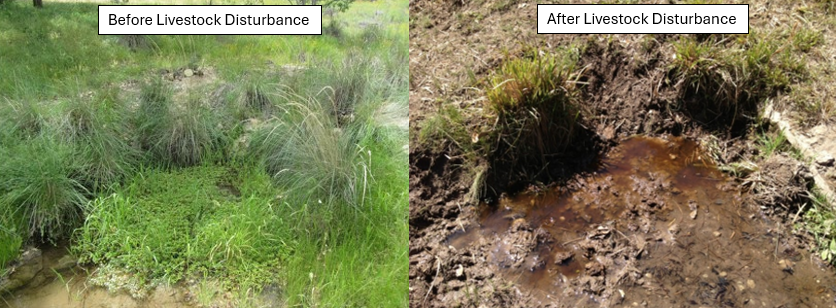 Photo Credit: Megan Bean
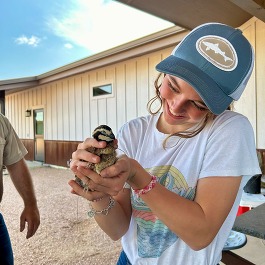
Lead. Learn. Conserve: A Summer with Texas Brigades
By: Stoney Newberry, Wildlife Biologist - Runnels & Coke Counties
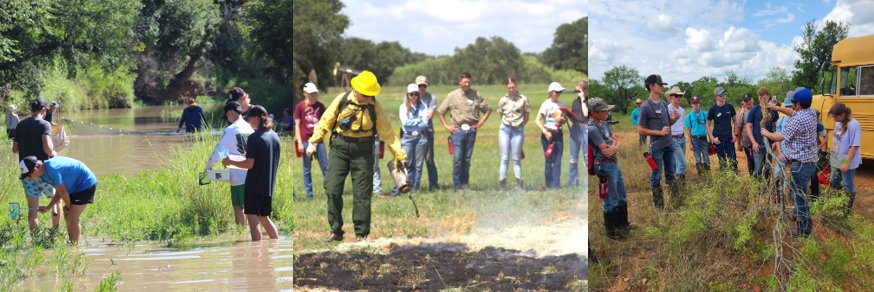
Texas Brigades Camps are 5-day summer camps for youth (ages 13-17 years old) interested in the outdoors, or who have a general thirst for knowledge. These camps teach leadership, critical thinking, teamwork, plant ID, conservation ethics, and biology, while learning about the specific key animal of that camp. After the 5-day camp, the cadets go home exhausted, but with a heart full of excitement for the knowledge and skills that they have gained. A week in the life of a Texas Brigades cadet includes marching as a group as the sun rises to form a cohesive unit, plant identification, firearm safety and target practice, radio telemetry, leadership through team-based games, and much more. The days are long, but the smiles are worth it. Each group is given tasks to complete both as a group and as individuals. These tasks instill time management, teamwork, and the skill of knowing when to ask for help. At these camps, the phones are put away and hours are spent outside learning about our natural world. Cadets can earn college scholarships by continuing to complete activities within the Brigades organization after their camp graduation.
As a reader of the Cedar Post, you care about wildlife conservation; passing down that passion to a child in your sphere can positively impact their lives. Help them become passionate about something meaningful and tell them about Texas Brigades.
Camps include Bobwhite, Buckskin, Bass, Coastal, Ranch, and Waterfowl. The 9 camps are held during the summer months all throughout Texas. Click here for more information!
|
Mesquite Control
By: Ian Witt, Wildlife Biologist - Crokett, Schleicher, & Sutton Counties
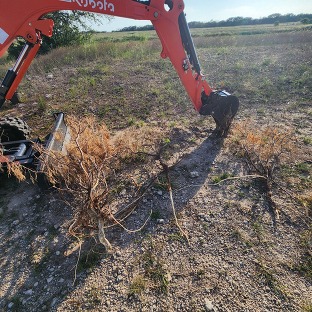
Is mesquite necessarily a bad plant, or is it a problem due to its vast presence on rangelands in Texas? Some things are simply better in moderation, and that may be the case with this thorny shrub/tree of the legume family.
Historically, many Texas rangelands were described as grasslands with scattered large mesquites throughout and some areas of Central Texas were described as covered with groves of mesquite trees. This indicates mesquite was a natural component of Texas rangelands in many historical accounts, but maybe not to the extent we see today in many areas.
Understanding mesquite’s growth and development processes are the key to successfully managing the plant. Mesquite plants produce buds both above and below ground. This below ground bud zone is the target for controlling mesquite when utilizing both chemical and mechanical applications. Successful control of the plant is dependent on whether these buds were eliminated or successfully targeted. If not, the plant will continue to resprout, and re-treatment will be necessary. Industry professionals can provide land managers with management options that have been proven to be successful, cost effective, and safe to use on the landscape.
Mesquite canopy cover has direct impacts on understory grass and forb production when dense stands are left intact. This impact is due to the allelopathic effects of mesquite, which releases chemicals that can inhibit growth and reproduction of surrounding vegetation. Mesquite management to reduce canopy cover can be done on a broad scale, as well as an individual plant treatment (IPT) method. The density of canopy cover and the goals of your overall treatment will help you decide which method may work better for your specific situation. Although we often view mesquite strictly as a plant targeted for complete removal, it is important to remember the potential benefits (food and cover) it can provide at low densities for both wildlife and livestock species.
|
From the WMA: MAPS Station
By: Tessa Boucher, Wildlife Biologist - Mills & Hamilton Counties
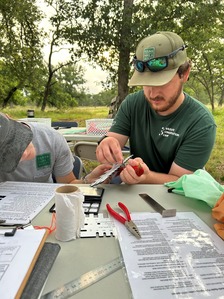
The Monitoring Avian Productivity and Survivorship (MAPS) banding program aims to contribute to conservation by collecting data on neotropical migrating birds. A standardized bird monitoring protocol is followed to ensure that site specific data is comparable across different regions and years. MAPS data is collected to generate the rates of survival, reproduction, and recruitment. This is extremely important in understanding how populations are responding to environmental changes and help predict causes of avian population decline, such as vulnerability during the breeding season, or regional habitat degradation. The first MAPS station was started in 1989 and has grown to more than 1,200 across the U.S. and Canadian provinces. Over 2.5 million bird captures have been recorded in this time frame. Many of these birds are of conservation concern. MAPS data aims to prevent future endangered species listings by detecting, identifying causes, and preventing population declines before reaching critically low numbers where recovery is unlikely. The vast timeframe and geographical span of this data set makes it very valuable to avian conservation.
Biologists in the Hill Country are embarking on their 2nd year of MAPS banding at Mason Mountain WMA. This program was initiated last year during the summer breeding bird season of 2024. A total of 89 different birds were banded between 10 different net locations within a 20-acre station. Although 13 different species were identified, almost half of birds captured were Painted Buntings. This data will give biologists more insights into the productivity and survivorship of the birds that breed in the Mason area.
|
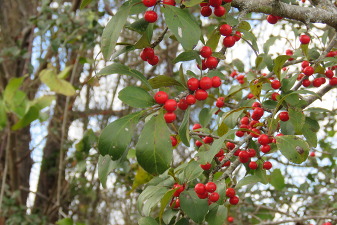
Spotlight Plant: Yaupon Holly
By: Robert Booker, Wildlife Biologist - Real & Edwards Counties
Yaupon Holly (Ilex vomitoria) is a hardy evergreen shrub native to southeastern North America. The leaves are arranged in an alternate pattern, and are small, oval with slightly serrated edges that are not sharp, and have a dark green, glossy appearance on top, with a paler color below. Mammals and small birds feed on the berries, and deer may utilize some of the foliage, though it is not preferred browse. Yaupon is also the larval host for Henry’s Elfin Butterfly. Yaupon is typically used as a landscape plant, for either groundcover or edging, and once established are fairly drought, heat, insect, and disease resistant. It is adaptable to a wide variety of soil types but prefers sandy sites.
Under optimal conditions, Yaupon can be aggressive, forming dense stands, which can shade out other plant species. A way to manage this on the range is through fire, as they are not tolerant of it. Trimming will cause regrowth and increase the density. To reduce the plant, the stumps should be treated with herbicide within an hour of cutting, as Yaupon spreads when cut via root suckers.
Recently, there has been a rise in popularity of this plant at farmers markets because it’s the only caffeinated plant found in the United States, and more folks have been using the leaves to make teas. Native Americans also used this plant ceremonially in “Black Drink” to purify the body, or medicinally to induce vomiting since the berries are toxic.
|
Follow Hill Country Wildlife on:
|