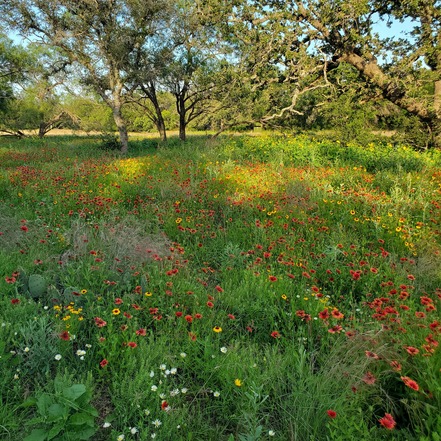
Wildflowers: Nature's Deception
By: Kory Perlichek, Wildlife Biologist - Mason & McCulloch Counties
In the heart of Texas, one of the most captivating natural displays each spring is the wildflower bloom. Many Texans look forward to seeing the vibrant colors of wildflowers on the hills and along the highways of central Texas. But beyond their beauty, wildflowers and native grasses play an essential role in maintaining the health of the landscape, supporting biodiversity, and ensuring the vitality of the ecosystem. This delicate balance is not just a visual treat but a crucial component in the intricate web of life that sustains the environment.
Wildflower diversity plays a crucial role in the health and vitality of the landscape. However, wildflowers can sometimes be deceptive in that they might be a symptom of disturbance or alteration on the landscape. For example, in places where there’s been overgrazing, some hardy wildflowers might persist, but it’s not always a sign of health. It could be that these plants are just the survivors of a stressed ecosystem. Sometimes, the appearance of wildflowers in disturbed areas can mask the fact that the ecosystem is not fully functioning in a balanced way.
Ultimately, the context in which wildflowers appear is key to understanding whether they’re signaling a healthy ecosystem or a landscape in decline. To get the full picture, ecologists will often look at not just the diversity of wildflowers but also the health of other species in the area (like native grass, trees, and animals), the quality of the soil, and the presence of invasive species. So, it seems that the key is in the diversity and the context—wildflowers can be an indicator, but not always the whole story!
Up-Coming Workshops & Events
-
Plant Party: Spring Green Up, March 19th, 10:00am - 11:30am, Virtual
-
Ranchers Round-Up, April 4th, 8:00am - 4:00pm, Leakey, TX
-
Small Landowner Workshop Series: Inks Lake State Park, Burnet, TX
-
Part 1: Valuing Your Land, April 5th, 8:30am - 2:00pm
-
Part 2: Managing Your Land, May 10th, 8:30am - 2:00pm
-
Part 3: Monitoring Your Land, June 7th, 8:30am - 2:00pm
-
East Texas Fire & Nature Festival, April 5th, 10:00am - 3:00pm, Tyler Nature Center
-
Prescribed Fire Workshop, April 11th, 8:30am - 4:00pm, Neasloney WMA, Gonzales, TX
-
Online Wildlife Tax Valuation Workshop, April 14th, 8:30am - 11:00am, Virtual
-
Landowner Workshop & Field Day, April 25th, 10:00am - 4:00pm, Mason Mountain WMA, Mason, TX
-
Cow Pokes & Land Folks Conference, May 9th, 8:00am - 4:00pm, Kerrville, TX
-
iNaturalist Gathering/BioBlitz, May 9th - 11th, Timberlake Biological Field Station
Spotlight Habitat Management Practice: Ashe Juniper Management
By: Johnny Arredondo, Wildlife Biologist - Kerr & Bandera Counties
Who, what, when, where, why, and how? Those same questions can be used to gain a deeper understanding of Ashe juniper (Juniperus ashei) management and whether it be a considerable habitat management practice for your property.
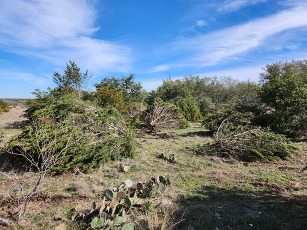
Who/What/Why? Ashe Juniper, also known as blueberry juniper, mountain cedar, or just CEDAR, is a drought-tolerant evergreen tree native to Texas. Historically, Ashe juniper occurred only in steep draws and canyonlands, in which this system was maintained by natural or man-made wildfires for tens of thousands of years. Ashe juniper that occurs in these areas are referred to as “Old growth” juniper and is considered to play a vital role in the ecosystem. Over the past 150 years, changes in land use practices and fire suppression have created a new landscape. Today Ashe juniper is well known for its vast expansion across the Texas Hill Country. Ashe juniper can become overabundant and invasive, and its expansion has caused a decrease in plant species diversity. In addition, some studies have shown that Ashe Juniper in some instances can increase soil erosion (due to the lack of understory grasses to stabilize the soil and can reduce the amount of water recharge to the aquifer by collecting water in the canopy.
When/Where? The removal of “re-growth” juniper should be practiced in areas with the best soils, which have the greatest potential for increased production of herbaceous and woody plants. This should be applied to areas where it has previously been cleared, hill tops, or areas with low grade slopes. But remember, not all junipers are bad! Both old growth and re-growth Ashe junipers can provide shelter, thermal cover, and nesting habitat for numerous wildlife species and songbirds. Thus, removal should be done outside the nesting season, which generally occurs from March to early August. In addition, areas with steep slope or old growth junipers should be left alone to help reduce soil erosion and to maintain suitable habitat for specific species such as Golden-cheeked warblers.
How? Ashe juniper dies when the main stem is cut at the base of the tree and is one of the best methods of removal. Depending on the scale of project, cost, and time, there are a few options to consider. For years, bulldozers have been used as an effective and efficient method to achieve this goal but can be quite destructive, causing a high disturbance of the soil and erosion. Smaller machinery like hydraulic shears can be used for more selective removal and less soil disturbance, generally at the same cost and efficiency level. Hand cutting is another method that allows removal and less soil disturbance but is a slow process. Another method to consider is prescribed fire, which has proven to be a highly efficient and low-cost tool to manage Ashe juniper, if done safely and properly.
If you are a landowner or land manager that is deliberating whether to implement an Ashe juniper management program on your property, take these questions into consideration. You can also view more information about habitat management practices on the TPWD website and/or contact your local biologist for further recommendations.
|
From the Field: Fire Promotes Vegetative Diversity
By: Erin Wehland, Wildlife Biologist - Western Lampasas & Burnet Counties
Maintaining diverse vegetative communities is an important aspect in land management. Historically, fire was one of the major forces that shaped the vegetative community in this region. However, since European settlement, natural fires have been suppressed and generally, the use of fire on the landscape was viewed with dread. Fire limits woody encroachment and is particularly effective on species that do not root sprout like Ashe juniper. Fire removes the top growth of grasses and the thatch areas allowing forbs to germinate and encourages grasses and shrubs to sprout. Wildlife and cattle frequently graze in recently burned areas, taking advantage of the new growth. Burning releases nutrients bound in dead organic material and releases it back into the soil.
The perception of fire and its use by landowners has shifted over the past decades and its benefits are more recognized and promoted. Prescribed burning is considered one of the cheapest methods per acre to control small juniper trees. The removal of thatch invigorates the growth of wildflowers. Burning and removal of old organic material leaves less fuels to burn in a wildfire. Timing and the intensity of fire influences the vegetative response. Burns in the late summer are good at controlling juniper but can set back warm season grasses while cool season burns impact cool season grasses such as wintergrass. When using fire, develop your goals and consider timing and tactics best fit to meeting those goals. Like any useful tool, the use of fire requires proper planning and training.

The Importance of Pollinators & How We Can Improve Their Habitat
By: Rachel Hamilton, Wildlife Biologist - Coleman & Concho Counties
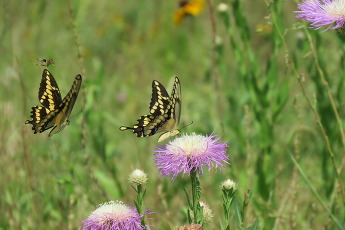
Pollinators are species that facilitate pollination and can include bees, butterflies, bats, birds, moths, and even small mammals. Many flowering plants use colorful displays, nectar, and pollen to attract various pollinators who act as carriers transferring pollen between plants along the way. They play a crucial role in our ecosystem, supporting wildlife systems, agriculture production, and the growth of many flowering plants.
One of the most effective ways we can help improve pollinator habitats is by creating more diverse and native plant environments. Some activities that achieve this include prescribed fire, disking, well-managed grazing, and native plantings. Controlled burns remove excess thatch and brush, exposing and adding nutrients to the soil. This process creates a more favorable environment for native species. Another method that promotes the growth of early successional plants is disking which involves lightly turning over and opening the soil. Grazing or resting pastures, dependent on habitat conditions, can also benefit pollinators. Managed grazing allows for careful control of vegetation, while resting certain areas from grazing can help restore native plant populations. Finally, planting native flowers, shrubs, and trees can provide essential food sources for pollinators when diversity is otherwise lacking.
Not sure where to begin? Consider contributing to a local Bioblitz, an event in which community members identify and record as many species as possible in a designated area within a set timeframe. Through these events, important data on pollinator populations is collected and can be used to guide management goals and activities.
Incorporating one or more of these strategies into our land management practices can contribute to healthier pollinator habitats. Let’s work together to ensure a thriving future for pollinators and the ecosystems they support.
|
From the WMAs: Black-tailed Prairie Dogs

By: Kelton Mote, Wildlife Biologist - Mason Mountain WMA
The black-tailed prairie dog (Cynomys ludovicianus) once occupied 100 million acres across the Great Plains from southern Canada to northern Mexico. Today, however, they occupy roughly 2% of that historic range due to the loss of prairie habitat, human persecution, and the introduction of sylvatic plague. The black-tailed prairie dog is an important ecosystem engineer benefiting up to 150 other wildlife species including lesser prairie-chickens, Texas horned lizards, and burrowing owls. They serve as an important prey item to a host of predators while their burrows provide shelter for a wide array of wildlife. Thus, grasslands inhabited by black-tailed prairie dogs often support greater biodiversity than those without.
Because prairie dogs are historic residents of Mason County, as recently as the 1990s, we began reintroduction efforts on Mason Mountain Wildlife Management Area in 2018. Through multiple releases across several years, our prairie dog colony is now healthy and has established itself as a sustainable population.
Through the process, we have experienced several positive benefits for the WMA. We’ve observed predation from bobcats, badgers, and red-tailed hawks. This fall a burrowing owl utilized the colony for several weeks as a rest stop before continuing its migration South. White-tailed deer have heavily utilized the colony as a natural food plot due to the innate ability of prairie dogs to maintain vegetation in a low-growing, highly palatable form. However, the most entertaining show comes from the prairie dogs themselves when their pups begin to appear in the spring emerging from their burrows and exploring the world around them.
In the future, we plan to grow our colony on the WMA for the betterment of prairie dogs as a species and the plethora of wildlife that have come to benefit from their presence.
|
Spotlight Animal: Spotted Skunks
By: Annaliese Scoggin, Wildlife Biologist - Callahan, Nolan, Taylor, & Mitchell Counties
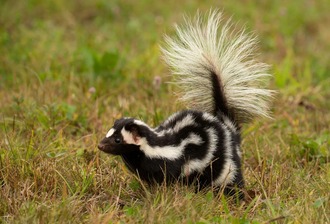
Many people are not aware that Texas is home to FIVE species of skunks: the striped skunk, the hog-nosed skunk, the hooded skunk, and the eastern and western spotted skunks. The striped skunk (Mephitis mephitis) is our most common and widespread skunk that most Texans readily recognize at first sight - or smell! The two spotted skunks together occupy almost as much of the state, with the eastern spotted skunk (Spilogale putorius) occupying the eastern 2/3rds of the state, the western spotted skunk (Spilogale gracilis) occupying the western 1/3 of the state, and a small area of overlap in the hill country.
Spotted skunks are extremely elusive, yet captivating creatures native to Texas and other parts of North America. They are the smallest members of the skunk family, known for their diminutive size, secretive nature, and unique tendency among the skunks to perform a handstand as part of their defense display. These small omnivores typically weigh between 1.5 to 4.5 pounds and measure about 15 to 18 inches in length. Their diet primarily consists of insects, small mammals, birds, fruits, and vegetation, allowing them to live in various habitats ranging from forests and hills to grasslands, though they seem to prefer forested or brushy habitats.
Though spotted skunks are still considered widespread, their highly nocturnal behavior and elusive nature makes them very difficult to study. Scientists in Texas know very little about their current populations. They are not currently listed as endangered, but there is some concern over their potentially declining numbers and rarity.
|
Follow Hill Country Wildlife on:
|