Snake Fungal Disease in sympatric Water Snake (Nerodia spp.) populations within the Brazos river basin
Wednesday, December 2, 2020
12:00 p.m. - 1:00 p.m. CST
Dr. David Rodriguez, Texas State University
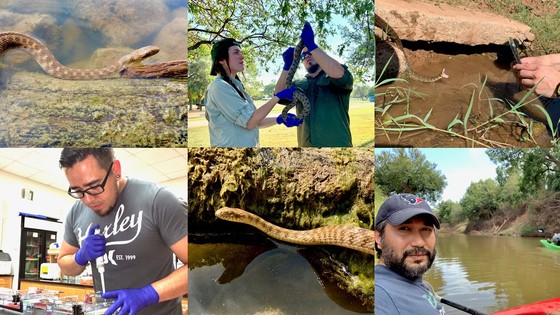 Nerodia harteri harteri is a range restricted and state threatened small-bodied water snake endemic to Texas and is closely associated with tributaries and lakes in the Brazos river basin. Previous studies detected low genetic diversity and low abundance compared to its sympatric congeners. Known threats to these inbred populations include habitat modification, mortalities owing to human activities, competition from larger sympatric congeners, and fire ants. Additionally, Snake Fungal Disease (SFD) has negatively affected other snake populations in the US, and even more concerning, the first confirmed detection of SFD in Texas was from two N. h. harteri in 2016. Therefore, as part of a two-year monitoring project starting in 2018, the team sought to perform the first assessment of the prevalence and distribution of Ophidiomyces ophiodiicola, the causative agent of SFD, in populations of N. h. harteri and its sympatric congeners (N. rhombifer and N. erythrogaster transversa). Dr. David Rodriguez will discuss the results of their surveys and potential implications for the management of the Brazos water snake and other snakes with low genetic diversity and small population sizes.
Dr. Rodriguez (seen in the lower right photo) is an Assistant Professor in the Department of Biology at Texas State University. He was born and raised in Del Rio, TX and received both his B.S. (2000) and M.S. (2002) degrees in Biology at Texas State University. He completed his doctoral program in Zoology at Texas Tech University (2007) where he researched the population genetics of New World crocodiles. His NSF Postdoctoral Fellowship at Cornell University (2010-2013) focused on the population genetics/genomics of the amphibian-killing fungus. Combining his broad research experiences and strong interests in conservation, his research group at Texas State University focuses on investigating host-pathogen dynamics in reptiles and amphibians using genetic, genomic, and bioinformatic tools in Texas and abroad.
Note: Registration via mobile devices is not supported. You must register using a computer.
 |
|
This project was funded by a State Wildlife Grant from the U.S. Fish and Wildlife Service's Wildlife and Sport Fish Restoration Program (WSFR). |
To view upcoming or archived Wildlife Diversity Webinar topics, visit the TPWD Wildlife Diversity Program page.
Sign up to receive future Wildlife Diversity Webinar Announcements
|