In This Issue:
Did someone forward this email to you? Subscribe now -- it's free!
"Many of the problems of conservation and management are vexatious and appallingly involved. It is not hard to understand why conservation or management practice (or policy) has not been free from confusion and cross purposes or how it may be guided less by long-time than by immediate objectives. In common with other human endeavors, conservation or management probably always will be attended by its share of futility and short-sightedness. Regrettable though this may be, worse still is the outright destruction of the values needing most to be preserved -- especially in management programs sponsored by agencies subject to public pressure or catering to circumscribed groups. "Management, in the sense of judicious manipulation both of organisms and of their environment, should be legitimate and desirable as long as the price is not too great. "We should know of marshes with sandhill cranes and the more retiring of water birds, of rivers where otters live, of mountains where martens, fishers, wolverines, cougars, wolves, grizzly bears, and native sheep and goats exist in some security. Close to home, we should be able to find natural retreats in appropriate places, to see an eagle, osprey, loon, or one of the larger falcons on occasion; still to watch, among the sights that belong, the red-tailed hawk in the sky; still to hear, among the night sounds, the hooting of the horned owl in the woods."
Paul Errington, Journal of Wildlife Management, 1947
Declining Light Goose Populations & Regulation Changes in TX
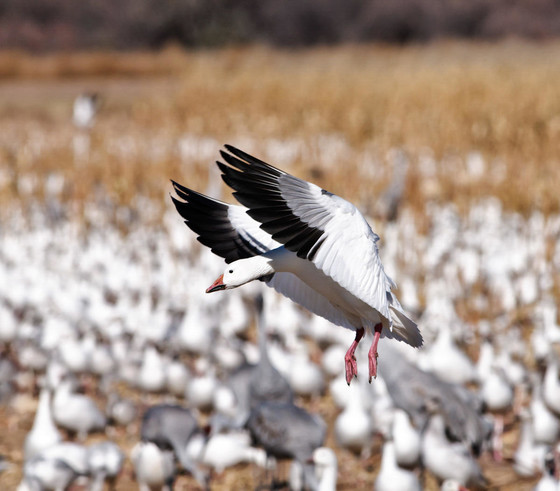 A light goose touches down in a flock of migrating waterfowl. Credit: Martin Sneary
Background: It’s no secret we have seen a decline in light geese wintering in Texas, a decline in Texas goose hunters, and a huge decline in light goose harvest in Texas over the last 2 decades. Now we are witnessing an unprecedented population decline of the mid-continent population of light geese across North America.
Texas coastal prairies and marshes used to be home to North America’s largest wintering population of light geese, commonly defined as snow geese (white and blue phases) and Ross’ geese. Currently, biologists are observing declines due to a warming climate, loss of habitat, substantial agricultural changes, water shortages, urban expansion, and changes in hunting practices; sadly, Texas’ Gulf Coast is no longer the favorite winter destination of North America’s light geese. In response to these complex factors, large scale distributional shifts and population declines, Texas Parks and Wildlife Commission approved a reduction in light goose bag limits from 20 per day to 10 per day to begin this coming hunting season (2020-21).
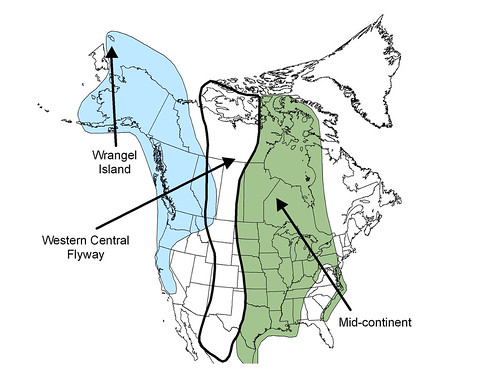
Range map of mid-continent light geese.
Hunters & Harvest: The mid-continent population of light geese are getting wiser and older, so a 20-bird bag limit was no longer in line with current population status in Texas. The bag limit to many waterfowl hunters was, and is, often mistaken as a “goal”. As such, an unattainable bag limit doesn’t help when hunters stay out long hours trying to reach the “goal”, that practice only increasing disturbance, hunting pressure, and hunter dissatisfaction/frustration.
For perspective, in the state of Texas:
- There are ~43,000 goose hunters, down from a high of ~76,000 in 2001.
- Our highest light goose harvest estimate was roughly 341,000 birds in 1999.
- The most recent harvest estimate for light geese was ~43,000.
- Current Conservation Order participation was estimated at a little more than 1,000 people, down from a high of 27,000 participants in 1999.
In 1999, when the initial Light Goose Conservation regulations were implemented, it was estimated that 1 million light geese were harvested in North America during the regular season. In 2018 that number was down to 360,000, a 64% decline, despite extreme liberalizations during that period. Later in 2018 we estimated that total harvest of light geese during the Conservation Order reached a high of 1.6 million, with nearly 700,000 of those birds coming from Arkansas alone. It is now evident that most of the harvest of light geese is coming from the Conservation Order and clearly in places other than Texas.
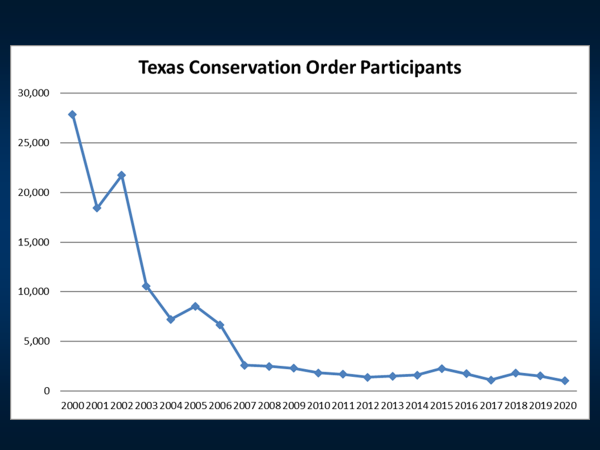 Participants in Texas Light Goose Conservation Order hunting, 2000-20, TPWD.
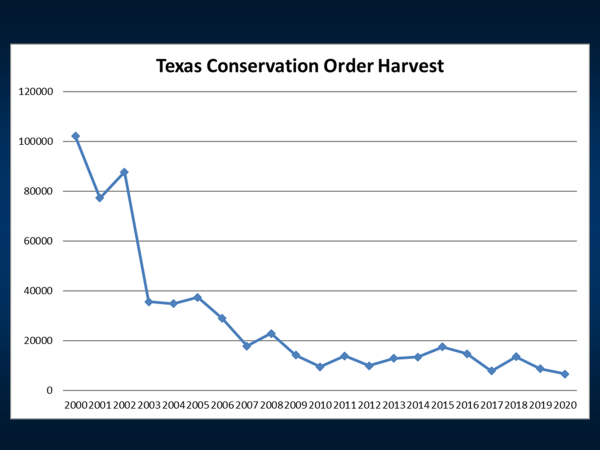 Light goose harvest under Texas Light Goose Conservation Order, 2000-20, TPWD.
Breeding Grounds: Concern about light geese destroying their breeding grounds has long been on everyone’s mind (it was predicted larger populations would deplete local resources and impact reproduction). In the late 1990’s goose hunters and biologists were all on the same page to address calls of overabundance of light geese and no one was more suited to answering the call for management than Texas goose hunters. As we approach 25 years since those recommendations, concerns about overabundant geese eating themselves out of house and home are being looked at more closely; notably, the disastrous die-off’s that were predicted have yet to come to fruition.
Extensive damage by breeding geese to these fragile habitats appears to have not expanded much beyond a small stretch of the Hudson Bay shoreline, where most of North America’s light geese stage for a few days prior to departing to the high Arctic. This latter destination is where the vast majority of the geese breed. Additionally, it appears there was an underestimate of the vastness and carrying capacity of the Arctic and the light goose’s breeding ground as a whole. Over two decades of liberalized regulations and with the Conservation Order in place, take has not significantly decreased adult survival of light geese like biologists once hoped; thus, it has not had the desired impact to the overall population. However, the mid-continent population of light geese is now rapidly declining, and that decline is not attributed to management and take; something else is going on with these birds.
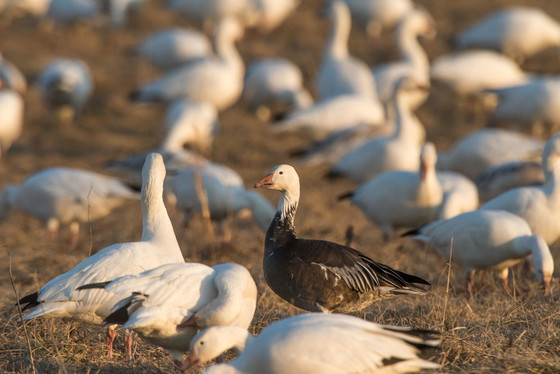 White and blue morph light geese evening feeding. Credit: Steven Kersting
Continental Population Dynamics: Using population estimators that incorporate banding and harvest data, it is estimated that North America had a high of almost 20 million light geese in 2007. Our most recent estimates suggest that figure is down close to 10 million. In a little more than a decade we have seen an apparent population decline of nearly half of the mid-continent population of North America’s light geese, and that figure is cause for alarm.
Light goose productivity has been low and decreasing for many years and five out of the last six years, light geese have seen very poor, to almost zero recruitment (simply, the number juveniles added to the fall population). Researchers suggest this is due to a mismatch of resource availability (vegetation green up) at the time of hatch, depleting chicks of vital nutrients when most needed. This phenomenon has resulted in very few juvenile birds in the flocks of mid-continent light geese for many years and we are now seeing bigger impacts to the overall population in North America, not just in Texas.
So, what should we take from these data? First, the population is not growing like it once was in the 1990’s and the recent population decline is not explained by liberalized regulations and management, but more likely climate change. Regarding harvest, banding data reveal that harvest rates on these birds are very low and once a bird is recruited into the population as an adult, their survival rates are very high. These facts are frustrating for goose hunters broadly, but are an even greater frustration for Texas hunters, considering we may be the only state the country that really likes and wants these birds in abundances they once were. Alas, the issues are bigger than any one of us.
Second we must ask ourselves, can the overall snow goose population continue to handle extensive pressure like we’ve seen the last two decades? Possibly, but at what cost? They are becoming increasingly harder to hunt and rapidly changing their behaviors and distribution in response to pressure. Yes, there are still a lot of snow geese, millions actually, but they just aren’t in Texas. The majority of the light geese now winter east of Texas in the Mississippi flyway or farther north of Texas in the Central Flyway.
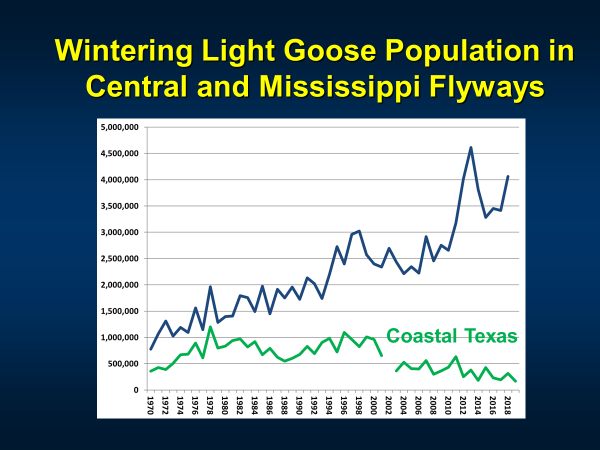 Light goose population trends in Central and Mississippi Flyways, 1970-2018.
Texas Lands and Hunter Preference: Historic high light goose populations along the Texas Gulf Coast reached an estimated 1.2 million birds in 1978. This past year’s coastal goose survey resulted in an estimate of just 243,000 light geese. Our Gulf Coast goose habitats are shrinking almost daily and the foods available to light geese, as well as other waterfowl, are also declining. Coupled with a landscape with near zero sanctuary or roost ponds and we begin to see why light geese find these areas less appealing.
There has been a change in the way hunters view the Gulf Coast. Twenty years ago, the rice prairies were dominated by hunters who wanted to promote the great goose hunting that the area long provided. Soon, as many of land holdings got smaller, waterfowl clubs and leases became more abundant and ducks started to dominate the interests of most hunters in this region. This created a new issue for light geese that were once provided with roost ponds and sanctuary to keep them from leaving the area. Hunters now had a duck blind on most all pockets of surface water in this goose Mecca and the geese no longer felt as welcome to their once favored wintering grounds. Couple all this with a growing abundance of food in other parts of the Central and Mississippi flyways, open water farther north throughout the winter months, a decline in food and planted rice acreage in Texas, new rice framing practices, new rice varieties, declining water availability, and urban expansion, and we enter into the two decade decline of light geese coming to Texas.
 Google Earth depicition of urbanization, West of Houston, Texas Coastal Plain, 1995.
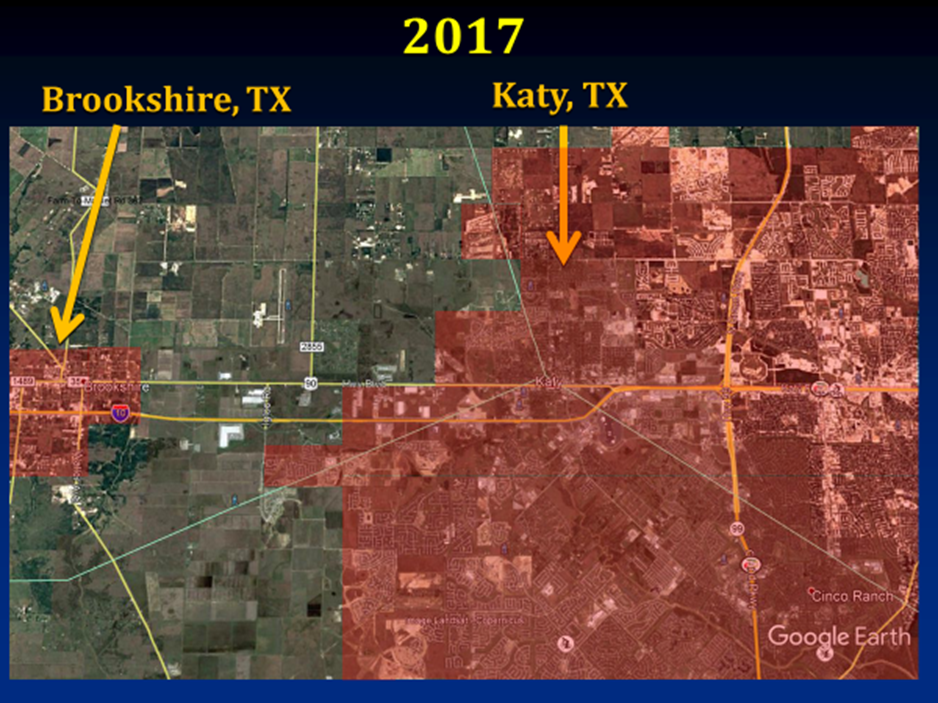 Google Earth depicition of urbanization, West of Houston, Texas Coastal Plain, 2017.
Upcoming Efforts: Most of the issues related to light goose declines in Texas, especially the Gulf Coast, are way beyond our control. But, in addition to the recent bag limit reduction, TPWD is in the second year of a new experimental program that should provided some excitement for all. This program is currently funded by Migratory Game Bird Stamp revenue, with a goal of providing roost sites, waterfowl sanctuary, and spring stopover water during migration for all waterfowl and water birds on strategically located tracks of private and public lands. This waterfowl roost pond/sanctuary program is informed with years of waterfowl research and science compiled by TPWD and our partners with the Gulf Coast Joint Venture, Ducks Unlimited, and Texas A&M University-Kingsville. Modern telemetry research has allowed us to better understand this landscape and how the birds use it in relation to roost sites and food resources. We can now look holistically at the landscape and determine where these key sanctuary sites are most needed. In an attempt in improve hunter success and satisfaction, we hope this program can grow in the coming years to a scale that can increase wintering populations and health of the ducks and geese wintering along the Texas coast.
 Light goose population estimates, rice production, and Light Goose Conservation Order, Coastal Texas, 1948-2018.
Bringing it All Together: Texas invented snow goose hunting, they are called Texas’ Rags for a reason, and we sincerely want to maintain that tradition as best we can. We believe Texas and our residents have done their part for the big picture of North America’s light geese and it's time to take care of what is best for Texas hunters. It is imperative we begin to address the few things we can here at home. This regulation change, along with the roost pond/sanctuary program, are necessary to achieve those goals and are the first steps down a long road in the right direction.
The snow goose should be celebrated. Not much on planet Earth is as inspiring both visually and audibly as giant flocks of snow geese stretching across the sky, and we want them back in Texas.
I personally regret and am disappointed that the world has vilified the snow goose. This attitude has sometimes led to self-justifying acts of wanton waste, extensive wounding loss, and even the take of non-target species. All the while unfairly claiming a hunter was “doing their part to save the tundra.” That rhetoric is no longer acceptable.
By. Kevin Kraai, Waterfowl Program Leader
Quail Season Underway - Modest Expectations, Save South TX
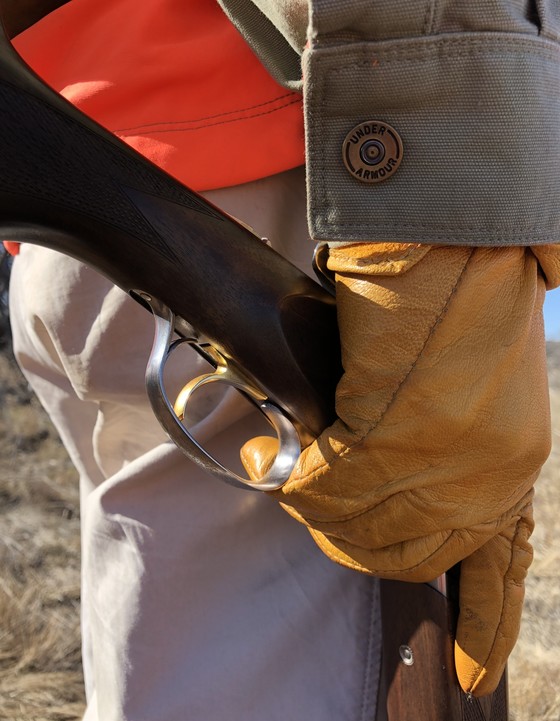 One of our most anticipated times of the year, this past weekend heralded the start of the quail hunting season across Texas. Opening on Halloween (31 Oct 2020), the season is set to run through 28 Feb 2021. While our surveys indicated below average numbers for bobwhite in the Rolling Plains ecoregion, and as such we expect below average hunting conditions, South Texas looks primed to move birds throughout the season. For more information on conditions across the state, check out our northern bobwhite and scaled quail hunting forecasts. For local conditions, feel free to contact a TPWD biologist near you. And don't forget about additional opportunities to hunt coming up including waterfowl! Best of luck this season!
By: John McLaughlin, West Texas Quail Program Leader
Surface Water, Waterfowl, & Habitat in the Prairie Pothole Region
Every spring, the U.S. Fish and Wildlife Service (USFWS), the Canadian Wildlife Service, and state agencies work together to conduct the Waterfowl Breeding Population Habitat Survey (WBPHS). These habitat surveys started in 1961 for the prairie region of Canada and in 1974 for the northcentral region of the U.S. The goal of the WBPHS is to estimate the breeding waterfowl population and habitat availability in the northern U.S. and Canada. The survey involves counting ponds along stratified (segmented) transects across the entirety of the Prairie Pothole Region (PPR) in North America with subsequent population estimation based on available habitat.
 Prairie Pothole Region, North America.
In light of the Covid-19 pandemic in 2020, WBPHS aerial surveys were canceled. A joint effort by TPWD, Gulf Coast Joint Venture (GCJV), and the U.S. Geological Survey (USGS) is now underway to assess the feasibility of performing the WBPHS using remotely sensed products (e.g., filtered satellite imagery). Initially, the team will use three different approaches for classifying (labeling) ponds:
- A technique recently employed by the GCJV for landscape-scale waterfowl habitat using Landsat 4, 5, and 8 imagery;
- A novel classification algorithm developed and employed by USGS for an operational surface water product using Landsat 4–8 imagery; and
- A relatively new technique developed by TPWD for weather-independent surface water extraction using Sentinel-1 C-band Synthetic Aperture Radar (SAR) imagery.
 Illustration of Landsat satellite. Credit: NASA's Goddard Space Flight Center
Pond classifications and counts generated by each of the three remotely sensed approaches will then be compared to historical aerial survey data to determine suitability for a full remote sensing methodology replacement of the WBPHS manned flights. Advancement in the WBPHS survey design and implementation would translate into more reliable, cost-effective, and accurate breeding waterfowl population estimates in the PPR. In concert with dedicated conservation partners and advocates, sound (and the best available) science continues to be the hallmark of waterfowl harvest guidelines in North America.
By: Dr. Rachel Fern, Statewide Wetland Program Leader
Chestnut-Bellied Scaled Quail Declines in South Texas
Chestnut-bellied scaled quail are one of two scaled quail sub-species in the state. Unlike the widespread Arizona scaled quail, commonly associated with open grasslands, chestnut-bellied scaled quail are restricted to the Tamaulipan Brushlands of South Texas and associated with denser, diverse thorn-scrub vegetation. The North American Breeding Bird Survey indicated an annual decline of 4.5% from 1965-2015, accelerating to 8.5% from 2000-2015. These data are supplemented by Texas Parks and Wildlife Department’s Annual Roadside Surveys, which show a decline from 6.29 birds/route (2000-2009) to 1.23 birds/route (2010-2019) over the last 20 years. Nowhere within the greater species geographic range have declines been more severe than South Texas.
Habitat loss and fragmentation represent the primary threats to quail populations in Texas. In particular, the conversion of native, undisturbed thorn-scrub vegetation in South Texas has disproportionately affected chestnut-bellied scaled quail. These birds require large, intact habitat tracts characterized by diverse shrub species, modest herbaceous cover and abundant bare ground. Reductions in habitat connectivity result in imperceptible habitat islands, within which demographic (i.e., survival, reproduction) performance is reduced, environmental susceptibility is increased (e.g., drought tolerance), and local extirpation becomes likely. A complex matrix of agricultural production, emerging energy infrastructure, and novel land-use changes (e.g., wildlife management for deer, northern bobwhite) illustrate the scope of landscape changes and challenges.
 TPWD Scaled Quail Roadside Counts, South Texas Plains, 1978-2020.
As a united front emerges between TPWD and our partners, both here in Texas and regionally, continued investments in scaled quail conservation are needed. The seriousness of the challenges faced by scaled quail and the need to understand how chestnut-bellied scaled quail interact with evolving habitat matrices in South Texas are of paramount interest. As TPWD expands cost-share programs with their partners in South Texas (e.g., South Texas Grassland Restoration Incentive Program – Rio Grande Valley Joint Venture) it is essential that these conservation activities are guided by the most relevant and up-to-date research in order to maximize the funding available for the benefit of chestnut-bellied scaled quail.
In this vein, "The Wildlife Research Program of Texas Parks and Wildlife Department (TPWD) is requesting proposals from universities and non-profit organizations/agencies interested in partnering with TPWD to investigate important wildlife conservation and/or management questions through grant funded research opportunities. The source of this funding is the Federal Aid in Wildlife [and Sport Fish] Restoration (WSFR) program, which is a federal assistance program for state wildlife conservation agencies. The purpose of the WSFR Grants program is to restore, conserve, manage and enhance wild birds and mammals and their habitats. During this funding cycle, TPWD plans to make up to $1,000,000 in funds available to support cooperative, cost-share projects specifically for the project topics," including chestnut-bellied scaled quail.
Further information will be posted, along with the goals and objectives, for these projects in the coming weeks. Be sure to check our TPWD Wildlife Research webpage for more details on this funding source and for opportunities to collaborate with TPWD on quail and other important species research in Texas.
By: John McLaughlin, West Texas Quail Program Leader
Welcome the New Joint Venture 8 Coordinator!
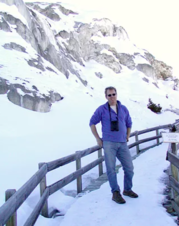
Dr. Graeme Patterson has accepted the Conservation Director position for the Joint Venture 8 Central Grasslands Initiative. Most recently, Graeme was the Vice President for Field Conservation at Denver Zoo. In this role, he delivered field conservation and research projects in the southern Great Plains and around the world (Peru, Mongolia, Botswana, and Vietnam) where he focused on ecosystem restoration involving multiple partners and stakeholders. Prior to his Denver Zoo work, Graeme was the Deputy Director of the Wildlife Conservation Society’s Africa Program where he honed his skills as a conservation manager, strategic planner and technical advisor for a large and growing program. Graeme's experience with strategic planning, fundraising, and delivering international conservation programs make him a great fit for the JV8 Central Grasslands Initiative. Graeme started as the Conservation Director on 12 Oct 2020 and he is located at the Playa Lakes Joint Venture office in Lafayette, Colorado.
To learn more about the JV8 Initiative, check out their flyer!
By: Jeff Raasch, Conservation Partnership/Joint Venture Program Leader
|
Going Live with the Small Game Crew!
Over the last few weeks members of the Small Game Program were invited to sit down and discuss game bird management and conservation in Texas with several great partners. In interviews with the Stewards of the Wild and their parent organization, the Texas Parks and Wildlife Foundation, Owen Fitzsimmons (Webless Migratory Game Bird Program Leader) and John McLaughlin (West Texas Quail Program Leader) had an opportunity to talk about their backgrounds, our program, federal and state wildlife policy, game bird management in Texas, and much more. Also joining John was Mr. Kelly Thompson, Chairman of TPWDs Upland Game Bird Advisory Committee, most certainly an advocate for quail and the Department. As you're taking a lunch break, hitting the road, or winding down your day, take some time to listen in on conversations with Owen, John, and our partners. Enjoy!
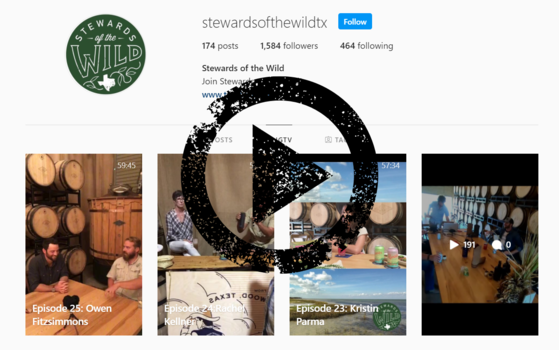 Ep. 25: Matt Hughes of Stewards of the Wild is joined by Owen Fitzsimmons of Texas Parks and Wildlife Department.
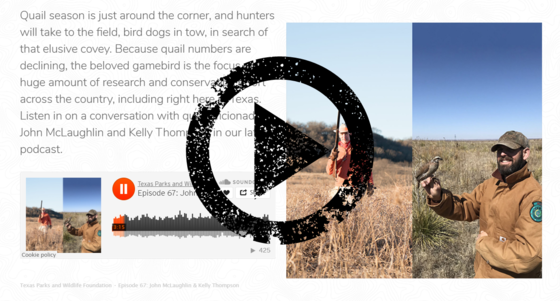 Ep. 67: Lydia Saldaña of Texas Parks and Wildlife Foundation is joined by John McLaughlin, Texas Parks and Wildlife Department, and Mr. Kelly Thompson.
Driving Home Quail Conservation
 Declining quail populations in the U.S. have spurred conservation efforts across the country. Here in Texas, our biologists are partnering with other experts across the state to hone in on the best strategies to bring back this beloved gamebird.
And you can help! Texas Parks and Wildlife Foundation, our official nonprofit partner, launched a quail conservation license plate to raise critical funding to enhance quail conservation efforts, including habitat, conservation and education.
For just $30 you can put one of these conservation license plates on your vehicle, motorcycle or trailer. For every license plate purchased, $22 goes to TPWF to support quail conservation.
Order your quail plate today – what better way to drive home your support for quail conservation in Texas?
TPWD in partnership with our friends at Texas Parks and Wildlife Foundation
|