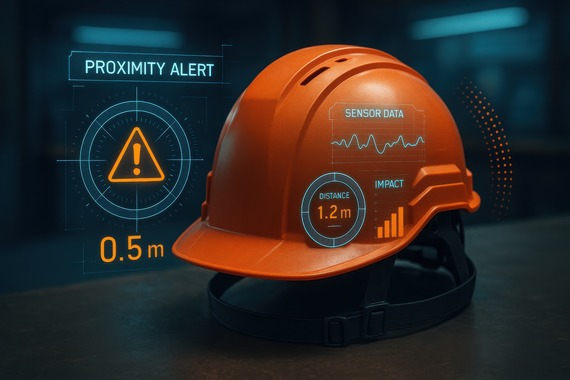
Hard hats that detect heat stress. Wearables that monitor fatigue. Sensors that warn workers about gas leaks, equipment failures, or falls before injuries happen. Connected safety technology is changing how employers protect workers. See how smart devices can improve workplace safety with these tips.
Esta información también está disponible en español.

As connected devices, artificial intelligence (AI), and smart systems become more common on jobsites, employers need workers who understand how to use these tools safely and effectively. To support workforce development in emerging technologies, the U.S. Department of Labor has launched an AI in Registered Apprenticeship Innovation Portal. This resource is designed to help employers and apprenticeship programs integrate AI skills into workforce training across industries — including those adopting advanced safety equipment and monitoring systems.
As workplaces adopt more technology-enabled tools, proper training helps workers recognize hazards, respond to alerts, and safely work alongside new systems. Read more about the initiative in the U.S. Department of Labor's news release.

Workplace injuries can happen fast — but OSHA training helps workers recognize hazards before they become accidents. DWC’s OSHA-authorized 10-Hour Construction, 10-Hour General Industry, and 30-Hour Construction courses prepare Texas workers to identify the most common job-site dangers, understand OSHA rules, and build safer work habits.
Classes are taught by experienced OSHA-authorized instructors and are open to Texas residents or employees working in Texas.
Key details
- OSHA-10 Construction: Free.
- OSHA-10 General Industry and OSHA-30 Construction: $30 per person.
- Classes offered in English and Spanish.
- In-person and Zoom (online) options available.
- Photo ID and advanced registration required.
- Official OSHA class completion card provided within six to eight weeks after successful course completion.
Which OSHA course is right for you?
-
Step 1: Pick your industry. If you spend most of your day building or remodeling, choose an OSHA Construction course. If you mostly work in or for a facility that is already built — such as plants, warehouses, healthcare facilities, offices, delivery routes, oil fields, or utilities — choose an OSHA General Industry course.
-
Step 2: Pick a 10‑Hour or 30‑Hour class. If you are an entry-level or frontline worker who needs basic hazard recognition, worker rights, and job safety training, choose a 10-Hour course. If you are a supervisor, foreman, lead worker, or anyone with safety responsibilities who needs deeper training in hazard prevention, leadership, and OSHA compliance, choose a 30-Hour course.
Seats fill quickly! Register early by clicking on a date below to secure your spot.
July-August classes
OSHA-10 Construction — Free
English:
Spanish:
OSHA-30 Construction — $30
English:
Spanish:
OSHA-10 General Industry — $30
English:
 Make safety a habit.
Get trained this summer to protect your crew and grow your career.
See the full 2026 training calendar here.

When a medical emergency happens at work, every second counts. DWC's CPR, AED, and First Aid classes give workers the confidence and skills to respond until professional help arrives.
Class details:
- Cost: $35 per person.
- Length: Approximately 5 hours (8:30-4 pm).
- Certification: Official American Heart Association eCard.
Upcoming classes:
English:
Spanish:
Advance registration is required, and class size is limited to eight participants.
Reserve your seat today. Call 512-804-4610 for more information.

Technology is reshaping how work gets done — and how hazards need to be managed. As employers and workers navigate this shift, reliable safety information helps them recognize new risks, use emerging technology safely, and strengthen their programs. DWC offers free publications, articles, and videos on emerging technologies and evolving workplace hazards affecting today's jobsites.
Use these free resources to learn more and share during safety meetings, toolbox talks, and employee training:
- 3D Printing Safety Fact Sheet (English).
- 3D Printing Safety at Work (English).
- 3D Printing Safety in Construction (English/Spanish).
- Artificial Intelligence (AI): The New Safety Partner Small Businesses Can’t Afford to Ignore (English/Spanish).
- AI’s Role in Preventing Workplace Hazards - Fact Sheet (English).
- Connected Safety Technology and the Internet of Things (IoT) - Workplace Program (English).
- Drones for Workplace Safety - Fact Sheet (English).
- Exoskeletons and Injury Prevention (English).
- Exoskeleton Safety - Fact Sheet (English).
- Five Safety Tips for Lone Workers (English/Spanish).
- From Hard Hats to High-Tech: How Robotics Protects Construction Workers (English/Spanish).
- Industrial Robotics and Workplace Safety (English).
- Lasers and Eye Safety in the Workplace (English).
- Lone Worker Safety - Fact Sheet (English).
- Nanotechnology: Keeping Small Things from Becoming Big Workplace Health and Safety Issues (English).
- Nanotechnology Safety - Fact Sheet (English).
- New Safety Technology in the Workplace (English).
- Robotics Safety Fact Sheet (English).
- Suit Up For Safety: How Exoskeletons Fight Worker Fatigue and Injuries (English/Spanish).
- The Role of Drones in Construction Safety (English/Spanish).
- The Role of Video Analytics in Construction Safety (English/Spanish).
- Trends in Safety Footwear (English).
- Wearable Safety Technology: Revolutionizing Workplace Safety (English/Spanish).
- Wearable Safety Technology - Fact Sheet (English).
Know someone who could use these resources? Share this newsletter or scan the QR code below to help coworkers, employees, or safety contacts subscribe to Safety@Work and stay current on workplace safety trends, OSHA updates, and free safety resources.

|



