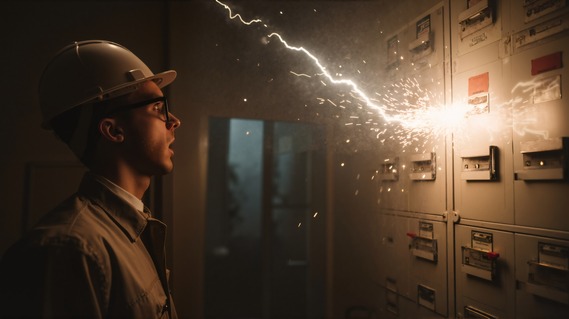
 Before the blast: Arc flash safety basics every worker should know
An arc flash can turn a simple task into a life-changing emergency in less than a second. Help protect your crew by sharing these tips so workers can prevent burns, blasts, and other serious injuries when working on or near electrical equipment.
Esta información también está disponible en español.
May is National Electrical Safety Month, a great time to put the arc flash prevention tips from this issue into action and focus on everyday electrical hazards. Employers can use this month to inspect equipment, refresh safe work practices, and talk with workers about how to avoid shocks, burns, and arc flashes.
OSHA’s Electrical Roll-Up Initiative supports these efforts by encouraging construction employers to inspect extension cords, power tool cords, and ground fault circuit interrupters (GFCIs) for wear and damage. During a “roll-up,” crews check cords and tools, remove defective items from service, and track results to help prevent future incidents. OSHA also offers free resources, including a “5 Things to Know” poster, a ready-to-use toolbox talk, and a customizable PowerPoint training presentation to support quick safety discussions on site.
DWC offers additional free publications to strengthen your program:
You can also schedule DWC’s OSHA‑authorized training or request a free, confidential onsite consultation through the OSHCON program for help improving your electrical safety practices. Share your activities with the hashtag #ElectricalRollUp to spread awareness and keep workers safe.

Workplace injuries can happen fast — but OSHA training helps workers recognize hazards before they become accidents. DWC’s OSHA-authorized 10-Hour Construction, 10-Hour General Industry, and 30-Hour Construction courses prepare Texas workers to identify the most common job-site dangers, understand OSHA rules, and build safer work habits.
Classes are taught by experienced OSHA-authorized instructors and are open to Texas residents or employees working in Texas.
Key details
- OSHA-10 Construction: Free.
- OSHA-10 General Industry & OSHA-30 Construction: $30 per person.
- Classes offered in English and Spanish.
- In-person and Zoom (online) options available.
- Photo ID and advanced registration required.
- Official OSHA class completion card provided within six to eight weeks after successful course completion.
Which OSHA course is right for you?
-
Step 1: Pick your industry. If you spend most of your day building or remodeling, choose an OSHA Construction course. If you mostly work in or for a facility that is already built — such as plants, warehouses, healthcare facilities, offices, delivery routes, oil fields, or utilities — choose an OSHA General Industry course.
-
Step 2: Pick a 10‑hour or 30‑hour class. If you are an entry-level or frontline worker who needs basic hazard recognition, worker rights, and job safety training, choose a 10-Hour course. If you are a supervisor, foreman, lead worker, or anyone with safety responsibilities who needs deeper training in hazard prevention, leadership, and OSHA compliance, choose a 30-Hour course.
Seats fill quickly — register early by clicking on a date below to secure your spot.
Summer 2026 classes
OSHA-10 Construction — Free
English:
Spanish:
OSHA-30 Construction — $30
English:
Spanish:
OSHA-10 General Industry — $30
English:
Spanish:
 Make safety a habit.
Get trained this summer to protect your crew and grow your career.
See the full 2026 training calendar here.
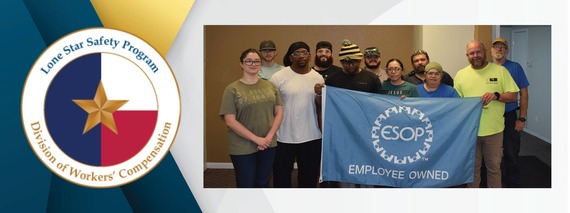
Congratulations to Laminate Technologies Inc. in Waco on receiving its first Lone Star Safety Award for an outstanding commitment to worker safety. This 13-employee facility manufactures high-quality laminated cabinets and shows how a small team can build a strong safety culture by focusing on injury prevention, open communication, and shared responsibility.
As a Lone Star Safety Award recipient, Laminate Technologies joins a select group of Texas employers recognized for maintaining low injury rates and continuously improving their safety and health programs. As part of the award, recipients receive an OSHA 10-Hour training class or a customized onsite training session from a DWC safety training instructor to support their ongoing efforts. Recipients are also often invited to share best practices as part of safety outreach across the state.
To learn how DWC can help strengthen your safety program, watch this video and explore available training, resources, and free consultation services at www.txsafetyatwork.com.

As highlighted in this issue, electrical hazards extend across workplaces — including those involving lithium-ion batteries. OSHA recently issued a Letter of Interpretation explaining when injuries from personal rechargeable lithium-ion batteries (such as those in e-cigarettes) used at work must be recorded on OSHA Forms 300, 301, and 300A (or equivalent logs). If a lithium-ion battery injury is work-related and meets one or more of OSHA’s general recordkeeping criteria, employers must include it on their injury and illness logs.
Lithium-ion batteries are common in tools, equipment, and personal devices, but they can create serious hazards, including fires, explosions, and exposure to harmful chemicals. Employers can reduce these risks by storing batteries in cool, dry areas, ensuring proper ventilation, using approved recycling methods, and training workers on safe handling practices.
OSHA Letters of Interpretation do not create new rules, but they help employers understand how existing requirements apply in specific situations and support stronger electrical safety practices and recordkeeping compliance. For more information on recording workplace injuries related to lithium-ion batteries, review OSHA’s news release.
|



