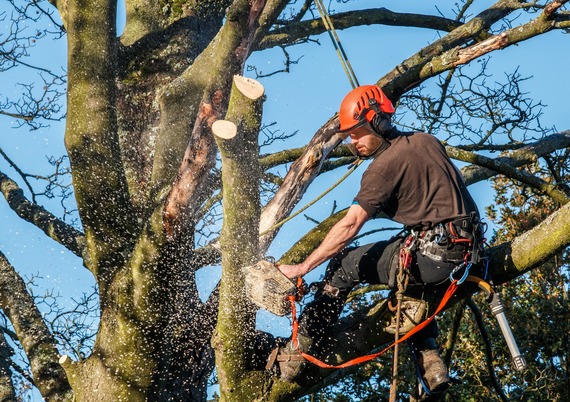
Tree work can turn deadly in seconds when crews rush, ignore power lines, or skip fall protection. Tree care incidents cause about 70 worker deaths and thousands of injuries each year in the United States. Learn how employers and crews can reduce these risks with these tips for safer tree trimming and removal.
Esta información también está disponible en español.

This week marks the National Safety Stand-Down to Prevent Falls in Construction, OSHA’s annual campaign to raise awareness about fall hazards and strengthen fall protection programs. Falls remain one of the leading causes of serious workplace injuries and deaths, making this week an opportunity for employers to talk with workers about preventing fall incidents.
The Stand‑Down is already underway, but it’s not too late to participate. Employers can hold short toolbox talks, review fall protection procedures with workers, inspect climbing and lift equipment, or discuss safe ladder practices.
OSHA offers free resources — including training programs, safety videos, and publications — to help employers lead Stand-Down activities. DWC also provides free workplace safety and health publications and videos. For help with fall protection training, and ladder safety training or other workplace safety topics, contact a DWC safety training specialist at 512-804-4610 or SafetyTraining@tdi.texas.gov.

Every 104 minutes, a worker in the United States died from a job-related injury in 2024, according to recent data released by the U.S. Bureau of Labor Statistics. In total, 5,070 workers died on the job in 2024, down from 5,283 in 2023.
Even with this improvement, some occupations still face much higher risks. The data shows that transportation incidents remain the leading cause of workplace deaths, responsible for about 38% of all fatal injuries.
Some of the jobs with the highest fatality rates include the following, along with examples of ways to help prevent deadly incidents:
-
Logging: Keep workers at least two tree lengths away from active tree felling. Maintain chainsaws and hydraulic equipment regularly.
-
Fishing and hunting: Require personal flotation devices on deck. Use weather alerts and emergency radio beacons.
-
Roofing: Many fatal falls occur when workers skip fall protection. Use proper tie-off systems every time.
-
Refuse and recycling collection: Wear high-visibility vests and keep the truck between workers and traffic when possible.
-
Aircraft pilots and flight engineers: Follow pre-flight checklists and support decisions to delay or cancel flights due to unsafe weather.
-
Construction helpers: Pair new workers with experienced mentors and hold regular safety briefings.
-
Truck drivers (heavy and tractor-trailer): Use electronic logging devices to prevent drowsy driving. Practice defensive driving.
-
Grounds maintenance workers: Use lockout/tagout procedures before clearing mower blades. Provide water, rest, and shade in hot conditions.
-
Agricultural workers: Install rollover protective structures on tractors. Never enter grain bins without a lifeline and trained observer.
-
Structural iron and steel: Train workers on fall protection and safe transitions between lifelines when working at height.
Strong safety programs can help stop these deadly events. Employers who look for hazards, train workers, keep equipment in good condition, and make sure workers follow safe work practices are more likely to prevent injuries and help workers get home safely at the end of each shift.
If you need help improving your safety program or want free, confidential onsite help with OSHA compliance, contact a safety professional in our Occupational Safety and Health Consultation (OSHCON) Program at OSHCON@tdi.texas.gov or 800-252-7031, or visit www.txoshcon.com.
Adapted from reporting by Industrial Safety & Hygiene News using data from the U.S. Bureau of Labor Statistics.

Workplace injuries can happen fast — but OSHA training helps workers recognize hazards before they become accidents. DWC’s OSHA-authorized 10-Hour Construction, 10-Hour General Industry, and 30-Hour Construction courses prepare Texas workers to identify the most common job-site dangers, understand OSHA rules, and build safer work habits.
Classes are taught by experienced OSHA-authorized instructors and are open to Texas residents or employees working in Texas.
Key details
- OSHA-10 Construction: Free.
- OSHA-10 General Industry & OSHA-30 Construction: $30 per person.
- Classes offered in English and Spanish.
- In-person and Zoom (online) options available.
- Photo ID and advanced registration required.
- Official OSHA class completion card provided within six to eight weeks after successful course completion.
Which OSHA course is right for you?
-
Step 1: Pick your industry. If you spend most of your day building or remodeling, choose an OSHA Construction course. If you mostly work in or for a facility that is already built — such as plants, warehouses, healthcare facilities, offices, delivery routes, oil fields, or utilities — choose an OSHA General Industry course.
-
Step 2: Pick a 10‑hour or 30‑hour class. If you are an entry-level or frontline worker who needs basic hazard recognition, worker rights, and job safety training, choose a 10-Hour course. If you are a supervisor, foreman, lead worker, or anyone with safety responsibilities who needs deeper training in hazard prevention, leadership, and OSHA compliance, choose a 30-Hour course.
Seats fill quickly — register early by clicking on a date below to secure your spot.
May and June 2026 classes
OSHA-10 Construction — Free
English:
Spanish:
OSHA-30 Construction — $30
English:
Spanish:
OSHA-10 General Industry — $30
English:
Spanish:
 Make safety a habit. Get the right training now to advance your career!
See the full 2026 training calendar here.

Congratulations to CMI Inc., doing business as Corrosion Materials in Houston, for earning its fifth Safety and Health Achievement Recognition Program (SHARP) certification.
This recognition from the U.S. Department of Labor honors small employers with safety and health programs that go beyond OSHA requirements. Corrosion Materials earned its fifth SHARP certification, covering seven years. The newest recognition gives the company a one-year exemption from programmed OSHA inspections during the certification period while it continues its proactive safety efforts.
The company, which supplies corrosion-resistant alloy products to the chemical processing, oil and gas, and power generation industries, worked with DWC’s OSHCON Program consultants Jim Beare and Binny Joseph to strengthen its safety systems and maintain this achievement.
To learn more or request free, confidential onsite OSHA compliance help, visit www.txoshcon.com or call 800-252-7031.
|



