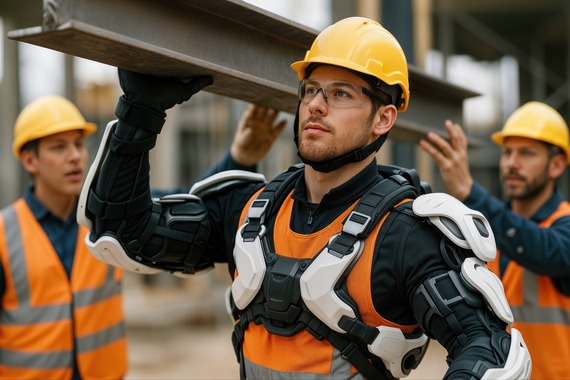
Exoskeletons may bring to mind fictional robotic superheroes, but in the workplace, they can cut muscle strain up to 44% — helping workers stay safer, stronger, and more comfortable on the job. These tips can help you get the most from this high-tech safety gear.
Esta información también está disponible en español.
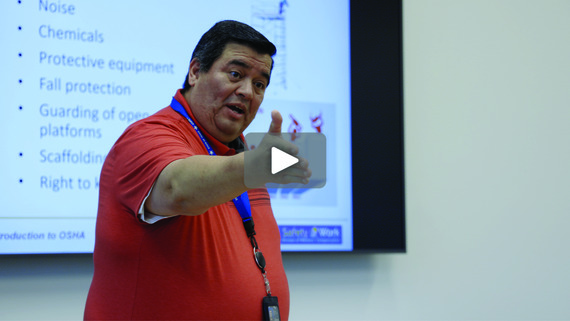
Meet Raymond Provencio, safety training and inspections manager at DWC.
Growing up in Arizona, Ray learned the value of hard work from his father, who spent long days in a copper mine. As a teenager, Ray took whatever jobs he could find — cleaning construction sites, changing tires at the old Western Auto Store. He saw how proud his father and others were of their work, but also the risks they faced daily.
“I remember my father cleaning car parts with no gloves or eye protection, just his bare hands,” Ray recalls. “That image stayed with me.”
Ray’s understanding of safety deepened during his time in the U.S. Air Force, where he supervised a crew. One day in England, while rushing to finish an aircraft repair before a cookout, he made a choice he’ll never forget.
“We needed to remove a fuel tank from the wing, and part of the process was draining leftover fuel. I decided to skip that step. Some crew members spoke up, but I didn’t listen — and I wasn’t wearing the right safety gear,” he says.
When the tank came off, fuel splashed into Ray’s eyes. Quick action by his team got him to an eyewash station and the base clinic, but the incident nearly cost him his sight.
“That moment changed how I think about safety,” Ray says. “It’s not just a checklist. It’s a way of working that starts with leadership and doing the right thing, even when it’s inconvenient.”
Turning lessons learned into safer workplaces
Today, Ray leads a team of safety professionals that delivers OSHA-authorized courses and customized safety training to Texas workplaces — on your jobsite or at a DWC location. His trainers, with backgrounds in industries like construction, manufacturing, and energy, share real-world experiences and solutions that help teams work safer, prevent injuries, and protect the bottom line.
“When safety becomes part of your culture, it saves lives, prevents downtime, and cuts costs,” Ray explains. “It’s the right thing to do, and it’s smart business.”
Get started today
Ray’s team offers affordable, customized training and other workplace safety resources to meet your organization’s needs. Contact DWC safety training specialists today to create a safer workplace, improve operations, and protect your most valuable asset: your people.
Courses include:
- OSHA 10-Hour General Industry or Construction.
- OSHA 30-Hour Construction.
- Fall Protection.
- Forklift Operator Safety.
- Lockout/Tagout (Control of Hazardous Energy).
- Hazard Communication (HazCom/GHS).
- Safety Leadership.
- Cardiopulmonary Resuscitation (CPR), and much more.
For a complete list of courses, see our English course descriptions or Spanish course descriptions. We can also design fully customized training to meet your specific workplace needs.
For more information, email SafetyTraining@tdi.texas.gov, or call 800-252-7031, option 2.

Get the safety training you need at no cost! DWC is offering FREE OSHA 10-Hour Construction classes in English and Spanish, in cities across Texas and online. Learn how to recognize and prevent jobsite hazards, meet OSHA standards, and earn your official OSHA 10-Hour card.
Get hands-on learning from OSHA-authorized instructors. To register, you must be a Texas resident or work in Texas and be able to understand the language of the course. Space is limited, so register now to save your spot.
Upcoming classes:
October 2025
Important: Advanced registration is required due to limited seating. All participants must show a photo ID.
For more information email: SafetyTraining@tdi.texas.gov, or call 512-804-4610.

September is National Suicide Prevention Month — a time to face a difficult truth: Construction workers die by suicide nearly four times more often than those in other industries. No one should have to struggle alone.
Why are construction workers at risk? The job is tough on both body and mind. Long hours, physical demands, job uncertainty, and a culture that says "tough it out" can take a serious toll. Add financial worries and time away from family, and the stress can feel overwhelming.
You are not alone. If you or someone you know is struggling, there is help:
-
Call 988 or text "HELLO" to 741741 - The national crisis lifeline is free, confidential, and available 24/7.
-
OSHA Suicide Prevention - Visit osha.gov/preventingsuicides for workplace resources and safety information.
-
Construction Industry Alliance for Suicide Prevention – Go to preventconstructionsuicide.com for industry support and training.
Watch out for each other. Creating a workplace where people can talk about mental health saves lives. If you notice someone struggling, reach out, listen, and connect them with help. Break the silence today.

A new school year has begun, and roads are busier with students and buses. Now is the time for all drivers to use extra caution in school zones.
For all drivers:
- Slow down in school zones.
- Watch for children crossing streets, especially near schools and bus stops.
- Never pass a stopped school bus that is loading or unloading children.
- Obey school crossing guards and posted speed limits.
For school bus drivers:
- Always do a pre-trip inspection of your vehicle.
- Watch for students as they get on and off the bus.
- Stay alert for other drivers who may not stop when they should.
- Follow safe driving practices, including the rules for railroad crossings and proper use of flashing lights.
Everyone plays a role in protecting children on their way to and from school. Let’s keep our roads — and our kids — safe. For more safety tips, check out DWC’s Back-to-School Safe Driving publication in English or Spanish.
|



