 Critter Highlight - Corn Snake (Pantherophis guttatus)
Native to the southeastern United States, the corn snake (also known as the red rat snake) is one of the most recognizable and widely studied nonvenomous snakes in North America. Known for its calm temperament and adaptability, this species has also become popular in educational settings and the pet trade. Selective breeding in captivity has produced a wide variety of color and pattern variations, expanding opportunities for close observation and learning.
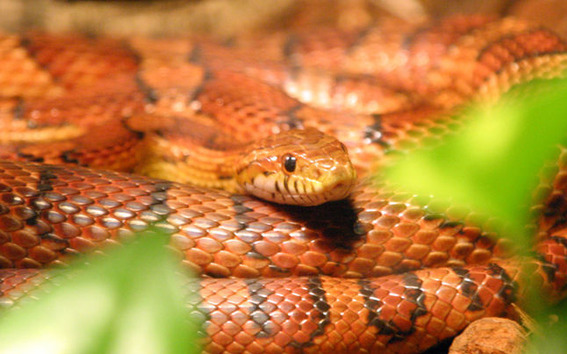
The corn snake gets its name from the distinctive pattern on its belly scales, which resemble kernels of maize, or “Indian corn.” In the wild, individuals typically display dark orange or deep red saddle-shaped blotches set against a gray or straw-colored background. This coloration provides excellent camouflage among leaf litter and forest debris.
Corn snakes are oviparous, meaning they reproduce by laying eggs. A single clutch may contain anywhere from 3 to 40 eggs. Adults have slender yet muscular bodies and can reach lengths of 5 to 6 feet. With round pupils and primarily nocturnal habits, they are most active during the evening and nighttime hours.
Their natural habitats include woodland edges, open fields, and scrublands. Corn snakes are also commonly found near abandoned buildings or other structures that attract rodents, which make up the majority of their diet. As powerful constrictors, they prey on small mammals and occasionally other reptiles.
When threatened, corn snakes exhibit defensive behaviors such as rapidly vibrating their tails and coiling their bodies into an “S” shape, a posture that signals readiness to strike. These behaviors, along with their ecological role as rodent population controllers, make corn snakes an excellent subject for studying adaptation, predator–prey relationships, and animal behavior.
Did You Know?
- Corn snakes are nonvenomous and rely on constriction to subdue their prey.
- They are excellent climbers and can often be found in trees or rafters while hunting.
- Corn snakes help humans by naturally controlling rodent populations.
- Their calm nature makes them one of the most commonly used snakes in classroom education programs.
For more information about these and other animals, visit the student safe resource: TexQuest (Login needed)
Bring these fascinating reptiles into your classroom with a two-week checkout from the Learning Alive Cooperative Materials Center.
|