|
May is National Water Safety Awareness Month! With summer approaching and warmer temperatures on the way, it is crucial to stay alert and follow the necessary precautions. Water safety awareness highlights the importance of public education about safer practices for both kids and adults in and around all types of water.
As the weather improves, kids will be eager to head outside and swim. Each year in the United States, 3,572 people die from drowning, with 945 of those being children. Children account for 1 in 4 drowning deaths, and these incidents are particularly common during the summer months. Now is an excellent time to review important safety tips to protect your family.
According to the Texas Department of Family and Protective Services, 103 kids have drowned in Texas in 2024 alone. Drowning is a leading cause of accidental death for children under the age of five, and toddlers are especially at risk. Drowning can occur in any amount of water, whether indoors or outdoors, making it essential to recognize potential dangers and follow safety guidelines. Here are some tips to keep your family safe while enjoying various water activities.

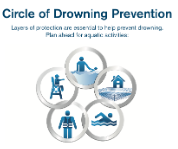
The Basics: Be Water Smart and Use Layers of Protection In & Around Water
-
Be a “water watcher” – provide close and constant attention to children you are supervising; avoid distractions including cell phones.
- Teach children to always ask permission to go near water.
Take specific precautions for the water environment you are in, such as:
- Fence pools and spas with adequate barriers, including four-sided fencing that separates the water from the house.
|

6 Essential Water Safety Tips
-
Provide Constant Adult Supervision- Actively supervise children and non-swimmers around the water, even when lifeguards are present. Don’t just drop kids off. Avoid distracting activities such as checking email or social media
-
Learn to Swim — No matter your age, learning to swim is one of the best ways to be safer in and around the water.
-
Look for Lifeguards — Swim in designated areas supervised by lifeguards.
-
Swim with A Buddy — Do not allow anyone to swim alone. Even at a public pool or a lifeguarded beach, use the buddy system.
-
Wear A Life Jacket — Adults and kids should always wear a properly-fitted U.S. Coast Guard-approved life jacket while boating. Non-swimmers and inexperienced swimmers should also always wear a life jacket when in and around the water. Inflatable toys can be fun but are not a substitute for U.S. Coast Guard-approved life jackets.
-
Learn CPR — Learn how to prevent and respond to emergencies by learning CPR.
|
 |
|
|
Water Safety Tip: Don't Rely on Water Toys
Never use water toys to protect weak swimmers - this includes water wings, noodles, floaties, or inner tubes. Air-filled or foam toys are not safety devices and are not designed to keep swimmers safe. U.S. Coast Guard-approved life jackets are the only water safety devices that are certified to protect children.
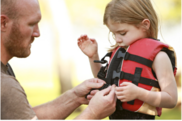
If you're on a boat or a dock or near a body of water, children should wear life jackets. The law says all children under 12 must wear a life jacket while boating, and for good reason - studies show that potentially half of all boating deaths might have been prevented with the use of life jackets. Also, life jackets only work well when they are worn correctly.
- Make sure the life jacket is the right size.
- Follow the manufacturer's instructions - all straps should be fastened, and the life jacket should not be loose.
Anytime you are on a boat, adults should set a good example and wear a life jacket, too.
|
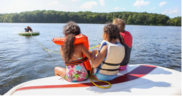
Water Safety Tip: Be Safe Around Open Water
Texas is full of beautiful creeks, ponds, lakes, rivers, and beaches that offer lots of opportunities to make fun family memories. Before you go to an outdoor water area, be sure to talk with your children about water safety. Make sure kids know how important it is to follow all the rules and to never swim or play in water alone and always go with a buddy. Once you arrive at your recreation area, make sure you appoint an adult to be the Water Watcher.
Water Safety Tip: Open Water Do's and Don'ts
Pay attention to signs and swimming area boundaries, and make sure you follow the specific water safety rules of the area that you're visiting.
Do's - Tell your child to:
- Always swim with a buddy-that goes for adults, too.
- Stay within the designated swim area.
- Watch for swim condition flags or signs.
- Enter the water feet first every time.
- Always wear a life jacket when on a boat or swimming in open water.
- Be aware of currents. If they're caught in a current, swim parallel to the shore until they can get free.
Don'ts:
- Don't let kids of any age roughhouse or race each other across water.
- Don't let kids swim around boats or other watercraft.
- Don't let kids swim in murky water or near drop-offs.
- Tell your child to never dive off swim platforms or into murky water.
- Tell your child to not play or swim in ponds, streams, gullies, ditches, canals, etc.
|
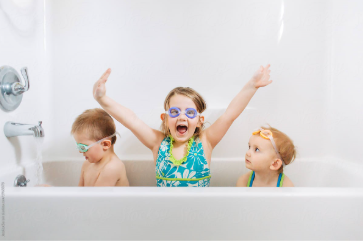
The most important safety rule is: Never leave a young child unattended in the bathroom. This is especially important during bathing. Even a child who appears to be well propped in a safety tub or bath ring can slip down and drown. This can happen in seconds. Most bathtub drownings or accidental burns happen when a child is left unattended, even briefly.
Water temperature also is important. Hot water can be dangerous, particularly for kids younger than 5. Their skin is thinner than older kids' and adults', so can burn more easily. Just 3 seconds of exposure to tap water that's 140°F (60°C) can cause a third-degree burn.
You can reduce the risk of scalding by setting the water heater thermostat in your home to 120°F (49°C) and by always testing the water with your wrist or elbow before placing your child in the bath.
Preventing slips. Bathtubs can be slippery places. To keep kids safe, you can put anti-skid strips on the bottom of the tub or use a plastic bath mat that adheres to the tub. Put a rubber cover (or a washcloth) over the faucet to avoid injuries if your child bumps into it.
Eventually, kids want to take unsupervised baths. Kids mature at different rates. Some might be ready to be left alone in the tub at age 6 or 7, while others need mom or dad nearby longer. Of course, older kids and teens should be given privacy in the bathroom.
Toilets. Bathtubs aren't the only bathroom water hazard. To keep young kids safe, install a toilet-lid locking device and keep bathroom doors closed at all times (or you may want to install a doorknob cover), and promptly wipe up any water spills whether from the tub, sink, or toilet to prevent falls.
More than half of all infant drownings (under age 1) happen in bathtubs. Supportive baby bathtub "rings" don't prevent drownings if the child is left unsupervised. Water hazards in and around the home may include:
- Ice chests with melted ice
- Hot tubs, spas, and whirlpools
- Ponds and decorative garden fountains
Small children can drown when they lean forward to look into a bucket or open the toilet. The head is the heaviest part of a small child so it's easy for the child to fall over into a container. Containers filled with liquid often weigh more than the small child and won't tip over when the child falls in.
|
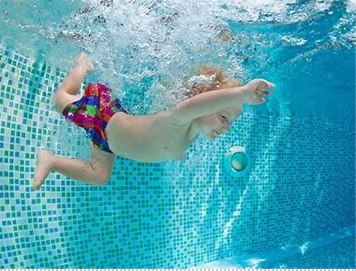
Water Safety: Pools and Waterparks
Secure Your Pool When Not in Use:
- Completely surround your pool with four-sided isolation fencing with a self-closing and self-latching gate that is out of the reach of a child.
- A four-sided isolation fence (separating the pool area from the house and yard) reduces a child’s risk of drowning 83% compared to three-sided property-line fencing.
- For above-ground pools, secure, lock or remove steps, ladders and anything that can be used for access (such as outdoor furniture and toys) whenever the pool is not being actively supervised by an adult.
Install a secondary barrier, such as:
- Door alarms and locks that are out of the reach of a child on all doors and windows with direct access to the pool or spa area.
For further details, consult the pool barrier guidelines issued by The United States Consumer Product Safety Commission.
Establish and Enforce Rules and Safe Behaviors
- Do not enter head first unless in a pool that has a safe diving area.
- Stay away from drains and other openings that cause suction.
- Only swim when supervised by a water watcher.
- Supervise others sober and without distractions, such as reading or talking on or using a cell phone.
"It's most common in older pools, but it is possible for small kids to get suctioned to the bottom of a pool by a strong drain," says Dr. Finkelstein.
They can be somewhat mesmerizing to children, but don't let kids play with or around a pool drain. If you own a pool, make sure all drains are protected by an anti-entrapment drain cover.
Keep All Kids Safer by Following These Water Safety Tips | Pool Safely
Teach children not to play or swim near drains or suction outlets, especially in spas and shallow pools. Powerful suction from a pool or spa drain can even trap an adult.
-
Never enter a pool or spa with a loose, broken or missing drain cover. Children’s hair, limbs, jewelry, or bathing suits can get stuck in a drain or suction opening.
-
Locate the emergency vacuum shutoff before entering a spa.
-
Ensure pools and spas have federal safety standard compliant drain covers. Virginia Graeme Baker, after whom the Pool and Spa Safety Act is named, died from drowning due to a faulty drain cover. All public pools and spas must have drain grates or covers meeting safety standards.
|
Stay Alert: Know What to Do in an Emergency
- If a child is missing, check the water first: seconds count in preventing death or disability!
- Alert the lifeguard, if one is present.
Recognize the signs of someone in trouble and shout for help. A swimmer needs immediate help if they:
- Are not making forward progress in the water.
- Are vertical in the water but unable to move or tread water.
- Are motionless and face down in the water.
- Rescue and remove the person from the water (without putting yourself in danger).
- Ask someone to call emergency medical services (EMS). If alone, give 2 minutes of care, then call EMS.
- Begin rescue breathing and CPR.
- Use an AED if available and transfer care to advanced life support.
|