|
Each month, PEI shares a variety of information for professionals, families, parents and children to support strong and thriving families.
For more information about PEI and its programs visit us online.

Tomorrow is Go Blue Day in Texas to raise awareness for Child Abuse Prevention Month, which takes place throughout all of April. The DFPS Executive Leadership Team also recognized Go Blue Day by creating a video about why they wear blue and the importance of these efforts. PEI’s very own Sasha Rasco kicks off the video by asking “Why do you go blue?” Watch the video below and continue to wear blue and raise awareness through the rest of the month!
PEI Social Media Toolkit
April is Child Abuse Prevention Month (CAPM), and we want your help to empower communities with resources to support Texas children, youth, and families where they live, work, and play!
This toolkit includes daily messages to use in promoting child abuse prevention awareness, CAPM resources, and sample CAPM imagery to share and post.
PCAA Toolkit
This year, Prevent Child Abuse America (PCAA) is embracing the theme “Building A Hopeful Future, Together,” focusing on creating a nurturing and supportive environment for children and families across the nation.
Visit PCAA's website to learn more tools and tips to ensure that every child has the nurturing environment they deserve for a better future.
Brazos County
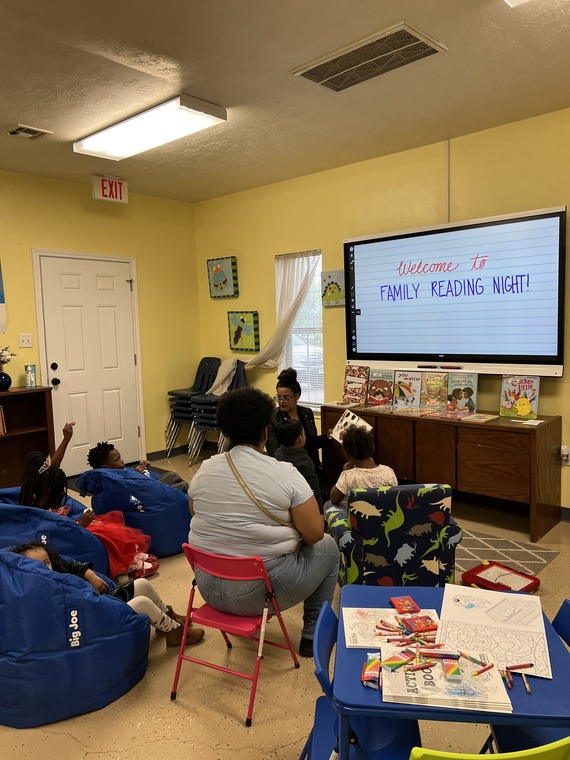
Unity Partners and members of the Parent Advisory Council hosted a Family Reading Night on March 22nd at the Family Resource Center. This event was an opportunity to focus on the Protective Factor of Family Strengthening by reading and creating an interactive experience for the children.
All families involved thoroughly enjoyed the experience and can't wait to have another one!
Starr County
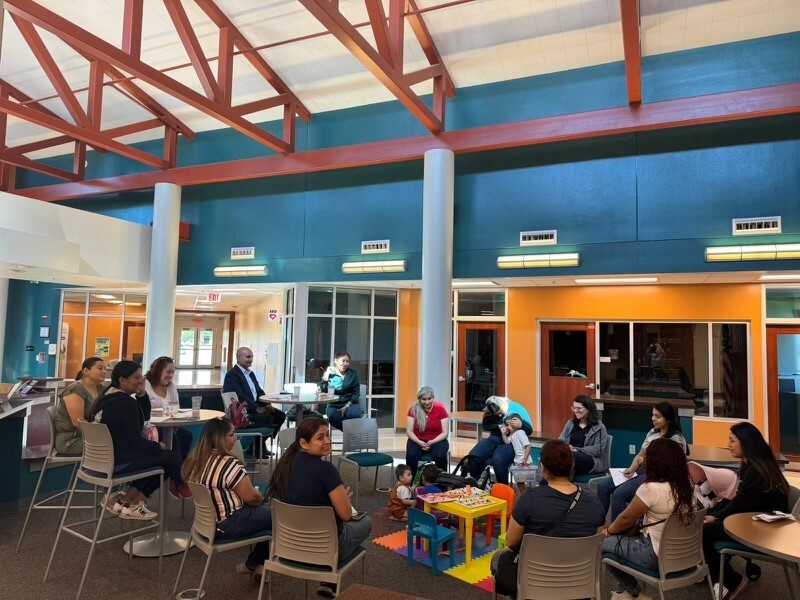
The Starr FRC held its first Coffee Talk on March 22nd with a great turnout of STC participants and community members, including the Campus Administrator, Dr. Montiel, who stopped in to participate. First initiated as an informal gathering at the Hidalgo FRC last year, the Coffee Talk uses peer-to-peer engagement to discuss parenting topics, stressors, ideas, and may invite a facilitator to the guide the conversation.
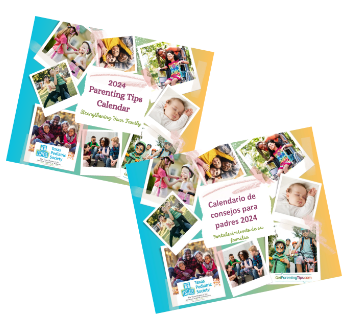
The 2024 Calendars are now available for order. This free family resource is filled with helpful tips for parents and caregivers of children of all ages. It’s available in English and Spanish, and endorsed by The Texas Pediatric Society.
Calendars can be ordered in multiples of 100 with a maximum order of 500.
The Texas Health and Human Services Commission (HHSC) has released a Request for Information (RFI) to obtain feedback and information about the Early Childhood Intervention (ECI) program from interested stakeholders. The 30-day response window closes on April 24, 2024. Respondents may submit questions and requests for clarification until April 9, 2024.
HHSC encourages all stakeholders, but especially current subrecipients, to provide specific, detailed information and data on the topics included in the RFI.
HHSC cannot address questions about the RFI outside of the formal process. Please see the RFI for more information.
The RFI may be accessed through this link:
In most states, the prevention of child abuse and neglect is limited to services
provided after maltreatment occurs and once the family is involved with child
protective services.
The Texas Department of Family and Protective Services (DFPS) sought to end this cycle by creating a division solely devoted to addressing risk factors that
lead to abuse and neglect. Rather than waiting for a child to be harmed before
intervening, the division of Prevention and Early Intervention (PEI) applies a
public health approach to keeping children safe: providing population-based
services to all families; normalizing a parent’s need to seek help; and instilling a
collective sense of responsibility for the safety and well-being of all children.
As parents we want the best for our kids. GetParentingTips.com is here to support you with tips from infants to teens.
Celebrate Earth Day with PEI
The first Earth Day was celebrated on April 22 in 1970! It was founded by Wisconsin Senator Gaylord Nelson and organized by Denis Hayes with a goal to get the youth involved in environmental activities. Since the 1990s, more than 190 countries and up to 95% of schools in the US participate each year. Below are activities that can be done at home or outside:
-
Step Out and Explore: A nature walk is a great Earth Day activity! It doesn’t need to take long and it’s great for children of any age, as it gives them a hands-on opportunity to learn more about their environment and the creatures that inhabit it. Encourage your children to look out for plants and animals, which they can identify while on the walk.
-
Get Your Eyes to the Skies: Bird watching encourages your child to observe nature, see different species, and appreciate birds in their natural habitat. You can choose to use binoculars, cameras, or both when out birding, depending on the age of your child and their level of experience. Bird watching facilitates can stimulate curiosity and excitement about nature.
-
Eco-Friendly Fun: Tap into their creativity by having them do an art project using recycled materials in your home. Recycled materials such as cardboard boxes, tubes, scrap paper, or any other item that won’t be used for anything else can be used to create something fun!
-
Growing Green Thumbs: Planting seedlings is a classic Earth Day activity and a great way to teach about plants vital role in our environment. First, research with your child the local plants, flowers, and trees that will grow appropriately in your climate. Second, start seedlings in newspaper cups or empty cardboard egg cartons — using items made from trees! Demonstrate how to dig a hole, place the seedling in it, and cover it with soil. Explain the importance of watering a seedling regularly and providing it with enough sunlight. You’ll get a chance to teach about decomposition and reusing materials simultaneously with this activity. The seedlings can be kept in indoors for to watch it grow, then planted outside.
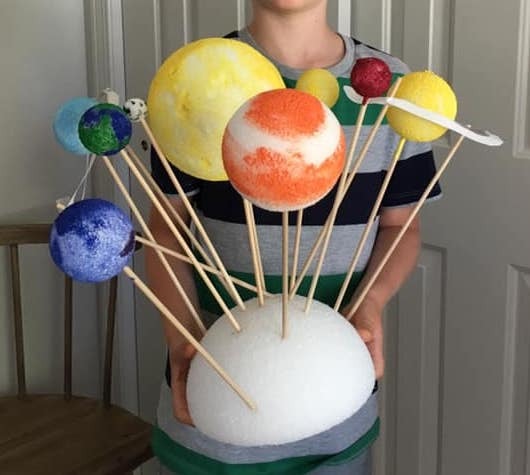 |
Materials You'll Need:
- Paint (red, orange, yellow, green, blue-green, dark blue, cobalt blue, light blue, white and black)
- 8 Small Styrofoam Balls (these will be the planets).
- You’ll need the following sizes: 5, 4, 3, 2 ½, 2, 1 ½ and 1 ¼ inches. Make sure you have two each of the 1 ½- and 1 ¼-inch balls.
- 10-inch Styrofoam Ball (this will be the base of the solar system)
- Wooden Dowels or Skewers (these will suspend the planets)
- Styrofoam Sheet, Pipe Cleaners, Cardboard or Colored Paper (this will make Saturn’s rings)
- Scissors
Instructions:
-
Stick the skewers or dowels about halfway through all balls except the 10-inch one.
-
Add detail to your planets by painting them. Do some research to decide exactly how you want to make each one look. For starters:
-
SUN — 5-inch ball, bright yellow
-
MERCURY — 1 ¼-inch ball, orange
-
VENUS — 1 ½-inch ball, blue-green
-
EARTH — 1½-inch ball, dark blue with green highlights
-
MARS — 1 ¼-inch ball, red
-
JUPITER — 4-inch ball, orange with red and white stripes. Be sure to add the Great Red Spot in the correct area with red paint.
-
SATURN — 3-inch ball, yellow-orange
-
URANUS — 2-inch ball, cobalt blue
-
NEPTUNE — 2 ½-inch ball, light blue
-
Make the stand. While you wait for the planets to dry, make the stand for your model. Cut the 10-inch ball in half, creating a dome with a flat bottom. Once all the planets are dry, stick them into the dome so each of them is arranged according to its order in the solar system. Optional: You can paint or decorate the dome too.
Safety Articles
In the spirit of Child Abuse Prevention Month, we encourage you to view the Safety tips on GetParentingTips.com!
|