|
In this issue:
The Community Youth Development (CYD) program contracts with community-based organizations to develop juvenile-delinquency prevention programs in ZIP codes with the highest juvenile crime rates for youth in Texas.
CYD is part of the Prevention and Early Intervention (PEI) division’s public-health approach to promoting healthy children, families, and communities. PEI works to prevent child maltreatment by increasing youth protective factors, building resilience in youth, and addressing underlying issues such as poverty, substance abuse, and mental health.
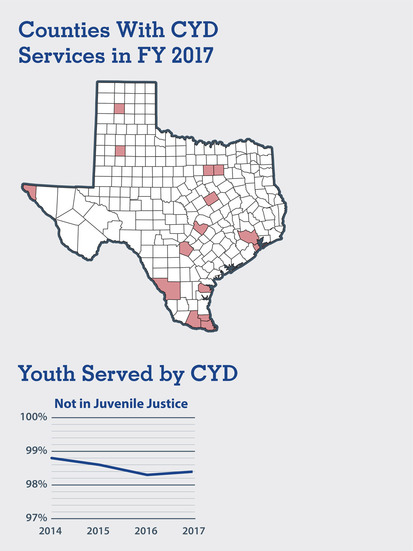
In FY2017, PEI expanded CYD, adding six ZIP codes to its services area. Overall, 15,159 youth were served by the program. More than 98 percent of those served did not subsequently enter the juvenile justice system.
Program Innovation
Some of the program services include youth and family-based curriculums and activities, recreational and academic support services, life skills classes, mentoring, and youth leadership development.
Examples of innovations within the program include:
- The Boys and Girls Clubs of Greater Fort Worth provides a music program for teens, where they learn how to read and write music, play instruments, and use computer equipment to record their compositions.
- In Amarillo, a program participant was concerned about the stress and anxiety affecting students gearing up to take the STAAR exam. With the help of CYD resources, she worked with her peers to set up a hotline for students to be able to talk through their worries.
-
In El Paso, CYD youth participated in Camp CEO, where girls spent the day working with female CEOs, taking personality and career tests, participating in mock job interviews, and having a formal sit-down dinner with their new mentors.
Program Value
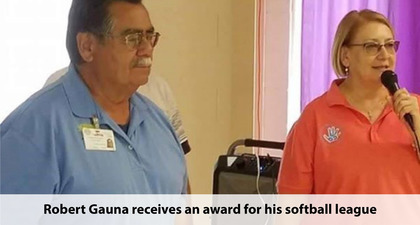
We know from the feedback that participants see the value in CYD programs. For example, long-time volunteer Robert Gauna of El Paso runs a charity softball league for young women as part of CYD and says many students who participated in the league as youth later become coaches in his program as adults. Some even have their own kids tag along.
Gauna says the program helps keep youth busy and gets them involved in the community, so they stay away from problem behaviors. Additionally, he focuses his energy on helping program participants get into college. Many of his players have problems at home, which makes them feel like they aren’t good enough to accomplish great things. He says it makes him feel good when the day is over to have worked helping youth.
Helping the Community
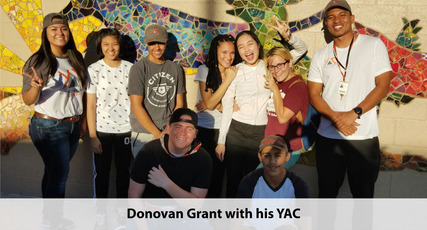
Donovan Grant is a paid team coordinator with the CYD program in El Paso. He helps youth run the Youth Advisory Committee (YAC) and uses his life experiences to connect with the youth leaders in his program. The YAC visits nursing homes, helps at child crisis centers, and plants gardens in the community. Just like Camp CEO, Grant works with his youth on developing job-seeking skills. They visit the university radio station to practice public speaking, including mock interviews on the air.
One of Grant's youth recently acknowledged the El Paso YAC during his valedictorian speech for having such a positive impact on his life. The committee members help each other out, so that they know they aren’t the only ones going through tough times as youth.
With successful programs like CYD, PEI continues to strengthen families, and expand initiatives designed to prevent child abuse, juvenile delinquency, and promote positive outcomes for children.
Back to top
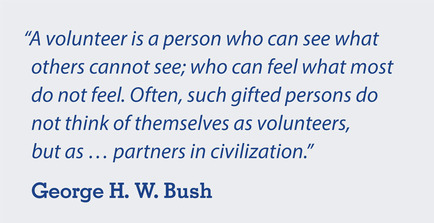
Vital in our mission to protect the most vulnerable Texans, DFPS volunteers accomplish selfless acts across our great state every day.
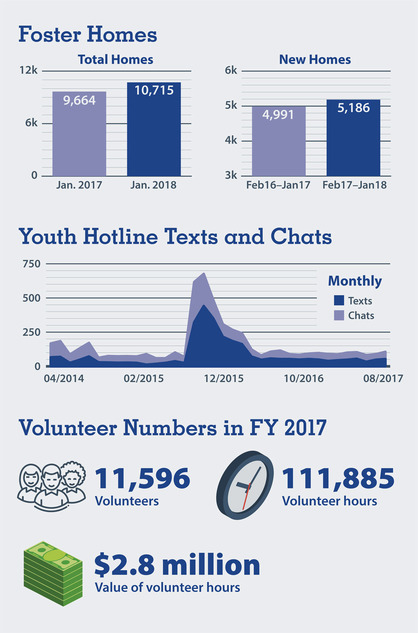
Whether it's helping increase foster care capacity, ensuring children in state care have their own personal belongings, raising awareness of elder abuse, or answering phone calls from youth in crisis, our volunteers donated over 111,000 hours in FY2017, a $2.8 million value.
Helping From Day One
Chaparral Hills Baptist Church, in Amarillo, donated a house to help with foster care capacity in their region. In cases where DFPS cannot find an immediate placement for a child just removed from their home, the child can stay at the house temporarily.
Volunteers furnished and decorated the home to make it welcoming for children whose lives are now in turmoil. This allows foster youth to spend their first night away from their own home in a warm and inviting space. Volunteers at the church also provide care bags, backpacks with a blanket, toiletries, books, and snacks. This ensures that youth who stay in the home are sure to have something of their very own as they leave to enter foster care.
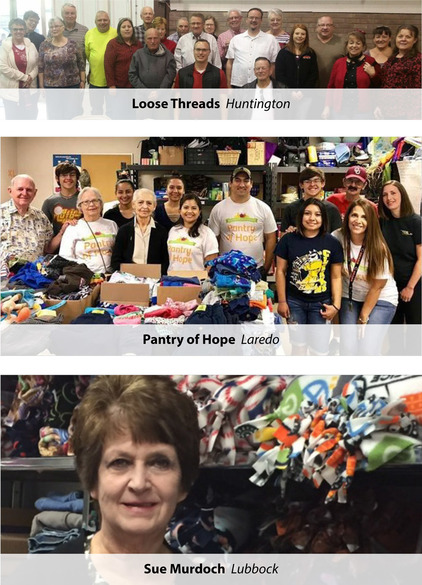
Pantry of Hope volunteers from First Baptist Church in Laredo have also identified care bags as comforting and practical for youth in our care. Pantry of Hope was created by the church to help families receiving services from DFPS. Volunteers collect backpacks and duffel bags, stock them with clothing, books, and toiletries and donate them to their local Rainbow Room.
Hunter Beaton in Boerne is another volunteer who understands the value of these bags, which he calls day one bags. After seeing his foster siblings join his family with only a trash bag of belongings, he was determined to change the situation for the better.
Beaton started the effort as an Eagle Scout project to fill 100 new bags, but he wanted to make the project sustainable. So, he partnered with the Texas Council of Child Welfare Boards and is now operating in eight counties so far.
Blankets Make a Home
Other volunteers have found creative ways to help children in foster care. Loose Threads is a volunteer group in Huntington that meets once a week to make handmade clothing and stuffed animals for children in foster care.
The volunteers also create personalized blankets for all children being adopted in their region. With the help of their church, Huntington United Methodist, they also supply their local Rainbow Room with needed items.
Sue Murdoch in Lubbock had the same idea. With the help of a youth group at her church, she prepares fabric for blankets. Then she takes the fabric to the local women’s correctional facility, and working with the prisoners there, finishes assembling them.
Not only do those women experience the joy of helping others, but their work and love benefit children in foster care.
Back to top
Did you know there is a phone number parents and youth can call for help with problems at home?
Established in 1973, the Texas Youth Hotline is a prevention program that helps youth and their families 24 hours a day, seven days a week, 365 days a year. Staff and trained volunteers use a database of over 2,500 resources to provide referrals for issues such as running away, bullying, and family conflict.
Volunteers provide crucial support to the hotline and help callers know there is a light at the end of tunnel. Depending on the volunteer’s comfort level, they train for 8 to 16 hours and always have a paid staff member on call to help them as needed.
Jeanna Keener, volunteer services coordinator, started out with the hotline as a volunteer intern. She felt a sense of pride working for the hotline and making such a difference in the lives of youth in crisis who called her looking for help. Now she leads a team of volunteers who answer calls and texts from youth in crisis. She points out receiving texts and instant messaging is even more important now than when the capability was added four years ago. According to Keener, youth feel a little more confident asking for help in this way, and the sense of anonymity also increases the likelihood they will reach out.
To help as many struggling parents and youth as possible, DFPS promotes the hotline on a regular basis. After an outreach push, the hotline experiences an increase in the number of calls and texts received. This uptick in calls can make things hectic at the hotline, and Keener hopes to add interns and volunteers to help with the increase in volume. The next promotion will run from May to August of this year.
For more information about how to volunteer with DFPS, visit our website.
Back to top
This year, DFPS added direct-service volunteer opportunities.
Expanding the role that volunteers play in the community helps provide additional support to children, their families, the elderly, and people with disabilities.
Activities such as hospital sitting, providing transportation, and helping to deliver medication enable the community to work hands-on with the people DFPS serves. In the first month, over 314 people inquired about how to help their fellow Texans in this new capacity.
“Seeing children on quite possibly the worst day of their lives, and showing them love and kindness, is something that I will never be able to explain. I want them to remember there are people that care for them – even complete strangers.”
Kimberly, volunteer
“I really loved the time I spent with a young man who was understandably wanting to be anywhere but the hospital. I sat with him for several days, mostly in silence, but the few words we did exchange were hopefully enough for him to know he’s loved and that someone believes in him.”
Shea, volunteer
“When I volunteer I put my worldly emotions and thoughts on hold. I am not thinking about myself, but am working to care for someone else. Children who are separated from their families have to grow up really fast. I don’t want my life to be in vain simply because I didn’t stop to see and care for people that God has placed upon this earth!”
Yolanda, volunteer
Back to top
May is Elder Abuse Prevention Month.
We are asking all Texans to please take some time to learn about elder abuse, recognize the signs, and find out what you can do to help. Preventing abuse, neglect, and exploitation of older Texans and those with disabilities is “everyone’s business.”
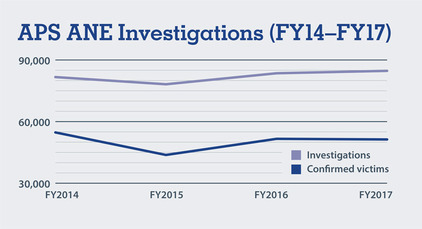
Last year, DFPS completed 84,712 investigations and confirmed 51,314 victims of abuse, neglect, or exploitation of older Texans or those with disabilities. DFPS not only investigates allegations, but also provides services to prevent further maltreatment. Like child abuse and neglect, DFPS cannot address this issue alone. Communities, stakeholders, and other government agencies must work together to protect our most vulnerable Texans.
When an older person becomes ill or depressed, that individual may not be able to care for themselves without some help. That’s when a caring person needs to call the Texas Abuse Hotline at 1-800-252-5400 or make a report online at txabusehotline.org.
Each May, DPFS hosts workshops, presentations, and caregiver support events to engage people and challenge them to take part in addressing the problem within their community.
For a list of upcoming events, visit EveryonesBusiness.org.
Back to top
A community-based model for foster care and case management services.
Community Based Care (CBC) aims to benefit foster children by placing them in their home communities and serving them in the least restrictive, most family-like setting possible. Last year, the Legislature, through Senate Bill 11, gave DFPS direction to expand CBC from Region 3B, west of Fort Worth, into four additional catchment areas. DFPS will expand CBC next to Region 2 (Abilene, Wichita Falls, and surrounding areas) and Bexar County in 2018.
Improving Local Partnerships
It all comes down to achieving positive outcomes for youth in foster care because a local contractor, known as a Single Source Continuum Contractor (SSCC), develops close relationships with local providers to increase the number and capacity of foster homes available locally. Plus, DFPS uses a performance-based contract with the SSCC which will improve overall accountability.
For example, the Region 3B SSCC, Our Community, Our Kids (OCOK), worked with a partnership of local churches, caseworkers, Court Appointed Special Advocates, and child-placing agencies, to highlight a 10-year old boy in foster care at their adoption matching event. One of the participating churches became the boy’s sponsor, created a video, and presented him to their congregation. When a family stepped forward, they were immediately connected with a child placing agency to become licensed to adopt. The boy was adopted within a year, thanks to the coordination of the SSCC and a local network of stakeholders all working together.
Improving Local Services
During stage one, the SSCC is responsible for:
- Improving capacity in the community to ensure we have the right kinds of placements for kids.
- Building a network of providers.
- Identifying placements and placing children and youth in homes and other living arrangements.
- Engaging the community to help.
- Coordinating and delivering services to youth.
After the SSCC demonstrates an ability to successfully manage these responsibilities, DFPS will transfer case management services. The SSCC will use this same community-based approach to serve the relatives and families of children in care. DFPS will retain all its investigative functions and focus on quality oversight.
In Region 3B, the results were promising in the first two years (FY 2015 - FY 2016) with a 20 percent increase in foster homes available and a 30 percent increase in therapeutic foster homes. With the right support, therapeutic foster families care for youth who might have otherwise been placed in a residential treatment center. Demand for therapeutic foster care continues to grow as the national focus on less restrictive settings intensifies.
Still, some children and youth need the types of services only offered at a Residential Treatment Center (RTC). So, the region’s first RTC opened in December 2017 to better meet complex needs. Plans are to double the number of beds in the center within the year. OCOK also collaborated with Cook Children’s Hospital in Fort Worth to open a new clinic dedicated to children in foster care and staffed by medical professionals trained in childhood trauma.
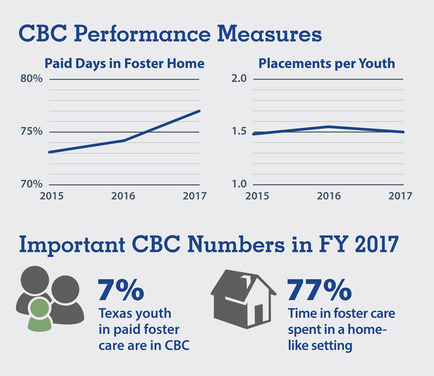
Because of Community Based Care, we have increased the number of children and youth who find foster homes within 50 miles of their home. Less-restrictive setting benchmarks have also improved. In FY 2017, kids in foster care spent 77% of their time in a home-like setting.
For more information, visit the CBC website.
Back to top
April is National Child Abuse Prevention Month.
April brings an important opportunity to remind all Texans that child abuse and neglect have a lasting negative impact on children and our community. Every child deserves to be protected and cared for, and as a community we need to be their voice and ensure their safety.
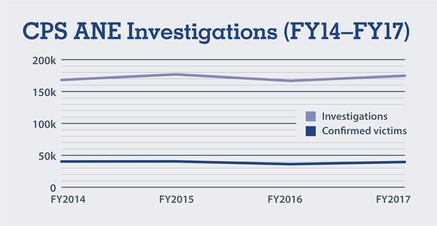
In FY 2017, DFPS completed 174,740 investigations and confirmed 39,570 victims of abuse and neglect of children. The DFPS Prevention and Early Intervention (PEI) division works to reduce child abuse and neglect through community-based programs like HOPES. As PEI grows, it continues to focus on research, evaluation, and expanding evidence-based practices -- approaches to prevention that are backed by documented scientific evidence.
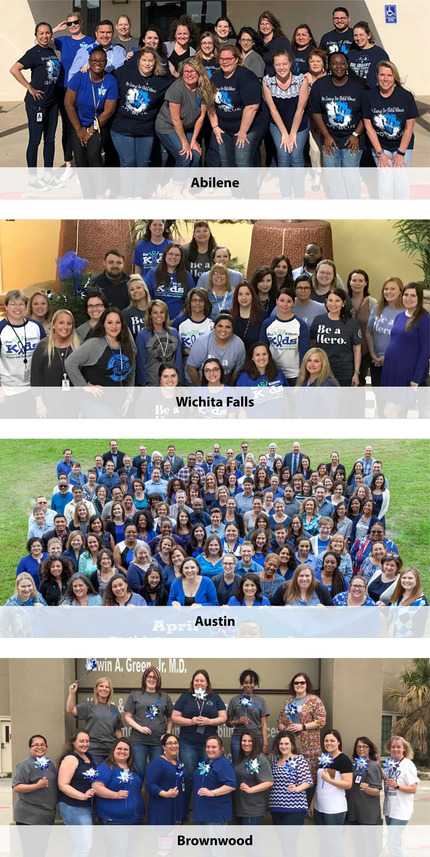
On April 6, thousands of DFPS employees around the state wore blue to recognize the safe and loving childhoods we want for all kids, and to encourage individuals and organizations to play a role in making communities across Texas a better place for children to live.
Step up and join us in raising awareness year-round. Together we can make a difference.
Visit HelpandHope.org for more information on how you can help, to explore a wide variety of parenting tips, lessons, and resources, or find help for you or someone you know.
Back to top
 Back to top
Strategic Plan Public Comment – May 7, 2018
Committee on Advancing Residential Practices – July 12, 2018
Public Private Partnership Committee – July 13, 2018
Family and Protective Services Council – August 17, 2018
Back to top
|