|
In this issue:
This is the inaugural issue of DFPS Vision, a quarterly newsletter that will provide updates on the latest news at the Department of Family and Protective Services (DFPS).
As DFPS evolves to meet the complex needs of the children, vulnerable adults, and families we serve, this newsletter allows us to share best practices, trends, and our goals to provide better service. Each issue will feature a specific theme. This issue's focus is on safety and quality casework. Nothing is more critical to our mission than safety and providing the best quality services for our clients.
To complement the newsletter, we will share data and information monthly to illustrate how we are moving the needle forward and where the agency is working to make improvements. Our objective is to keep everyone well informed about our progress on key issues.
I hope you will take a few minutes to read about the work that our dedicated employees are doing to protect our fellow Texans.
Sincerely,
H.L. Whitman
Download a printable PDF version of the newsletter here.
Finding innovative ways to expand treatment options for human trafficking victims in Texas is a top priority at DFPS.
In 2017, we made great progress to enhance the way that we collaborate with stakeholders and other government entities, while addressing the devastation of human trafficking.
Energizing leadership and training
In July 2017, DFPS established the Human Trafficking and Child Exploitation team, led by Director Kim Grabert, to intensify the agency’s response. Moreover, DFPS created a human trafficking and internet safety training for youth who receive our services. We also established a team of special investigators across the state to coordinate with law enforcement on child sex trafficking cases.
DFPS partnered with the Texas Office of the Attorney General to recognize January as Human Trafficking Awareness Month by hosting a series of “lunch and learn” events for employees and the public about preventing online abduction, understanding the mind of a survivor, and how faith-based organizations can help support survivors.
Collaborative tools
This year, we have an ambitious agenda to combat human trafficking. We will partner with the Governor’s Child Sex Trafficking Team to launch the Child Sex Exploitation-Identification Tool, so DFPS employees can better assess risk to the youth they serve. Also, DFPS will use the Attorney General office’s new cutting-edge human trafficking video to train all 8,000 front-line caseworkers.
Collaborating with other government agencies and community stakeholders is paramount in the fight against human trafficking, and DFPS will continue to find ways to work together as a united front in the battle against this scourge. Read more about how DFPS is working to fight trafficking here.
Back to top
2017 was a big year for the CPS program – with the support of the Texas Legislature, we added over 800 positions and gave pay raises to all front-line caseworkers.
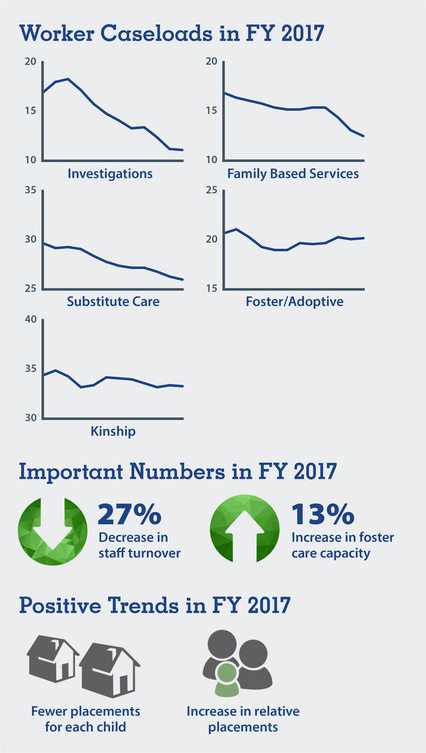
Getting employees through the door is one thing, but we must keep them on board to serve children and families in the best way possible. To keep quality employees, we must also ensure they are led by highly qualified supervisors who support their growth and development. So, we overhauled our supervisor training program, putting more emphasis on practical experience, working hands-on with a mentor and program director. These changes eased caseloads and cut employee turnover by 27%. Reducing caseloads and keeping quality employees means better and more consistent casework, and better outcomes for children overall.

Capacity building
CPS and our community partners also added 5,000 brand new foster homes, a welcome 13% increase in capacity, as a part of our larger plan to better partner with foster care and service providers. These achievements addressed critical needs in our services and they contribute to our vision of continuously working to improve the safety, well-being, and permanency of children in our care.
Improved Child Safety a Goal in 2018
We’d like to highlight two new initiatives that will roll out in 2018 to improve safety, care, and outcomes for children served by DFPS.
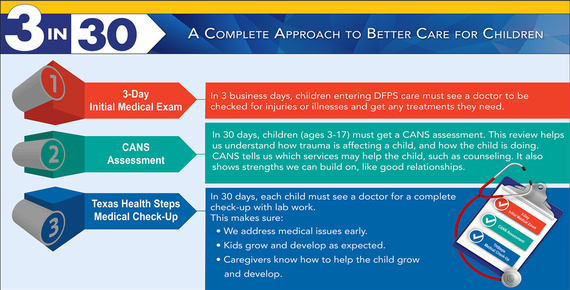
3 in 30 – Three separate, yet critical, tools for assessing the medical, behavioral, and developmental strengths and needs of children and youth entering DFPS conservatorship. Texas law requires each component, and together they chart the path for services of children and youth from the beginning of their time in care until their case is closed. Within three business days, children entering our care will now see a doctor to be checked for injuries or illness and get the treatment they need. In 30 days, they’ll get a CANS assessment, a comprehensive trauma-informed behavioral health evaluation, which helps in planning their services. Also in 30 days, they’ll see a doctor for a Texas Health Steps check-up with lab work to make sure medical issues are addressed early, children are developing as expected, and caregivers know how to support their child’s development.
Community Based Care – A new approach to providing services to youth in state care. A single contractor is responsible for case management and services to move children from foster or kinship care into a permanent home. Community Based Care allows the contractor and the community increased flexibility and innovation to meet the unique needs of each child. Results in the first catchment area are promising, with a 20% increase in foster home capacity. It will be rolled out across two new service areas in 2018. Visit the Community Based Care webpage for updates.
Safety Summit, FBSS Improvements
The Office of Child Safety coordinated a Safety Summit for all Family Based Safety Services (FBSS) managers with a focus on family engagement and using case information to make important safety decisions.
CPS conducted FBSS real-time case readings statewide, seeking to identify safety issues and address concerns in cases where the family is at a higher risk of recurrence.
In 2018, we will provide critical-thinking training to FBSS program directors, program administrators, and regional directors that will focus on safety decision-making and risk assessment. Read more about what CPS has planned for FY 2018 in the CPS Business Plan.
Back to top
The Prevention and Early Intervention (PEI) division helps create opportunities for children, youth, and families to be strong and healthy by funding community-level, evidence-informed programs and systems of support upstream from crisis and intensive interventions.
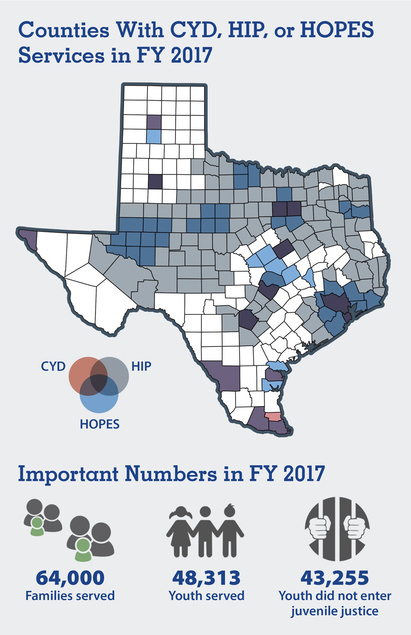
In FY 2017, PEI significantly expanded the reach of three programs – Community Youth Development (CYD), Helping through Intervention and Prevention (HIP), and Healthy Outcomes through Prevention and Early Support (HOPES).
CYD added seven zip codes to its service area. HIP expanded into six new primary and 26 surrounding counties, and HOPES is now available through 21 contractors in 25 primary and 35 surrounding counties. As a result of these expansions, more Texans are able to access more services in more locations. Visit our website to learn more about PEI programs.
In FY 2017, PEI served more than 64,000 youth and families, including 15,964 families through evidence based home visiting programs, parent education, counseling, and support services. Nearly all (99%) of children and youth remained safe while enrolled in PEI services and their parents who were at risk of child abuse and neglect did not become confirmed perpetrators in a DFPS abuse or neglect investigation.
A Public Health Approach
Applying a public-health approach to its work, PEI aims to improve the well-being of all Texans by providing evidence-informed family supports, parenting education, and youth programming.
PEI’s approach for preventing child maltreatment and other negative outcomes also includes supporting children and families by training its community based organizations on collaborative strategies to address challenges related to poverty, family instability, poor health, drug and alcohol abuse, mental illness, and more.
PEI prevention programs also provided mentoring, youth-employment programs, career preparation, and alternative recreational activities to prevent delinquency for 48,313 youth. More than 98% of youth between the ages of 10 and 16 who were served in FY 2017 did not enter the juvenile justice system.
Expanding Evidence-Based Programs
In 2017, PEI worked closely with our contracted providers to increase the number of evidence-based programs it uses to help prevent child abuse and neglect. Evidence-based means the program is proven through clinical evidence to be effective at producing positive outcomes for children and families.
To achieve this goal, PEI drew on the expertise of its Research Roundtable members to approve additional evidence-based models for use in Texas. In addition, PEI helped host model-specific training for employees.
By the end of 2018, all home visiting and parent education providers will use one or more evidence-based models or promising practices, which translates to a more efficient use of state resources and better outcomes for children at risk for abuse and neglect.
Back to top
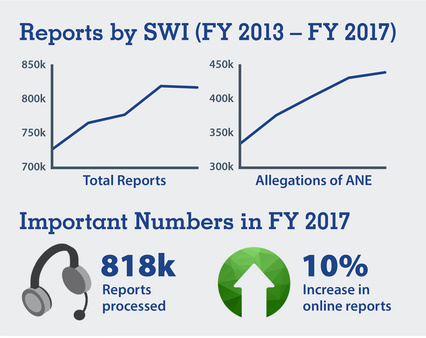
Last year, the Statewide Intake program (SWI) processed almost 820,000 reports, more than half of which were allegations of abuse, neglect, and exploitation of children and older Texans.
Reports can be made by phone call, online, fax, and letter.
To keep hold times on the hotline as short as possible, we improved the online reporting system, making it more user-friendly to those who are required by law to make reports. These “mandatory reporters” include doctors and teachers. Users of the Texas Abuse Hotline website can save a report and return later to finish it. The website also uses dynamic questioning so that users don’t have to answer questions that are not relevant to their situation. With these improvements, online reports have increased by over 10% this past year.
To make the absolute most with the resources we have, intake managers are looking at every procedure to maximize efficiency – making sure every vacant position is filled quickly, actively tracking bottlenecks to better use employees, and updating the existing phone system.
Back to top
In 2014, Adult Protective Services (APS) introduced a new casework model called SHIELD, which uses three tools to help employees make informed decisions about clients.
In 2018, APS will incorporate changes recommended by the National Council on Crime and Delinquency into the SHIELD tools to further reduce the chance a client has a repeat case.
With SHIELD, we not only look at client safety, but also at their risk of having a repeat case, and the client’s and caretaker’s strengths and needs. While we still help older Texans with emergency needs, SHIELD helps us look beyond the needs of the moment to the root causes of problems, and how likely they are to recur.
For example, when a client near Abilene was hospitalized with a possible stroke, APS used the revised tools to quickly identify his need for more intensive care. By the time our involvement with him had ended, he was getting more provider help with daily activities and was less likely to need APS services again.
Partnership with WellMed
In San Antonio, APS was awarded a grant from the Administration on Community Living in 2012. We partnered with the WellMed Charitable Foundation to develop new approaches to identifying and responding to abuse, neglect, and exploitation. Our employees trained WellMed clinic staff, and helped WellMed add a screening tool and reporting procedure to its primary care process.
In 2017, the Benjamin Rose Institute on Aging evaluated the partnership and found the improved coordination greatly beneficial, with over 330 clinic reports of suspected abuse confirmed.
In 2017, the Benjamin Rose Institute was awarded a grant to further pursue the research. APS and Wellmed continue to partner with Benjamin Rose in this project.
APS Promoting Efficiency, Best Practices
APS created a workgroup last year to review our policies, practices, and rules statewide to help identify areas for improvement, and eliminate processes not contributing to better client outcomes. In the coming year, we will also use committees to solicit feedback, recognize champions, and identify what’s working in each district. This process will ensure more coordinated casework, help enhance and leverage best practices for better client outcomes, and maximize our efficiency. For more information about APS, visit our website.
Back to top
DFPS investigative caseworkers must have a keen eye and a strong understanding of forensic investigation to catch child predators.
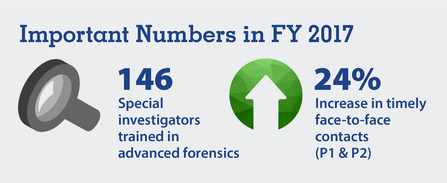
In September 2016, all special investigators, who were unique caseworkers with law enforcement backgrounds, completed advanced forensic training. In 2017, they took what they learned, developed a training curriculum, and taught specific techniques to help all investigative caseworkers in their regions conduct more insightful interviews.
Special investigators are conducting additional training for investigative caseworkers in 2018 on:
- Strategies for locating hard-to-find individuals.
- Situational awareness.
- Serving drug endangered children.
- Advanced domestic violence training.
- Improving Face-to-Face Contacts.
In 2017, a critical goal for DFPS was to increase the number children seen face-to-face in a timely manner, and last year, face-to-face contacts within the required timeframes were up by 24%. Timely initial contacts are essential to improving the quality of abuse and neglect investigations, which help keep children safe.
National Night Out
Special investigators worked with local law enforcement and other community agencies to distribute information on safe sleep, water safety, and internet safety during National Night Out. This event brings together communities, police officers, firefighters, paramedics, and others for an evening of neighborhood camaraderie. Special investigators visited over 100 National Night Out locations to promote our community partnerships. This year, our goal is to have them visit with at least 300 communities and help put a face to DFPS.
Back to top

Back to top
|