|
Two national reports released new public safety data this week. One measures what is happening with crime. The other measures what cities are doing to prevent it.
Memphis stands out in both.
The FBI's final 2025 crime report showed violent crime fell 9.7% nationwide, the largest annual decline since national estimates began in 1936. Murder fell 18.1%, robbery 18.5%, aggravated assault 7.2%, and property crime 12.4%.
Those are historic national declines. And while Memphis still topped the list as of 2025, it is important to note that Memphis' decline is outpacing the national average.
From 2024 to 2025, murders in Memphis fell 25.5%, compared with 18.1% nationally**, a roughly 7-point wider margin**. Robberies fell 31%, compared with 18.5%, a 13-point margin. Aggravated assaults fell 22.5%, compared with 7.2%, a 15-point margin.
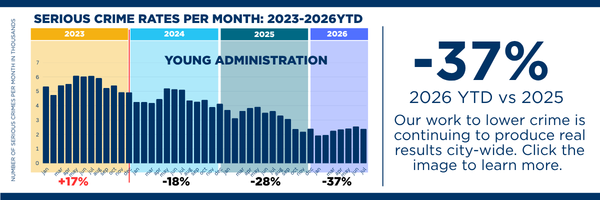
And when we step back from a one-year comparison, the change is even clearer. From 2023 to 2025, serious crime in Memphis fell 40.9%. Murders fell 46.5%, from 344 to 184. Robberies fell 47.2%.
The trend has continued in 2026. Through July, compared with the same period last year, serious crime is down another 37.4%, murders are down 41.7%, robberies are down 43.5%, and aggravated assaults are down 27.5%.
At the same time, the 2025 Community Justice Violence Prevention Index gives us another national measure of our public safety work.
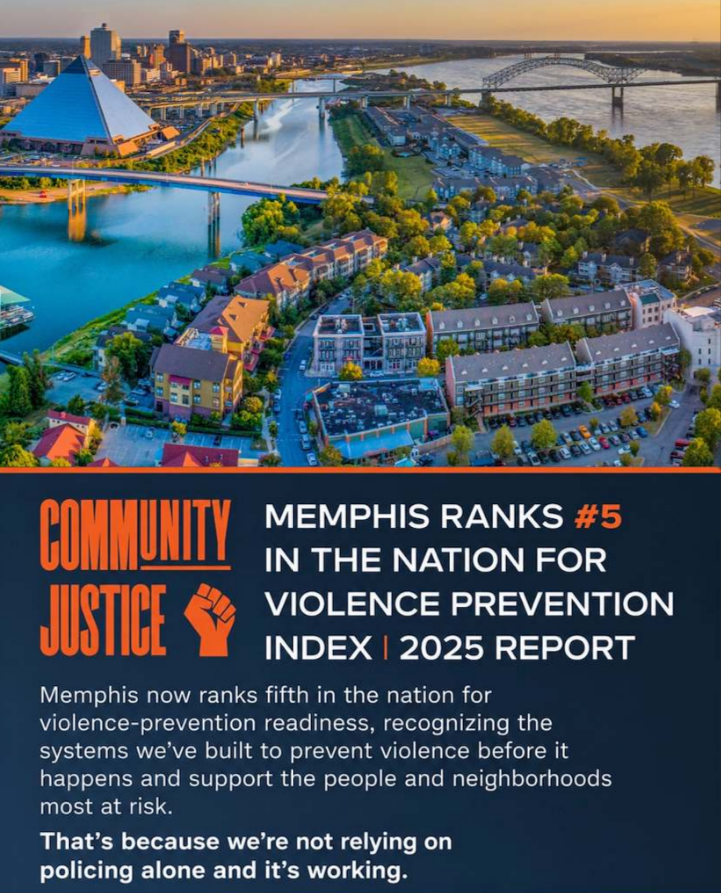
The Index examined 100 U.S. cities with some of the country's highest levels of gun violence and ranked Memphis fifth in the nation for violence-prevention readiness, behind only Washington, D.C., Baltimore, Chicago, and Philadelphia. This is Memphis' first year in the national top ten.
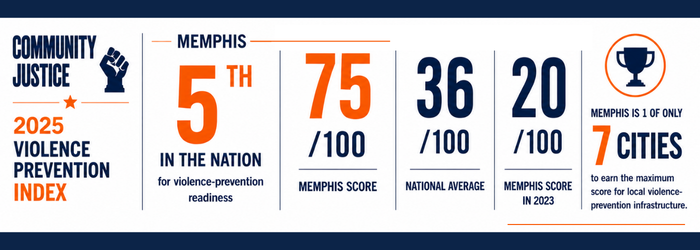 Memphis is one of only seven cities in the country to earn the maximum score for its local violence-prevention infrastructure. View Memphis' OVP scorecards here. Click the image to read the 2025 report.
Memphis scored 75 out of 100. The national average was 36. And while that national average has increased only two points in each of the past two years, Memphis has built one of the strongest violence-prevention systems measured in the report. For comparison, in 2023 Memphis scored only 20.
Central to that work is our Joint Office of Neighborhood Safety and Engagement, established in 2024 and led by Tamika Williams and Valerie Matthews. JONSE has helped build and coordinate the prevention infrastructure that the Index measures, bringing together City and County government, community partners, intervention strategies, and resources around a shared approach to reducing violence.
We were also one of only seven cities in the country to earn the maximum score for our local violence-prevention infrastructure. That means having a strategy, pursuing outside funding, aligning funding where it is most needed, coordinating with community organizations, providing technical assistance, and monitoring and evaluating the work.
These reports measure different things, which is exactly why they are worth looking at together.
The FBI measures the results we can see in our crime numbers. The Violence Prevention Index measures whether we are building the infrastructure to help sustain them.
Neither says the work is finished. Our crime rate remains too high, and too many families are still affected by violence. We must replicate and sustain the gains.
The next phase requires us to maintain pressure on violent offenders while strengthening intervention and prevention efforts. It also means getting more precise about connecting housing, workforce, education, health, and youth opportunities to the people and neighborhoods most at risk.
Crime is falling nationally. It is falling faster in Memphis. And at the same time, Memphis is building one of the country's strongest systems to help keep it going.
That's progress worth protecting.
|