|
Tuesday’s primary election is decided, and I want to congratulate every candidate who earned their place on the August ballot.
But before we move forward, I want us to sit with something.
According to the Shelby County Election Commission, 89,848 residents cast ballots in Tuesday’s primary election. That is a 16% turnout. While that is higher than the 11% turnout in 2022 and 13.8% in 2018, it still means roughly 84% of registered voters stayed home. Since Shelby County moved to partisan primaries in 1992, turnout has never topped 18%.
 That matters because elections shape the future of our city. But so do the systems around those elections.
While Memphians were voting on leadership, schools, public safety, and the future direction of our community, lawmakers in Nashville passed a congressional redistricting plan that will fundamentally diminish Memphis’ representation in Washington.
The new map eliminates a Memphis-centered congressional district and divides our city across multiple districts stretching into West and Middle Tennessee. Instead of one representative primarily accountable to Memphis voters, our city would become a smaller piece of several districts with very different economies, priorities, and political realities.
Housing. Transit. Blight. Public safety. Workforce development. Infrastructure. The issues our neighborhoods face every day would compete with the priorities of communities that do not share the same urban challenges or economic realities.
Memphis and Shelby County operate as one economic ecosystem: one airport, one port, one logistics network, one workforce, and one regional economy. Dividing that ecosystem across multiple congressional districts weakens Memphis’ ability to advocate as one city with one set of shared regional priorities.
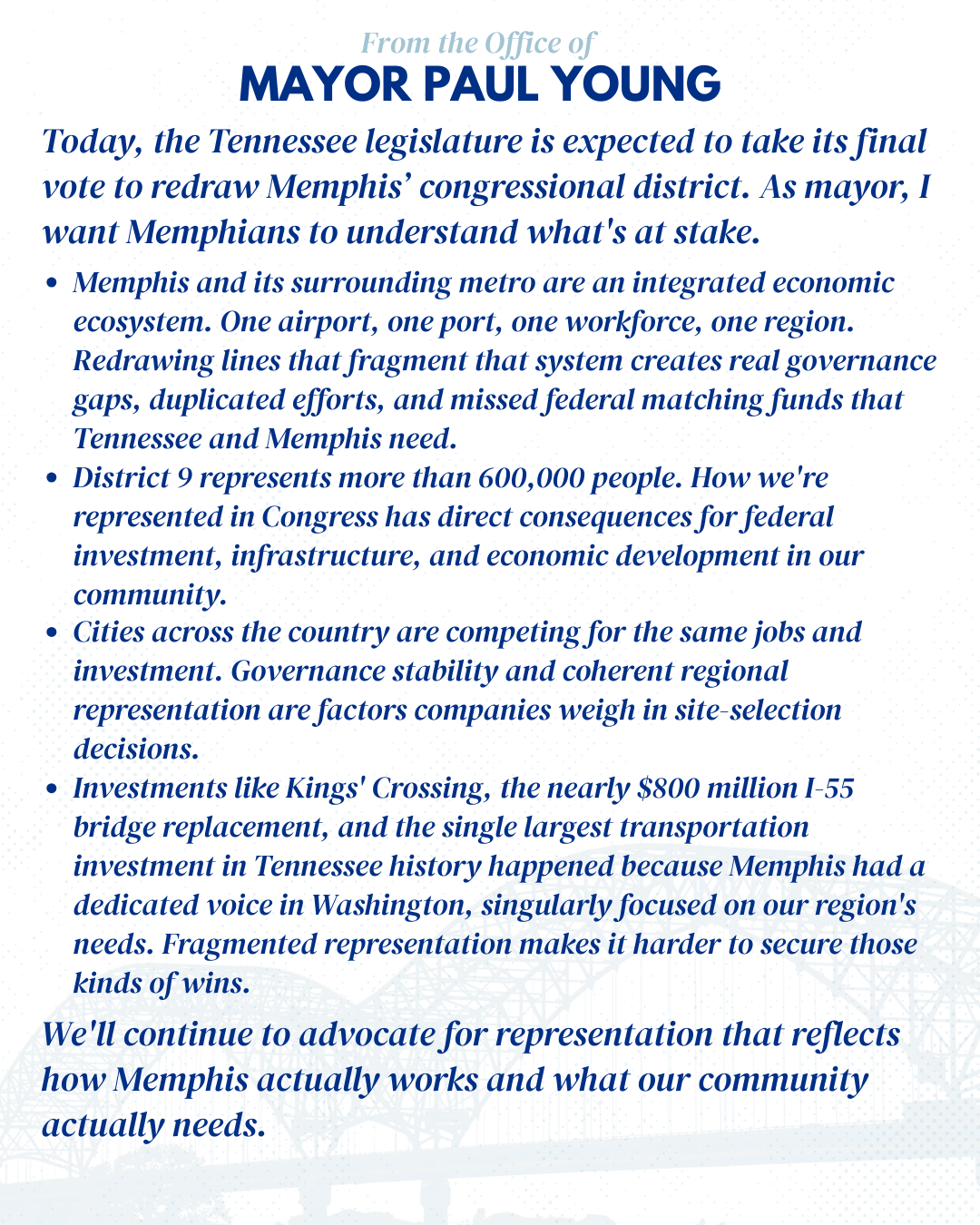
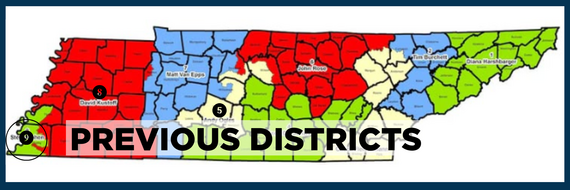 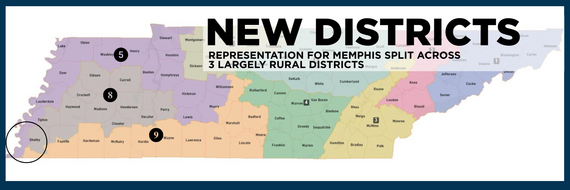 (Visualization of the redistricting and how Memphis’ voice will be diluted. Representation will be stripped from our city, and that means less advocacy for the issues that are critical to building a stronger Memphis.)
Projects like Kings’ Crossing and the nearly $800 million I-55 bridge replacement, the single largest transportation investment in Tennessee history, happened because Memphis had strong representation advocating for our region’s needs in Washington. Memphis would risk losing millions a year in community grants and constituent services with this districting map.
The legislation also raises larger questions about process and representation.
This was not the normal cadence of the redistricting process tied to the census. This legislation has redrawn congressional districts years after maps were already established following the 2020 census. Tennessee law has long stated that congressional districts “may not be changed between apportionments,” and legal challenges filed this week argue the process violated both state law and constitutional procedure. And our state officials know this.
In 2022, our state leaders argued that changing the election calendar in March before an August election would “wreak chaos upon the electoral process, and would unnecessarily risk voter confusion and disenfranchisement… causing irreparable harm…to the public interest.” If it wasn’t okay then, it shouldn't be okay now.
And earlier this week, the legislation also suspended residency requirements for congressional candidates in 2026. As one legal filing challenging the process put it, “The purpose appears wholly to allow the election of candidates who have no history of living in the district they seek to represent.”
Those requirements exist for a reason. People deserve representatives with real ties to the communities they seek to represent.
The same priorities you voted on Tuesday deserve a clear and powerful voice in Washington.
|