|
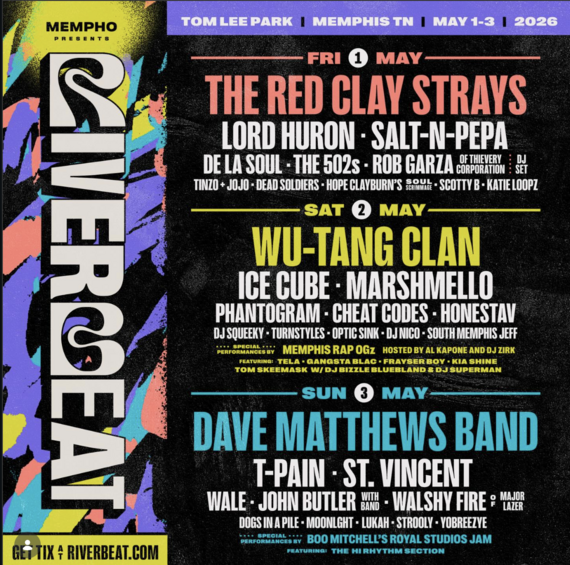
With RiverBeat happening this weekend at Tom Lee Park, I have been thinking about what it means to bring people downtown, to create energy, and to build on it the right way. Weekends like this show what Memphis can feel like at scale. They also remind us that growth does not happen by accident. It happens when you get the steps right. That is the work in front of us as we lean into Memphis Rising.
Memphis has a real window right now.
From the Pinch to South Main, roughly a mile and a half of our riverfront and downtown is coming online all at once. Baron Von Opperbean on Mud Island, the Memphis Flyway at Tom Lee Park, Grind City Amphitheater on the northern end of our downtown riverfront, and the new Memphis Art Museum rising on the bluff are all taking shape in the same vicinity as our award-winning, waterfront-defining Tom Lee Park. That is strategy. That is a true cultural corridor taking shape.
Culture brings people in, keeps them engaged, and creates the energy cities build on. But one sector alone is not enough. Cities come back in sequence. Jobs bring people. Daytime activity creates demand. People live near where they work. Housing grows. Retail follows. When the system is complete, you get a place that works every day.
People always want to compare us to Detroit. Let’s look at the Detroit comeback story. It wasn’t an advertising campaign or good press that rebuilt Detroit; it was people. And it started with a simple conversation. An intern told Dan Gilbert, co-founder of Quicken Loans/Rocket Mortgage, that he was leaving the company for a job in Chicago because he wanted to live and work in a more dynamic urban environment. That moment clarified something important: the talent they were attempting to recruit and retain were not just choosing jobs. They were choosing place.
Gilbert didn’t respond by marketing Detroit differently to his prospective employees. He changed the equation by adding people and, in turn, vibrancy. In 2010, he moved the company’s headquarters and roughly 1,700 employees into downtown Detroit.
That decision created immediate density. Workers filled buildings. Foot traffic returned to the streets. Businesses that served those employees began to open and stay open, many in properties Gilbert’s own firm controlled. Over time, that initial move scaled. The city's workforce grew to roughly 17,000, and the surrounding environment began to respond to the demand created.
The decisions we make now will define our future. Execution is the focus: move projects forward, connect jobs to housing, support density, and ensure growth includes Memphis residents.
Memphis already has demand. We need to capitalize on it. St. Jude Children's Research Hospital is expanding in the Pinch with its current $12.9B strategic plan, which includes 2,300 new jobs. FedEx is bringing daytime workers to the Arena District. AutoZone and First Horizon are headquartered downtown. Our Medical District is a major economic and employment engine. And the riverfront is becoming a true cultural destination. At the same time, targeted public investment is strengthening this vital district. The State’s $100 million investment in infrastructure and public safety supports one of our busiest nodes and helps bridge the gaps between them. The opportunity before us is to get the sequencing right and to connect it all.
South Main has residential rhythm. Beale Street and FedExForum bring visitors. The riverfront is rising, but the system is not complete. The convention center goes quiet after dark, the Pinch has jobs but almost no residents, and there is a gap between daytime and nighttime activity.
We can fix it. Renovations at 100 North Main and the Sterick Building have capacity to add housing, hotel rooms, and people. More than 20 parcels in the Pinch between Bass Pro and St. Jude create a high-leverage opportunity to connect more of downtown and support retail.
We are close to critical mass. The decisions we make now will define our future. Execution is the focus: move projects forward, connect jobs to housing, support density, and ensure growth includes Memphis residents. A stronger core benefits the entire city. It grows our tax base, supports small businesses, and expands our capacity to invest in neighborhoods. The pieces are in place. Now we have to finish the system.
Jobs bring people. People create demand. Housing follows. Retail follows residential rooftops. Together, they create a Memphis that works.
This is our moment. Now we have to get it right.
38109, 38106 and 38116 - this message is for you.
We have a real opportunity in front of us. For the first time in our history, we’re committing 25% of property tax revenue from Ai investments to reinvest directly into neighborhoods within a 5-mile radius of those facilities.
To help us hear from you, we have created a community benefits survey - it is live now, and you can help decide how those dollars are spent. This is about making sure your voices are heard. So take a few minutes and fill out the survey.
The future of Memphis should be shaped by the people who call it home.
Take the survey here.
|