|
With these details of the funeral
elements the community might better understand them.
“In order to know a community one must observe the style of its funerals
and know what manner of men they bury with most ceremony.”
(Mark Twain)
The American Fire Service of
today is ever changing but is steeped in rich history and tradition. That is no more evident in “the manner of men
and women we bury.”
Firefighter/Paramedic Shane Clifton, who was also a U.S. Navy Veteran, will
be buried at Fort Snelling National Cemetery on Wednesday, September 9 with the
full military and fire service honors that he deserves. Military honors will be presented by the Fort
Snelling Memorial Rifle Squad – our nation’s oldest all-volunteer memorial
rifle squad.
There are many elements to a
firefighter’s line-of-duty-death funeral that are deeply rooted in fire service
and military tradition, but they may be unfamiliar to those outside of the fire
service. Listed below are several of the
funeral elements and some background information to help you understand these
elements and the traditions behind them.
Flag Presentation
The presentation of the United
States flat to the next of kin can be a very memorable token of
appreciation. This is usually done once
the casket has arrived at its final resting place or near the close of the
service. We refer to “flag presentation”
as the act of presenting a properly folded flag to the family. After being draped over the coffin, the flag
is presented immediately following a flag folding ceremony performed by the
Memorial Rifle Squad.
Caisson
The custom of using a caisson to
carry a casket had its origins in the 1800s when horse-drawn caissons were used
to clear fallen soldiers from the battlefield.
For Shane, his fire engine – Engine 14 – will be used in place of a
hearse to transport the casket between the funeral home, church, and cemetery. The engine will be draped with bunting and
will take up a position near the lead of the processional.
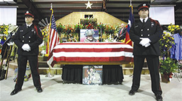
Vigil Standers
Firefighter’s Local 21 and their Honor
Guard are taking up the task of standing “watch” at the head and foot of the
casket 24/7 until burial. They began their
vigil on Monday night and will conclude it at Fort Snelling National Cemetery
on Wednesday afternoon. Vigil standers
assume a military position of “attention” and may hold a ceremonial fire axe. Vigils standers are relieved of their duty
every 15-20 minutes.
|
Badge Shrouds
Badge shrouds, also called
mourning bands, are thin black bands of material that wrap horizontally around
the center portion of the badge. They
are worn by all members of the Saint Paul Fire Department and any member of the
American Fire Service to recognize Shane’s passing.
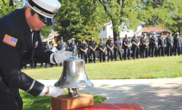
Bell Ceremony
A traditional bell ceremony is
used to pay honor and respect to the deceased through the symbolic use of a
bell to ring the deceased’s last alarm.
It will be performed at the very end of the ceremony at Fort Snelling
National Cemetery. The bell ceremony is
a tradition dating back at least 150 years and was used to notify a community
of a death. While there are several
variations that may be used, one of the most common signal is three rings,
repeated three times, known as signal 3-3-3.
The mournful toll of the bell symbolizes the end of the firefighter’s
duties and their final return home.
|
Processionals
A processional is the ceremony of
moving of Shane from the Gustavus Apolphus Lutheran Church to the cemetery. The procession will include Shane’s family
members and friends – and dignitaries that include Governor Dayton and Lt.
Governor Flint-Smith, Representative McCollum, Mayor Coleman and Deputy Mayor
Beckmann, Commissioner Dohman and Fire Marshal West, and City Councilmembers. Also the Saint Paul Fire Department, 151
other fire department apparatus and over 520 American fire service personnel,
and guests. There will be American fire
service members from as far away as FDNY and California.
This will be a huge processional
that will proceed west on Larpenteur, south on I-35E, west on I-94, south on
Snelling, east on Montreal, west on W. 7th, west on I-494, and exit
34th St. to Gate 2 of the cemetery.
Due to limited space and very limited time, visiting fire apparatus and fire
cars will not enter the cemetery but proceed on to Post Rd. and return to
quarters. Roads and ramps will need to
be closed periodically along the way.
Engine Bunting
Engine bunting is black material
loosely gathered and draped to form a “flag-type” banner around the front and
sides of fire engines. Shane’s Engine 14
and Medic 14 will have bunting.
|
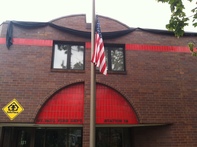
Station Bunting
Similar to engine bunting, Fire
Station 14 at 111 N. Snelling Ave. is “bunted” with black material.
|
|
 |
Display of Gear
A gear display is usually limited
to Line Of Duty Deaths like Shane’s. The
fallen firefighter’s turnout pants and coat, boots, and helmet are placed on
stage or near the casket during the memorial service. Shane’s helmet and badges will be presented
to family members as part of the funeral ceremonies. The boots symbolize that we stand for all
that is right. The coat serves to
protect the firefighter from hostile environments he or she enters. The helmet protects the head so that we may
see and make proper decisions.
Bagpipes
Due in large part to the Celtic
roots of the early firefighters, bagpipes have had a position of honor and
respect within the fire service for more than 150 years. Bagpipes will be played by the International
Association of Fire Fighter’s (IAFF) mass pipe-and-drum band as part of the
church service.
Taps
Taps was written during the Civil
War and played on the bugle and was used to signal the end of the day. Later it
was used before retrieving the dead from the battlefield and by the 1900s was
officially adopted as part of common military funeral protocol. Taps is sometimes played with a second bugler
echoing the first one a few notes behind the first player. These are called “echo taps” and will be
played by the Fort Snelling Memorial Rifle Squad.

Sea of Blue or Sea of Uniforms
The Sea of Blue refers to when
all uniformed personnel are organized into rows and columns at the church or
cemetery and are used during the movement of the casket before or after the
memorial service at the church. The 434 Saint Paul Firefighters and staff, and
over 500 members of other fire departments from as far away as California and
FDNY, will form separate Seas of Blue as Shane is removed from the church and
onto Engine 14 for the procession to Fort Snelling National Cemetery.
|
|
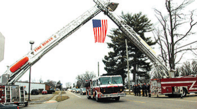
Crossed Ladders
Two ladder trucks will be
positioned so that an American flag will be suspended between their raised
extended ladders. This will be done first
at the entrance to the church on Arcade St. and again at the entrance to the
cemetery.
|
|
 |
Three Volley Salute
Today’s customary three volleys
fired over a grave probably originated as far back as the Roman Empire. More recently, the three musket volleys were
fired to announce that the burying of the dead was completed and the burial
party was ready for battle again. The
Fort Snelling Memorial Rifle Squad will provide Shane a three volley salute as
part of the military and fire service honors.
In closing…
The funeral for
Firefighter/Paramedic Shane Clifton’s sudden Line of Duty Death will be a
massive display of pomp and circumstance – and respect and affection from the
many walks of Shane’s short life. As a
U.S. Navy veteran, a Firefighter and Paramedic, a family man with many friends
- he deserves it. Please join us in
celebrating Shane’s life your own way.
Sent by Saint Paul Fire Department, 645 Randolph Ave, St Paul, MN 55102 | Phone: 651-228-6201
To manage your email settings, click here. To update your account settings, login here.
|