|
 City Administrator delivers infrastructure index to PPS
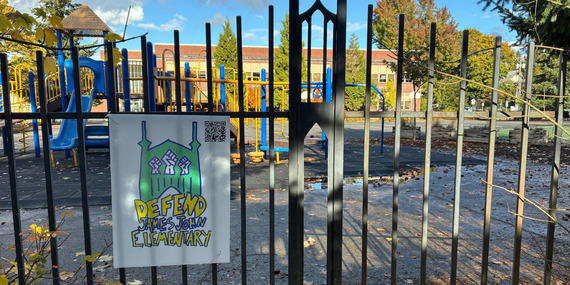 A sign on the fence outside of St. Johns’ James John Elementary’s playground reads, “Defend James John Elementary”.
Last week, at City Council and on KPTV, I let my colleagues and the broader community know that the City would deliver an infrastructure index report—something I’ve been calling for since early October—to Portland Public Schools’ (PPS) Superintendent and Board on November 2. I’m glad to share that City Administrator Lee did indeed share the index with PPS this Monday.
To recap, within my lane as a legislator, I asked City Administration to create a report outlining which schools currently being considered for closure and their surrounding rights-of-way have already been heavily invested in with public funds vs. which might require significant future investment. The City Administrator, along with the Deputy City Administrators (DCAs) for Public Works and Community & Economic Development, worked quickly and efficiently to make that happen.
Here are a few initial takeaways from the index that stood out:
- Parks & Recreation has invested more public dollars on projects adjacent to Creston Elementary—the skatepark, pool boiler replacement, and playground—than any other school on the proposed closure list. Public funds across those three projects totaled more than $5M.
- Planning & Sustainability reports that Maplewood (88%) and Stephenson (74%) have the highest percentages of missing sidewalks. Meanwhile, Irvington (2%) and Sabin (5%) have the lowest percentages of missing sidewalks. Relatedly, the bureau looked at barrier streets, defined as streets with 2+ lanes, a speed limit of 35+, and peak PM traffic volume of 2,500+. Buckman (23%) and Beach (20%) have the highest percent of barrier streets in their 1-mile walksheds, while Lewis (0%), Sabin (2%), and James John (3%) have the lowest.
- From a Transportation perspective, the single largest public investment was federally funded—$2M in the 82nd Avenue Major Maintenance Project at SE Raymond Street Crossing near Marysville Elementary. The largest non-federally funded project was $892,000 for the walkway at SW Stephenson near Stephenson Elementary. The highest number of individual transportation investments were at or near James John (12), while the fewest were made at Sellwood Middle (1) and Woodmere (1).
I am thankful the City Administrator for greenlighting this work and for leading the process to have it created by experts within the City’s bureaus. As the Superintendent and Board continue to weigh options, my hope is that this documentation provides an extra layer of context to inform their decision-making. Going forward, I’ve asked the City Administrator to provide such an index for all six public school districts with buildings in Portland. Attracting and sustaining families is key to our economic prosperity plan.
|
|
Recap: Community conversations on Hayden Island
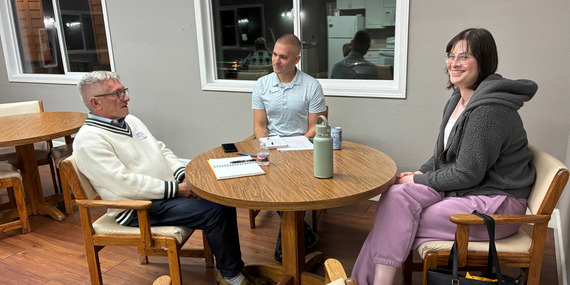 Councilor Dan Ryan (L), Chief of Staff Adam Green (M), and a District 2 constituent (R) at the Conversations with Councilor Ryan event on November 5.
Yesterday my team and I hosted a community conversation event with District 2 neighbors on Hayden Island. Over the course of an hour and a half, I connected one-on-one with seven Portlanders in 15-20-minute segments each. Most, but not all, were from the island. The theme that emerged across these conversations was Portland’s lack of a plan for Hayden Island. People who live there don’t feel like our city’s North Waterfront gets any respect or attention, and I agree. I hope that together we can begin to change that.
In addition to a lack of investment from the City, Hayden Island residents are experiencing the negative impacts of the State’s I-5 bridge replacement (IBR) project. They weren’t engaged by Oregon Department of Transportation (ODOT) to provide feedback on a project that would shape so much of their day-to-day experience. In the meantime, savvy individuals with enough means have purchased up properties near the bridge—letting structures become derelict and dangerous—so they can get a payoff at some point down the line. It’s a lousy practice, and it hurts the community.
I’m inspired to advocate for this precious area of our city, which is home to many wonderful people and waterfront businesses that provide good family-wage jobs. Digging in further, I want to create a robust North Waterfront Plan that lays out:
- What we can do to get the City of Portland a seat at the table before the bridge is replaced in order to lessen the negative impacts on Hayden Island
- How we can sustain livability on the island during bridge construction
- How we can create an exciting, vibrant future for Hayden Island after the bridge project is complete that both prioritizes public space and protects current residents who rely on affordable housing
Our North Waterfront can be a shiny welcome to our city and state. I will keep focusing on the future of a North Waterfront Plan that emphasizes both the short- and long-term. Much more to come on this blossoming idea. Stay tuned.
|
|
A report out on my quarterly ride-along with Portland Police
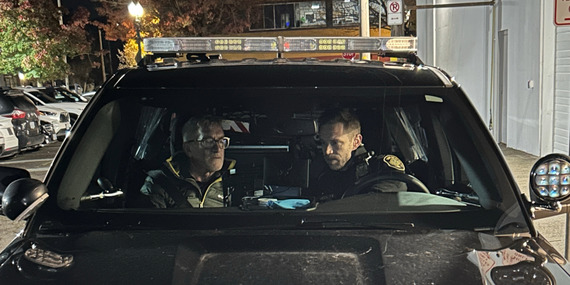 Gearing up to begin my seven-hour ride-along with Portland Police’s Officer Samson Blakeslee on October 30-31.
Public safety is the most expensive part of any city’s budget, and as a legislator responsible for approving our budget here in Portland, it’s vital for me to understand current public safety conditions. The best way to do that is to get on-the-ground insight from our public safety bureaus. For Q4, I started my public safety ride-alongs with Portland Police—a seven-hour ride-along on from 8 p.m. to 3 a.m. on October 30-31 with the North Precinct’s Officer Samson Blakeslee.
Reflecting on the experience, two takeaways continue to surface:
First, staffing remains a major challenge. On the evening of my ride-along, minimum staffing for the North Precinct would have been 19 officers. They started with 15, and 6 of those officers were on overtime. Three clocked off at 10 p.m. and another 2 were off-duty at 11 p.m. All to say: On the evening before Halloween, the North Precinct was severely understaffed. At the lowest point, from 10-11 p.m., there were only 10 officers on-duty—about 50% fewer officers than would be considered staffed up to the bare minimum standard. That’s a problem, and it reminded me why I voted no on several micro-policies related to police overtime in the last two years. Simply put, Portland Police need flexibility to be able to ensure shifts are adequately covered.
And secondly, I noted a theme during my time with Officer Blakeslee: Every welfare check he responded to had a behavioral health component, including mental health and addictions. We responded to a call about a disoriented unhoused Portlander in distress, a person on top of a hotel building threatening to jump, and a special needs teenager with a history of violence against their younger family members. I was impressed with Officer Blakeslee’s communication skills during each of these calls, both with the person themselves and their family members—he showed care and empathy for all. In these complex scenarios, I saw how few options officers had in responding. Officers being put in the position to respond to so many of these types of calls is a failure of our system. More specifically, the State and County are failing to provide a behavioral health system that works. That makes the job of our first responders harder.
Mental health and addiction issues impact also many of us. The fact that we, as a society, don’t know how to better address these challenges is puzzling to me. Building a better system is an urgent need, and I hope our partners at the State and County begin to take bold action on this. As always, thank you to the Portland Police Bureau’s North Precinct and to Officer Blakeslee in particular for the opportunity to ride-along and see your work up close and firsthand.
|
|
Update on parking signage issues along N Flint Avenue
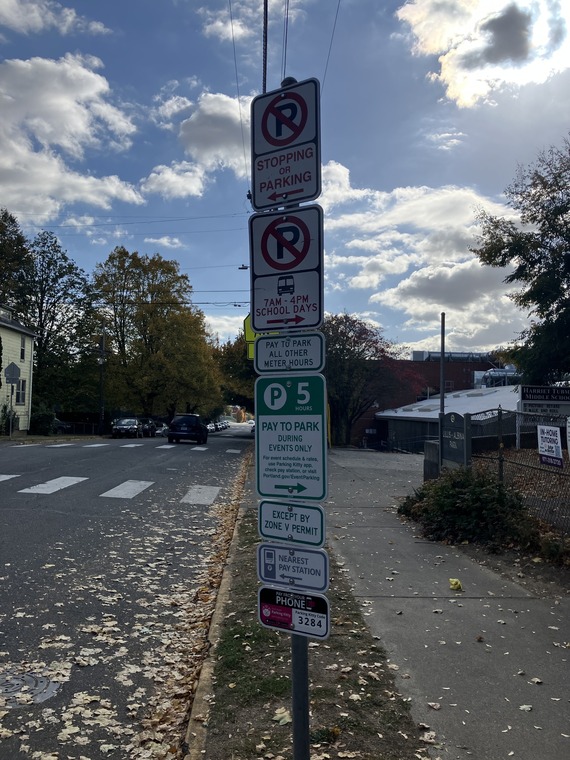 In October, Council heard an ordinance that would establish an $8 hourly event parking rate within the Lloyd Event District and Zone V Parking Permit Area in Eliot. While its intent was to prioritize parking for the neighborhood’s residents, other parking changes instituted there earlier this year were already taking a toll on local small businesses—particularly Lazy Days Brewing. Specifically, PBOT parking signage along N Flint Avenue, the road in front of the brewery, had become deeply confusing and has negatively impacted Lazy Day’s bottom line.
My office listened and got to work. This week, at the ordinance’s second reading, Councilor Kanal and I brought forward an amendment encouraging the City Administrator to suspend the Lloyd Event District/Zone V Park boundaries along N Flint Avenue between N Russell & N Page Streets. It also asks the Bureau of Transportation to establish an approach to signage that makes pay-to-park hours more clear and easier to understand. All 12 City Councilors voted to support the amendment and pass the underlying ordinance as an emergency, which means it will go into effect ASAP.
Many thanks to Lazy Days Brewing Co-Owner Jake who flagged this concern to my office recently. I hope your taproom patronage increases back to, and beyond, pre-signage levels.
|
|
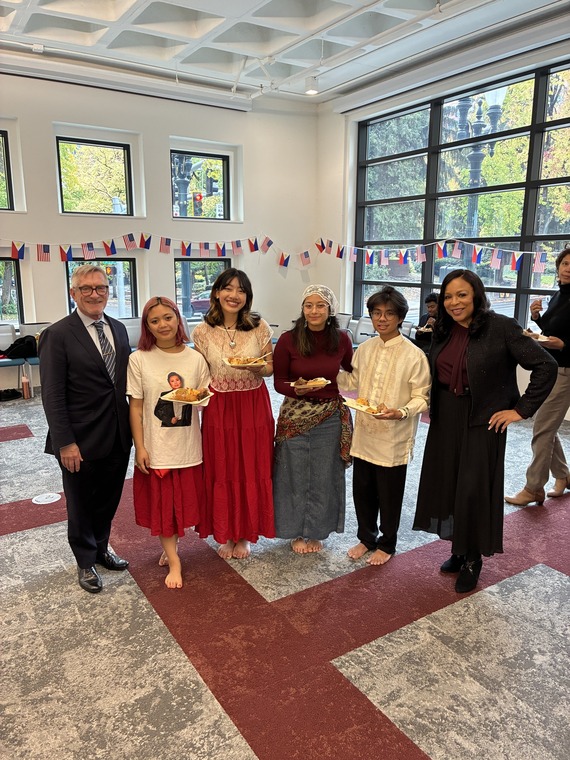 On October 28, the City of Portland celebrated Filipino American History Month with a lunch and dance performances by two student organizations—PSU Kaibigan and Lewis & Clark Kapamilya. I extend my gratitude to members of Filipino American City Employees (FACE), an employee resource group, which organized and hosted the celebration. It was a welcoming, inclusive, and gracious gathering with delicious food and impressive dancing. The warmth and hospitality from FACE, the student dancers, and attendees from across the City created the perfect opportunity for a midday pause in between meetings in Council Chambers.
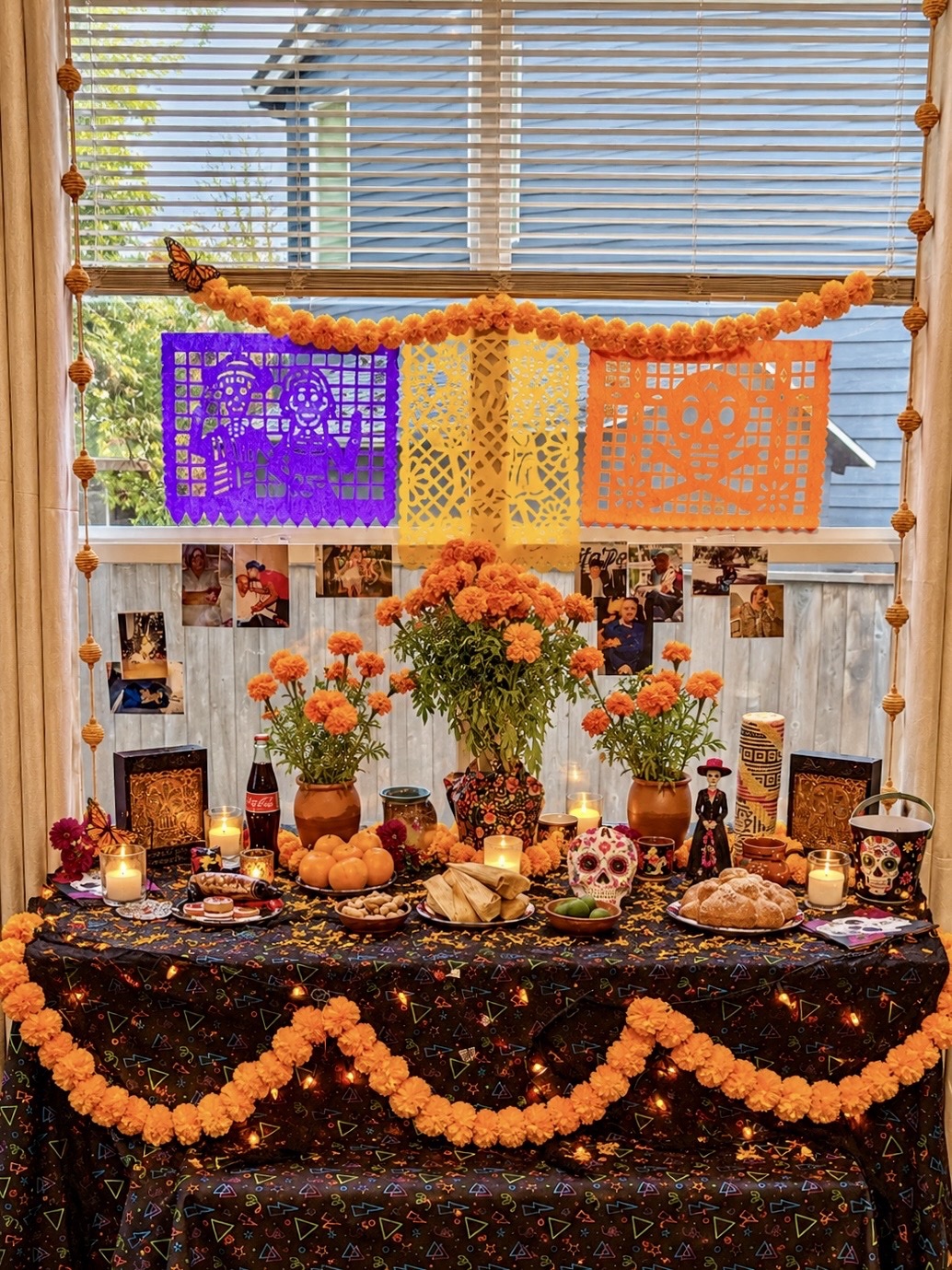 A traditional Mexican holiday, Día de Muertos—celebrated on November 2—honors and provides space to remember and connect with family members and loved ones who have passed. Rather than a somber occasion of mourning, it’s considered a joyful celebration of life and memory.
In that spirit, I want to share this photo of a beautiful and meaningful Altar de Muertos—one that belongs to a staff member from my office, Edna. She says, “It’s a small altar, but it holds a lot of meaning for my family. One of my main purposes is that my kids stay connected to their roots and ancestors and they never lose their traditions.” Many thanks to Edna for sharing this with me, the rest of our team, and you all here.
I wanted to also share that there's an ofrenda up on the second floor of the Portland Building. City employees and members of the public are invited to stop by and take a moment to honor their departed loved ones. If you’d like to, you’re invited to participate by writing a message to someone you miss, leaving a copy of a photograph, or simply spending a few moments reflecting.
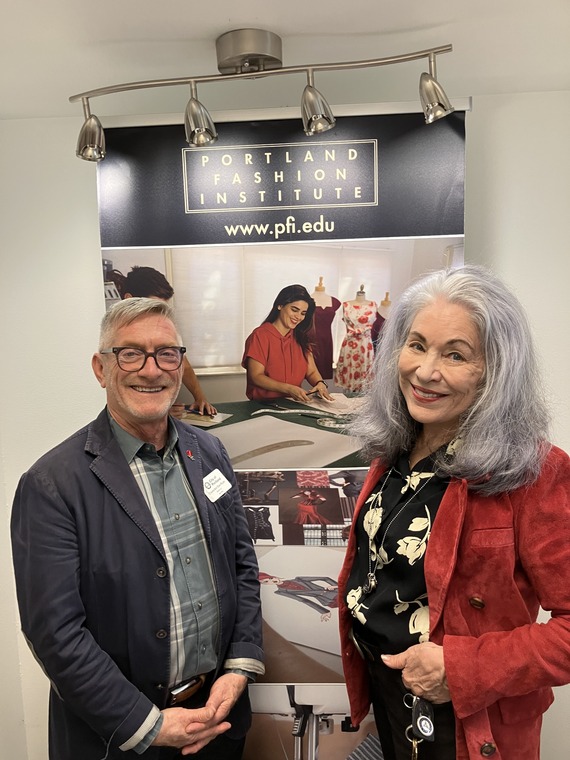 On Wednesday, November 4, I had the honor of joining the Portland Fashion Institute (PFI) community for the ceremonial ribbon-cutting and plaque unveiling for the organization’s new elevator. I’m a big fan of PFI—it plays an important role in workforce training and development in Portland, acting as a pipeline for professionals entering the fashion and apparel industries.
Co-founder Sharon Blair and her team worked through the City’s permitting process for more than three years, so the successful install and operational debut of their new ADA elevator was a long-time coming. To keep the faith throughout the process, students and staff took on a mantra of “cheerful persistence.”
Just to the left of the elevator, a new plaque honors PFI’s other Co-Founder Owen Schmidt, who passed earlier this year. The inscription reads that he was a nationally known environmental lawyer, award-winning bird photographer, and author and editor of Oregon Birds magazine, in addition to his work at PFI.
Many thanks, PFI, for your ongoing contributions to Portland’s creative economy and congratulations again on your new elevator!
|
|
Community Livability Grant
-
Funder: Prosper Portland
-
Deadline: November 30, 2026
-
Funding amount: Up to $300,000
-
Eligibility: Nonprofits, neighborhood and business associations, and neighborhood groups located within the Central Eastside Corridor, Cully, Gateway Regional Center, Interstate Corridor, and North Macadam Tax Increment Finance (TIF) Districts
The Community Livability Grant (CLG) provides grants to community-based organizations for projects that promote healthy, complete, and resilient neighborhoods that support community well-being and widely shared prosperity. Eligible applicants include nonprofit organizations, neighborhood and business associations, and neighborhood groups. Property owners may also be eligible. This grant accepts applications once per year.
|
|
|
Traducción e Interpretación | Biên Dịch và Thông Dịch | अनुवादन तथा व्याख्या 口笔译服务 | Устный и письменный перевод | Turjumaad iyo Fasiraad Письмовий і усний переклад | Traducere și interpretariat | Chiaku me Awewen Kapas
Translation and Interpretation: 311
The City of Portland ensures meaningful access and reasonably provides: translation, interpretation, modifications, accommodations, alternative formats, auxiliary aids and services. To request these services, call 311 for Relay Service or TTY: 711.
|
|
|
|
|
|