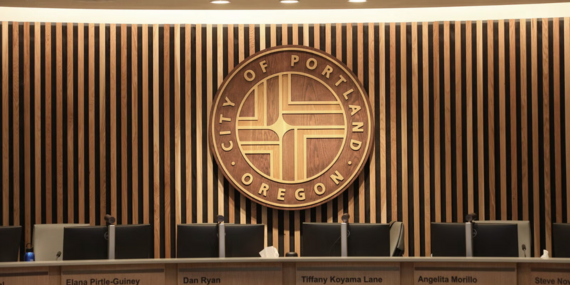
Council Chambers at Portland's City Hall.
For nearly six years I've represented Portlanders, doing my best to make tough decisions. This week, I faced the challenge of how best to make difficult tradeoffs when our revenue is down and our costs are up.
Last night, I voted on the City’s 2026-27 budget—the most important vote Councilors will cast this year.
We received a proposed budget drafted by Mayor Wilson this spring. More recently, amendments to that budget were proposed, and voted on, by this divided City Council. Options for improving the Mayor’s budget were limited to:
- Additional staffing cuts
- Tapping into a variety of funds
-
And/or reprioritizing the Mayor’s proposals
We simply can't preserve all City programs while our resources decline and fixed costs rise, and public safety should've never been on the chopping block.
Thoughts on the Mayor’s draft budget
The Mayor’s budget was reasonable and focused on improving the humanitarian crisis on our streets. He understands the connection between Portland’s economic recovery and providing services to those who are languishing. His budget was thoughtful when making the difficult decisions needed to reorganize the City’s bureaus and offices.
However, the Mayor’s proposed budget was short-sighted on public safety. Cuts to the police’s training budget are cuts to police reform, and cuts to PS3s are cuts to property crime services. To reiterate something I’ve said before: The only bureau that has experienced a net loss in staff over the last decade is police. Additionally, the Mayor’s budget was out of touch with Portlanders’ affordability challenges, with fee and rate increases well above inflation.
It wasn’t perfect, so the Council went to work.
City Council's amendments to the draft budget
I’ve been reflecting, and one thing I’m clear about: The amendments and budget notes passed by City Councilors as part of this process made the Mayor’s budget worse.
If the amendment Councilor Clark, myself, and others would have passed—an effort that would’ve allocated an unused $8-10 million to offset public safety cuts and preserve our credit rating—I would’ve been a “yes” vote tonight. It was a simple, legal, and fiscally responsible solution.
That didn’t happen because six of my colleagues believe that a loan from the Police Accountability Office would go against voter-intent. Instead, those funds will remain unspent, sealed in a vault as we cobble together temporary solves that plug budget gaps with one-time resources, reserve funds, and contingency dollars.
We back pedaled on:
- Emergency response times
- Police reform, due to decreased investment in training
- Decreasing property crime
-
Fire rescues
The takeaway: Local elected officials don't prioritize public safety
With City Council’s amended budget draft, we sent a clear message to residents and businesses: Your elected leaders don’t prioritize your public safety. When you marry the City’s police cuts with Multnomah County’s chronic cuts, that fact is compounded.
For example, Multnomah County spends around 40% of its budget on public safety. Clackamas spends about 70%. We must do better.
Hope for moving forward
A few weeks ago on the Willamette River, I was on a dragon boat with three members of Council’s peacock caucus. Each of us had everyone’s best interest in mind. Ideology did not matter; we were one team paddling forward together. I’ll continue to engage in the annual dragon boat race in future years because it builds our capacity to work as a team.
I do have hope, and I see a better path forward materializing—I'm excited to share more about that soon. Stay tuned.