With so much going on in our city and world, there’s comfort in the predictability of the seasons and how it informs our work. Even as we watch the election results roll in – our jobs remain the same. Our success requires us to stay focused on our mission – planning, building, managing, and maintaining a safe, accessible, and equitable transportation system. Thank you for your hard work and continued commitment to this mission!
I want to take this opportunity to thank Commissioner Jo Ann Hardesty for her leadership these past two years. She took control of our bureau at the start of 2021, mid-pandemic. Her strong leadership has led us on the path to a permanent Healthy Businesses and Plaza program. She secured funding for Vision Zero safety improvements. And she secured the deal with the Oregon legislature and the Oregon Department of Transportation (ODOT) for a successful transfer of 82nd Avenue to the city which included $80 million from the state and $70 million from ODOT.
We look forward to working with the Charter Reform Commission and our bureau partners to make a smooth transition to a different form of city government to fulfill the will of Portland voters. I recognize this transition will have challenges as well as opportunities for PBOT. Rest assured, I will keep you updated as we learn more.
- CW
Director Chris Warner
In this issue of Street Cred:

The following is a reprint of an email sent on Wednesday, Nov. 9 at 9:35 a.m. by CAO Michael Jordan
City Employees,
Yesterday, Portland voters approved a package of reforms that will change our city’s election system and form of government. Measure 26-228 is passing with approximately 56 percent of the vote, according to election results.
Please join me in thanking the community leaders who served on our Charter Commission. Over the past two years, this diverse group of Portlanders invested a tremendous amount of time, energy and insight into developing the proposal. They brought curiosity and determination. And they modeled a culture of inclusiveness and open dialogue that sets the tone for Portland’s future.
City employees also played an essential role in the charter review process, from taking surveys to attending town halls to answering questions from the Charter Commission. I can’t name every contributor here, but I want to highlight several people who have been devoted to this project full-time: project manager Julia Meier, engagement coordinator Sofia Alvarez-Castro, coordinator Diana Shiplet and team leader Shoshanah Oppenheim. They have spent long hours doing complex, vital work to support the Charter Commission, engage our community and develop a strategy for implementing these changes.
Today, a new chapter begins for the City of Portland. As public servants, it is our job to carry out voters’ direction while continuing to deliver the services that Portlanders rely on every day. Whatever your job title, you play an important role in Portland’s wellbeing – from keeping water clean to repairing roads, from managing the city’s budget to preparing for climate change.
I’ll have lots of details to share in the weeks to come. Today, I want to start with a short overview of what’s changing, what’s next and what this means for you.
What’s Changing
Portland voters have approved three connected changes:
- Allow voters to rank candidates in order of preference, using ranked-choice voting.
- Establish four geographic districts, with three city council members elected to represent each district – expanding city council to a total of 12 members.
- Allow the city council to focus on setting policy and engaging with community, transitioning day-to-day oversight of bureaus to a mayor elected citywide and a professional city administrator.
Portland will hold its first election using ranked-choice voting and geographic districts in November 2024. The new city council and mayor will take office in January 2025, in the city’s new form of government.
What’s Next
A transition team is being formed to lead implementation of the changes approved by voters. Based in my office, the team will need expertise across a wide range of disciplines, including project management, communications, equity, finance, human resources and more. Every bureau and office will have opportunities to get involved.
One of the first public milestones will be recruiting members for three community bodies:
- An Independent District Commission to establish geographic districts
- A Salary Commission to set salaries for elected officials
- A Charter Transition Advisory Committee to advise on the overall process
Throughout the transition, we are committed to providing transparent information and seeking community input – with a continued emphasis on reaching Black, Indigenous, people of color, LGBTQ+ and other communities who have historically lacked access to government decision-making.
We have already launched a transition website, Portland.gov/transition. You’ll find basic content now, and additional details will be added in the coming weeks.
What This Means for Employees
We have big changes on the horizon. Understandably, this will create a mix of excitement, anxiety and curiosity for our workforce.
Employee communications and engagement will be a top priority throughout the transition. Please stay tuned for an employee-centered transition webpage on our intranet, a series of employee town halls in early December, regular updates from me and invitations to provide feedback.
There will be opportunities to work directly on the transition, too. I will keep you posted as positions and special assignments become available, and I hope you will consider applying.
For the vast majority of you, your day-to-day work will stay the same for the foreseeable future. Portlanders need parks, roads, water, building permits, housing and safety services as much as ever. All of us will continue to depend on support services like recruitment, technology and procurement.
What could change is the way we organize ourselves to deliver those services over the long run. As part of the transition, we will consider how the city’s organizational structure can best support our new form of government.
I hope you will view this as an opportunity to do your best, most meaningful work on behalf of Portlanders. In the coming months, you’ll be invited to answer important questions: What resources do you need to do your job well? Who do you work with the most closely? What leadership structure can best support you? How can we truly deliver on our commitment to equity and anti-racism?
This is just the beginning of a long process, and we’re in it together.
Thank you for the work you do every day. Thank you for helping deliver the changes that voters have entrusted to us as public servants.
Michael Jordan
 |
|
Through the Citywide Charitable Campaign, city employees can meaningfully support community organizations by donating to qualified nonprofits through your paycheck. |
Give to organization through a one-time November donation or spreading your donations out over 26 pay periods. Donating is easy thanks to the user-friendly portal provided by the United Way of the Columbia Willamette.
This year, City Council has featured 10 local nonprofits they feel are particularly responsive to the needs and vision of our community.
From Joel Michaels, Occupational Health and Well-being Program Manager
The City is making on-site COVID-19 Bivalent Booster shots available to all staff who are interested and due for their next boost. A list of dates and clinic locations is below. Please see the CDC website to determine if you are due for a booster.
The clinics are open to all employees, but not family or dependents.
Sites will have either Pfizer or Moderna depending on what the vendor has available. Mixing and matching of booster types is safe and potentially advantageous for protection according to public health.
Use the sign-up links to hold your spot, and complete consent and insurance forms ahead of time if possible. Please bring your insurance card.
Slots are expected to fill quickly. More will be added as needed, so please check back daily. Last time we held a booster clinic there were cancellations that created “day of” opportunities – so keep checking back!
Still need a flu shot? Feel free to drop into any of these clinics to request a flu shot, no appointment needed.
Stay safe! Get vaccinated.
From Ray Lions, edited by Kailyn Lamb
In early August, the Bureau of Environmental Services (BES) started emergency repairs on a 110-year-old sewer pipe underneath the intersection of NE 33rd Avenue and Knott Street. The failing pipe had caused several sinkholes in the roadway. Work continued through October but recently finished. Ray Lions, BES Capital Project Manager, shared thanks to the following PBOT staff:
Chon Wong, Traffic Control & Engineering, was a key contributor and always available on Teams to review and discuss proposed revisions of the approved traffic control plan to address community concerns about traffic near construction.
Michael Magee and Andrew Sterling, Street Systems, coordinated striping of the road and crosswalks so they’d be ready when we reopened the intersection at project completion.
Vo Trung, Signals and Street Lighting, timely removal of a traffic signal in conflict with shoring for a new 144-inch maintenance hole, then restoration of the overhead signal in time to for reopening the intersection at project completion.
Todd Liles, Scott Bryan, and Bill Oliver, Construction, Inspection and Pavement Management, provided direction for final pavement restoration of the excavation and layout of the restoration limits at the intersection.
This next part didn’t come from Ray, but PBOT’s Street Cred editors would also like to thank PBOTers Mia Smith-Nash, Demetri Finch-Brown, and Angel Ordaz, as well as our partners at 3-1-1 for continued constituent support. These folks fielded many calls and emails about this project, providing clear information and support as neighbors dealt with increased traffic.
Due to the Veterans Day holiday, there will be no Scoop this Friday, Nov. 11. Our internal communications schedule through the rest of 2022:
-
Thanksgiving week: we’ll still publish an abridged version of Street Cred Wednesday, Nov. 23. Like normal, get us your copy by 5 p.m. the Thursday before, Nov. 17. There will be no Scoop on Friday, Nov. 28 due to the Thanksgiving holiday.
-
December: our last Street Cred of the year will be Wednesday, Dec. 7 before resuming in January 2023. Deadline for that issue is Thursday, Dec. 1. The Scoop will run each week in December.
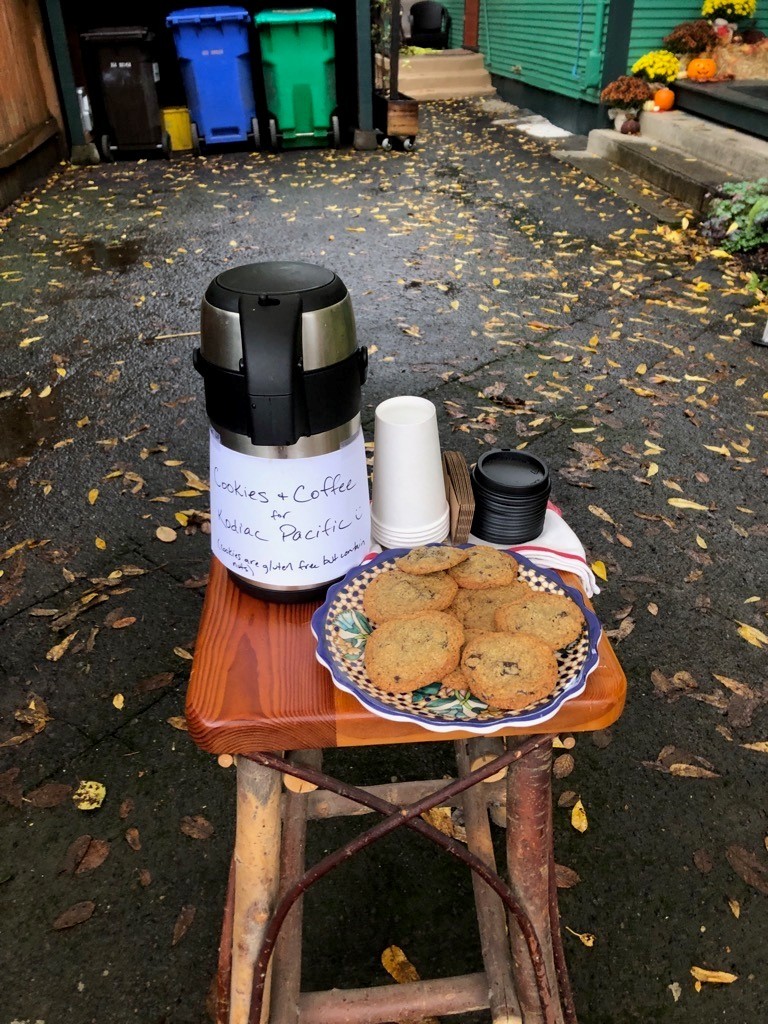
A coffee carafe and plate of cookies on a wooden stool outside in Errol Heights. A handwritten sign reads “Cookies and coffee for Kodiak Pacific. Cookies are gluten free but contain nuts.”
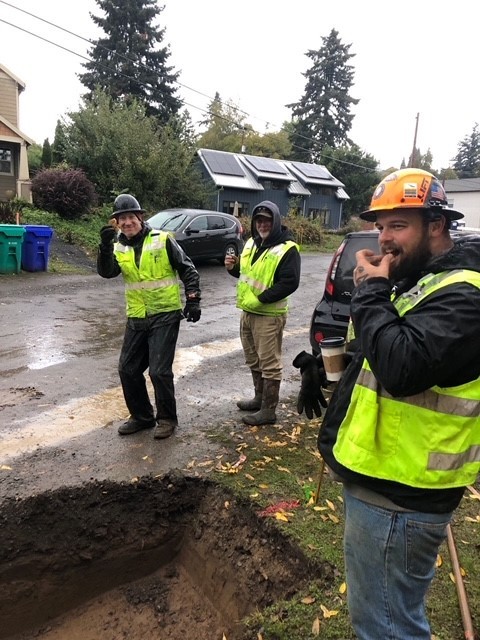
Errol Heights neighbors recently showed their appreciation in the form of coffee and cookies. “I have never seen the community respond in this way to construction – especially when it’s in front of someone’s home,” said Liz Tillstrom, Project Manager. “My sincerest thanks to you all and to the crews in the field for all the hard work on this project and maintaining the important relationships with local residents. Keep up the great work!”
Three workers with Kodiak Pacific in safety gear enjoy the cookies and coffee courtesy of Errol Heights neighbors.
These small gestures remind me how far an act of kindness can go to impact someone’s day and to look for ways to send gratitude in my own life. Thanks Errol Heights!
Rick Nys got the following thank you email recently about improvements to SW 35th Avenue and Falcon Street:
Hi Rick, Thank you! It feels nice to have concerns heard and solutions implemented. The yield sign, and raised stop sign, on Falcon is absolutely fantastic! Thank you to all the teams that were able to successfully put this together. I really appreciate your efforts and love the yield sign. It has immediately helped avoid confusion to motorists, which increased safety to pedestrians. My many thanks for your hard work. Reach out anytime if can help with local feedback.
Many thanks to Rick and Mike Corrie for these much-appreciated improvements.
BIKETOWN bike-share has had record ridership this year. Join Roshin Kurian (PBOT) and Tom Rousculp (Lyft) to learn more about the program’s success. Join us at noon on Nov. 16 to learn more.
Hey Coffee Talkers, second round pairs were sent earlier this week. Check your inboxes and schedule your chats. If you haven’t completed your first-round chat, it’s not too late! Do your best to find a time. Questions? Contact Kailyn Lamb.

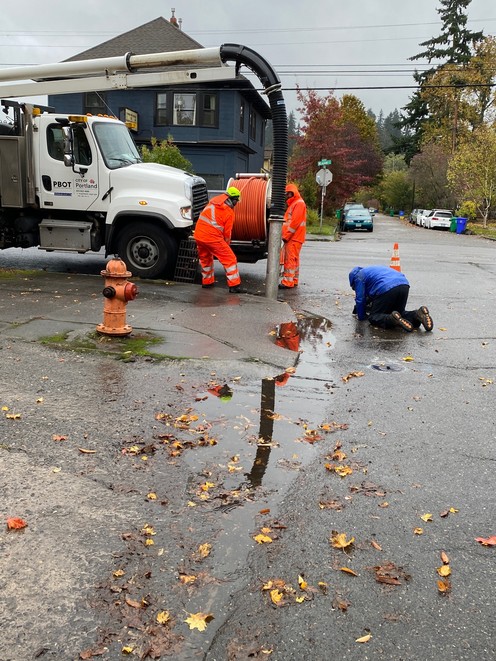
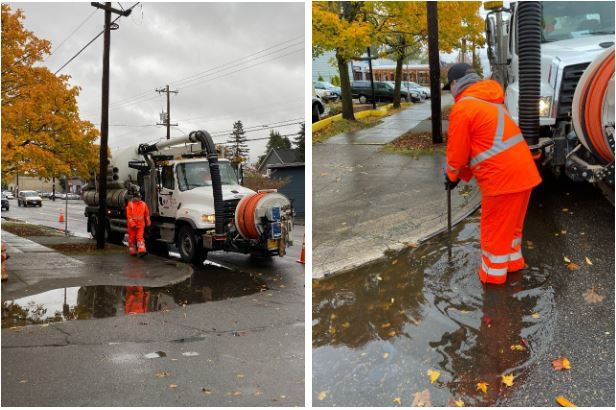
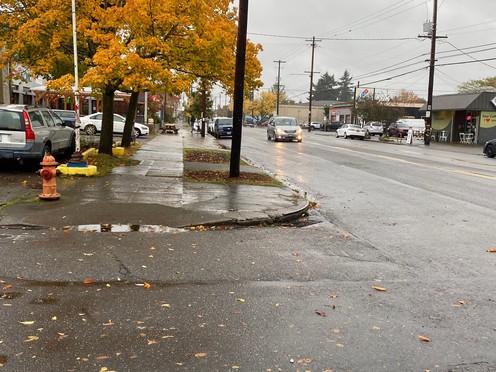
Late last week, an atmospheric river flew through northwest Oregon and southwest Washington bringing Portland’s first significant weather of the season. Michael Lewis, Utility Worker II, and Clint Anderson, Automotive Equipment Operator II, part of PBOT’s sewer cleaning crew were out at NE Glisan Street and 69th Avenue Friday to clear a clogged drain. Channels 6, 8, and 12 were there to capture the action, along with PBOT’s PIO Dylan Rivera.
KOIN TV gets up close for a look at PBOT weather emergency response.
Portland has 58,000 catch basins. Our crews work hard to keep them clear, but with so many they can’t get to them all. Help PBOT by keeping storm drains near you clear of debris.
Left: PBOT crew member in bright orange high-visibility gear walks next to a vehicle used for cleaning sewers. Right: Same crew works to unclog a storm drain.
NE Glisan Street and 69th Avenue clear of water after PBOT crews cleared the clogged catch basin.
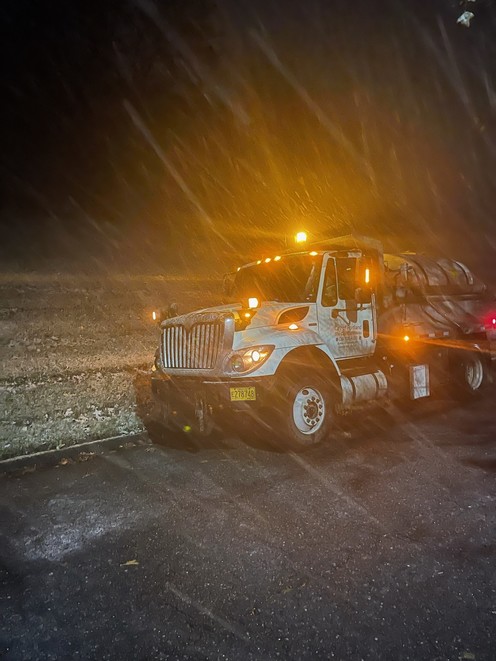
This storm also marked the beginning of our winter weather response. Sunday night into early Monday morning, crews placed 240 gallons of anti-icing liquid on NW Germantown Road and SW Sam Jackson Park Road, where they were seeing slow flurries around 1 a.m.
PBOT anti-icing truck putting down deicer early in the morning on Nov. 7 as snow flurries come down.
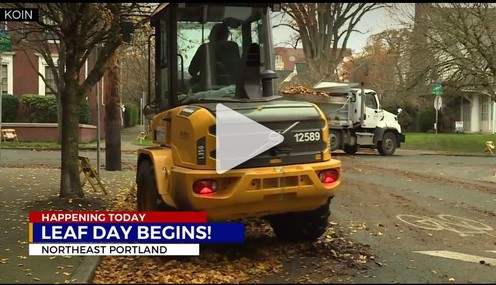
Speaking of clogged catch basins, Leaf Day is here! PBOT’s street sweeping crews are certainly in busy season. During Leaf Day service, street sweepers, dump trucks, and flushers work to clear and clean streets of debris in 52 designated Leaf Districts. These districts have the highest saturation of mature trees in the city. Crews work seven days a week from early November through mid-December. See them in action from this KOIN video:
Screenshot of a KOIN news story showing PBOT Leaf Day equipment picking up leaves. In the lower left corner, text reads “Happening today, Leaf Day begins! Northeast Portland.”
You’re going on vacation, great! Or you’re under the weather, not so great. Either way, you want to rest and make sure urgent matters can be addressed quickly while you’re out. For this reason, it’s CRITICAL to have a thorough out-of-office message with your assigned designees.
An out of office message should include:
- Duration of absence
- Designee name
- Designee contact information
For example: “I will be out of the office starting [date] through [date] returning [date]. If you need immediate assistance during my absence, please contact [name(s)] at [email address]. Otherwise I will respond to your emails as soon as possible upon my return. Thank you!”

I’ve seen a lot of material recently about the voting rights of people with disabilities. This article will publish after Election Day, but it’s a reminder of the many barriers and discrimination people with disabilities experience while voting.
Several laws protect the right of people with disabilities to vote. For instance, the 1965 Voting Rights Act provided that people with disabilities had a right to have a person of their choice help them vote. This predates the 1973 Rehabilitation Act and significantly predates the Americans with Disabilities Act (ADA) passed in 1990. There is also the Voting Accessibility for the Elderly and Handicapped Act of 1984 which requires that voter registration and polling facilities for federal elections be accessible.
And yet, even with these laws in place, an NPR report from 2016 showed that almost a third of people with disabilities who were asked said they had trouble casting their ballots.
In Oregon we are fortunate to have vote by mail. In states where people must vote in person, there can be many obstacles for people with disabilities.
The most obvious barrier is inaccessible voting locations. While federal law requires all locations be accessible, they aren’t. Where a location isn’t accessible, other options, such as curbside voting must be allowed. People with that as their only choice have reported voting officials watching them vote. The completed ballot is then taken back into the building by the election official. These circumstances compromise voters’ privacy and their ability to place their ballot in a secure voting receptacle.
All voting locations are required to have accessible voting equipment including ones with large print, ones that will read the ballot to a voter, or ones that allows a voter to use a machine to make their selections rather than a pen. In 2020, a blind voter in Maryland argued that there were accessible machines, yes, but they printed out a completed ballot identifiably different from other ballots, removing anonymity. A 2021 lawsuit now requires Maryland to provide accessible voting machines that print all ballots in the same format.
In addition to these barriers, voters in several states regularly report that accessible machines don’t work properly or that polling staff don’t know how to operate them.
People with disabilities have also experienced polling officials denying them the right to vote because of an assumption about ability. A wheelchair user is Nebraska said that poll workers told her she wasn’t smart enough to cast a ballot.
Additional barriers that many people experience, such as widely disbursed polling locations in rural areas, are also exacerbated for people with disabilities who may rely more heavily on public transportation or rides from others.
Voting is an important civil right. If there’s no remedy for someone to vote on or by Election Day, you’ve lost out on that fundamental right. This is why organizations nationwide educate voters with disabilities, offer training to polling officials, and advocate for more accessible elections. Hopefully these efforts will make voting more accessible in future elections.
Want to share a PBOT story here in Street Cred? Limit your copy to less than 500 words, provide detailed captions for any graphics, and email kailyn.lamb@portlandoregon.gov by 5 p.m. Thursday the week before the edition goes out so we have time to copy edit and proofread. For longer featured articles please reach out to us first so we can target the best date for you.
Upcoming editorial deadlines:
-
Nov. 23 issue [deadline: Nov. 17]
-
Dec. 7 issue [deadline: Dec. 1]. Note: this is the last issue of 2022!
|