|
In this issue of Street Cred:

Yesterday marked a return to class for students in Portland Public Schools, with other districts starting soon. This means Portland youth are walking, biking, rolling, and riding transit to get to and from school.
PBOT’s Safe Routes to School team reminds you there are more than 120 elementary, middle, and high schools in Portland. People moving about the city, on average, pass a school or cross a school route every half-mile. People driving should exercise caution, regardless of whether they’re near a school or not. Additionally, car crashes are most common from 3 - 7 p.m., a time when students are being let out from school for the day.
As members of the community, help keep students safe and remember to:
-
Drive 20 mph or less in school zones.
-
Stop for school buses, never try to pass them.
-
Pay attention around transit stops. Students ride TriMet all across the city.
-
Keep your focus on the road. Distracted driving is serious and can be costly. A quick glance at a cell phone can cause a driver to miss a student approaching a crosswalk. Distracted driving comes with a maximum fine of $1,000 and double for a second offense.
-
Watch for crossing guards and others helping students cross the street. Every intersection is a crosswalk under Oregon law. Watch this video on pedestrian safety created by PBOT’s Vision Zero team. It reminds drivers to slow down, stop for people crossing the street, and never pass another vehicle that’s stopped at a crosswalk.
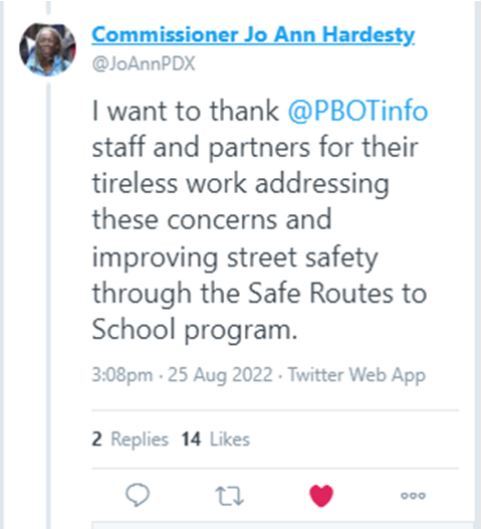
Commissioner Hardesty conveys her deep gratitude for the PBOTers who work to make our streets safer for kids getting to and from school:
A screenshot of a tweet from Commissioner Jo Ann Hardesty who says, “I want to thank @PBOTinfo staff and partners for their tireless work addressing these concerns and improving street safety through the Safe Routes to School program”
By the PBOT Safety Team
Illustration of a hard hat against a teal and orange background with words that read PBOT Safety Alert
Earlier this summer, Oregon Occupational Safety & Health (OSHA) finalized its permanent rule to help protect employees from the effects of unhealthy air (OAR 437-002-1081). Unhealthy air can be caused by wildfire smoke, industrial fires, stagnant smog, or inversion. Although Portland has not experienced the same level of unhealthy air quality this summer compared to the last two years, experts warn it’s only a matter of time.
PBOT’s Safety team wants to ensure you’re all aware of the dangers from exposure to unhealthy air and have posted a required training for ALL PBOT employees to complete by Monday, Sept. 19. Here’s how:
-
If you work in the field and have access to the VIVID learning system, log into your dashboard and take the posted training. You do not need to take the CityLearner version.
By Lauren Spear
An image from the TV series Star Trek: The Next Generation showing the U.S.S. Enterprise and a shuttle flying in space above a blue planet reads: PBOT Catalog The Next Generation in bold, yellow Star Trek font.
What data do we have available at PBOT? Who uses it? What is it used for? Who should you contact to access it? And how do you know if it is right for the work you’re doing? The PBOT Catalog can help answer these questions and more.
We’ve added new functionality and content to the PBOT Catalog Version 3.0! You can now use it to find data and track progress for performance goals and objectives.
Join our upcoming trainings to learn about this tool and how to use it. The Strategy, Data, and Performance section are hosting trainings weekly during September. The first training session is next Tuesday, Sept. 6, 10 – 10:50 a.m. via Teams. See this Friday’s Scoop for all four training options and calendar holds. You can also access the PBOT Catalog or see the PBOT Catalog User Guide to get started. If you have any questions or comments, please reach out to Lauren Spear.
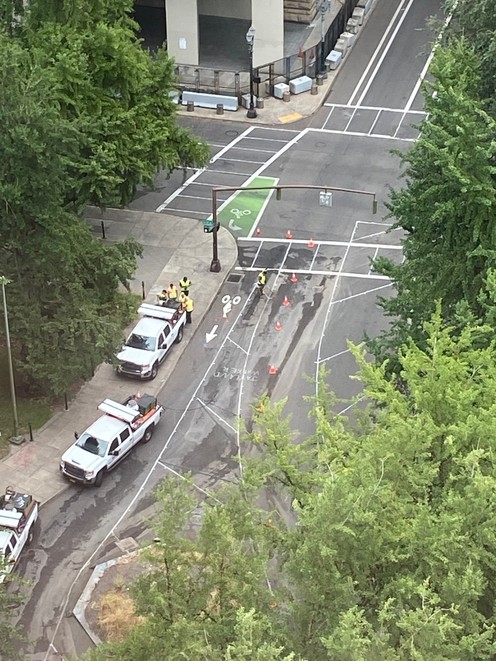
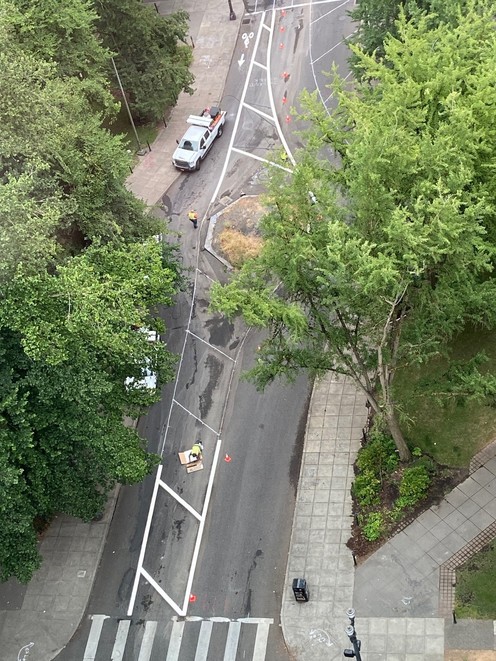
Early Saturday, Aug. 20, PBOT Maintenance Operations crews began transforming SW Main Street between Third Avenue and Broadway, adding bike facilities that never existed before along this stretch where Main Street curves around the former (and future) home of the Thompson Elk Fountain. Before these changes, the bike lane ended at SW Third Avenue. Now, people biking have a much safer, dedicated lane between SW Third and Fourth avenues, separate from vehicular traffic, including buses (the bike lane weaves around the fountain to the north, and all vehicular traffic to the south).
There is also a new shared bus and bike lane along SW Main Street between SW Fourth and Sixth avenues and a dedicated bike lane between Sixth and Broadway.
A bird’s-eye photo shows SW Main Street’s new dedicated bike lane between Third and Fourth avenues. Trees border the street. Maintenance crews are parked along the street and you can see staff wearing high-visibility safety vests.
A bird’s-eye photo shows SW Main Street’s new dedicated bike lane between Third and Fourth avenues. Trees border the street.
Credit for this project goes to Scott Cohen, who pressed to get this connection and paid for it with “Missing Links”; Gabe Graff, who made all the right connections with the Elk contingency; and our stellar traffic engineers Andy Sullivan and Adam Moore who provided the design and analysis to ensure it worked.
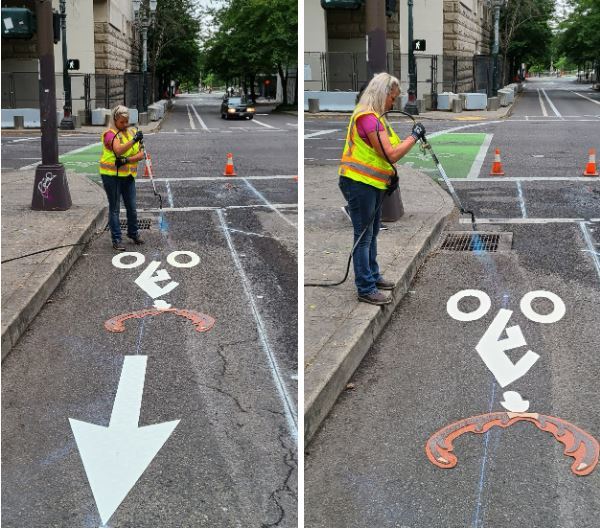
As always, a big shout-out to the amazing Maintenance Operations field crew: Jason Baggs, Mark Kodani, Dan Jones, Jim Brewer, Javier Corona-Lopez, and Rylan Bender. And a special thank you to Pennen Brelin and Jaclyn Rickard for creating and installing the elk bike lane art. Folks were up at 3 a.m. both Saturday and Sunday to complete the job and add their magic touches.
Two photos looking east from the intersection of SW Main Street and Third Avenue showing Pennen Brelin, in high-visibility safety vest, wielding a long blow torch to apply new bike lane art which add large brown antlers, an ode to the elk statue nearby.
This project is proving to be a favorite of both PBOT staff and the public. “I don’t know who exactly to thank for this, but I want to say that every day I come across the Hawthorne Bridge and bike past [where the elk was] is a better day,” wrote Catherine Ciarlo, Development, Permitting & Transit Acting Group Director. “The new street configuration feels so safe! So seamless! So simple and logical! Please pass along my congrats and gratitude to the folks who cut through the resistance and made this happen.”
At press time, PBOT’s Instagram post about the bike lane changes had 244 likes, 15 comments, and was shared 42 times. In all, we reached 2,366 accounts, 13% of which do not currently follow us.
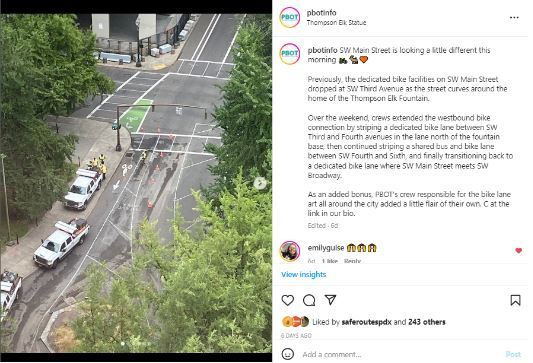 |
An Instagram posts shows an aerial view of SW Main Street. The new dedicated bike lane is visible as Maintenance staff stand alongside the road. The caption reads: “SW Main Street is looking a little different this morning 🚲🦌🧡Previously, the dedicated bike facilities on SW Main Street dropped at SW Third Avenue as the street curves around the home of the Thompson Elk Fountain. Over the weekend, crews extended the westbound bike connection by striping a dedicated bike lane between SW Third and Fourth avenues in the lane north of the fountain base, then continued striping a shared bus and bike lane between SW Fourth and Sixth, and finally transitioning back to a dedicated bike lane where SW Main Street meets SW Broadway. As an added bonus, PBOT's crew responsible for the bike lane art all around the city added a little flairof their own. C at the link in our bio”.
Hey cool cats and Coffee Talkers, remember to get your last chats of this round in! We’re officially closing out our current round this week. Keep an eye out for the Coffee Talk Experience Survey in this week’s edition of the Scoop. We appreciate the time you take to fill it out, as it lets us know what change is needed to ensure the program continues to serve participants.
Miss out on the last round? Don’t fret! Signups for the October, November, December round will open soon.
If you have other questions or feedback for the organizer directly, reach out to Kailyn Lamb anytime.
Copy got you down? PBOT’s next Lunch and Learon will feature a fun, interactive writing workshop with PBOT Content Producer, author, and overall word nerd Stacy Brewster. Using real PBOT examples, Stacy will walk through ways to improve your writing and public communication skills, tricks to transform bureau jargon into plain language, and tips for using the PBOT writing guides and glossary.

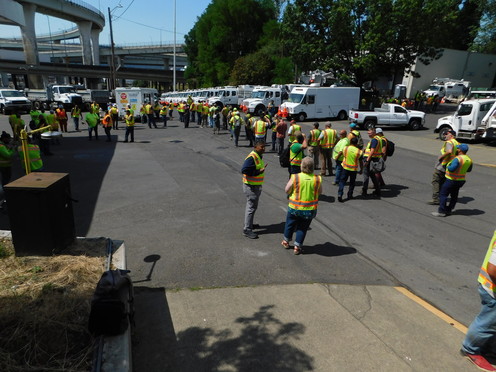
On Wednesday, Aug. 17, PBOT’s Maintenance Operations crews gathered in the N Kerby yard for some well-deserved ice cream and recognition. As you all know, maintaining Portland’s right-of-way both above and below the ground and sometimes on water (looking at you, Duckworth Dock) is no small feat. These talented and skilled people do technical and difficult work in the elements, often with an audience of kids or other curious passersby.
Photo showing dozens of Maintenance Operations employees, in yellow safety vests, standing in line for ice cream in the Kerby building parking lot. Parked PBOT trucks and other vehicles line the lot behind them, along with multiple freeway overpasses above in the distance.
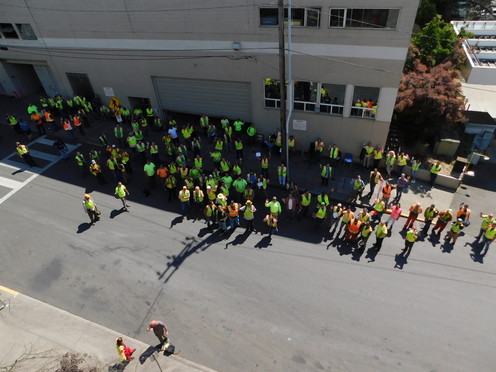
A resounding “thank you,” “huzzah,” and many high fives to our friends at Maintenance. This city is smoother, safer, cleaner, and frankly better because of the work you do. All ice cream scoops deserved!
A bird’s-eye photo captures a scene of 50+ Maintenance employees standing in the shade of a building. All wear yellow safety vests and some wave at the camera.
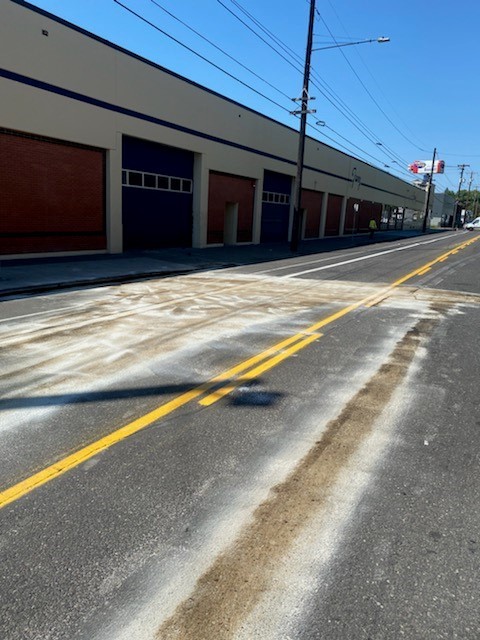
Last week, PBOT crews responded to a large gas spill on NE 12th Avenue between Davis and Flanders streets. Mark Bartholomew had crews onsite to close the street while they waited on the cleanup crew. The first email notifying folks of the spill came through at 1:35 p.m. Within two hours, the hazmat contractor finished their work and we reopened the road at 3:40 p.m.
If you look closely, you can see James Petit with his yellow vest on, in the photo below:
A view of NE 12th Avenue looking north toward Flanders Street with Franz Bakery along the left. The street has been freshly cleaned up from an oil spill.
The work that PBOT’s Maintenance Operations crews do every day is vital to safe travel, and in this instance, protecting our rivers and streams. Big thank you to our dedicated staff that responds to these emergencies with the urgency and skill they require.

By Lisa Strader, PBOT’s ADA Coordinator and Ramps by Request Program Manager
For the last eight years, my professional world has focused on increasing accessibility in our transportation system, especially for people with disabilities. Despite this focus, I recognize how little I understood about the depth and range of ableism in our culture.
Screen capture from Merriam-Webster’s definition of ableism, noun, defined as “discrimination or prejudice against individuals with disabilities."
Casual and commonplace ableism
Recently, I heard a community member complaining about the cost and unsightliness of our standard ADA-compliant curb ramps with truncated domes. “The old ones work just fine for people with disabilities and if they aren’t on every corner, people can just use a driveway,” they said. Another thing I’ve heard multiple times arguing against these same ramps: “someone will help them get what they need.”
These are common examples of ableism. Like other forms of discrimination, ableist actions or beliefs discriminate against people with disabilities, diminishing them.
The medical community writ large, historically, has been a major contributor to ableism, seeing disability as something wrong with a body, a defect within the individual rather than one of many characteristics. Although forced institutionalization or sterilization might be relics of the past, these prejudices persist, with an overreliance on a medical model of disability rather than a social or human rights model.
For example, some medical professionals still tell parents of a child born with Down syndrome that they may never walk, talk, or be able to sit up (I’ve heard this from more than one parent). Some in the medical community believe disabilities are exaggerated, refusing to authorize equipment, medication, or surgeries that may improve someone’s life, simply because it won’t “fix” the person. They under-prescribe birth control under the belief that people with disabilities can’t or shouldn’t be sexually active.
During the ongoing Covid-19 pandemic, some took comfort in the fact that those dying from Covid-19 tended to have preexisting conditions, which includes a wide swath of the disability community. The message to people with disabilities here is rather dark, saying that such deaths were less of a loss than that of a so-called “able-bodied” person. All of these views are, at their core, ableist.
A lot of ableism comes from years of media messaging of the needs and limitations of people with disabilities, portraying otherwise typical athletic, social, or intellectual activities as extraordinary. A local news story heralding a wheelchair user completing a marathon, for instance, or a TV show portraying someone with an intellectual disability graduating from college as remarkable, these are common tropes of ableism in our culture. It’s sometimes referred to as “inspiration porn.” If you are in the mood to laugh, check out Stella Young’s TED Talk “I'm not your inspiration, thank you very much.”
Worse are media tropes which center non-disabled people as heroic for including or helping a disabled person, e.g, the football player asking a girl in a wheelchair to the prom, or the baseball team whose ball boy has Down syndrome. The issue here isn’t necessarily the action of the players or team but the way the media reports the story, minimizing the worthiness of the person with the disability.
These trends may be reversing slightly now, but actors with disabilities are typically overlooked for parts in favor of non-disabled talent, even when the role has the same disability. Actors with disabilities are routinely undercast as well, given non-speaking roles, child-like roles, or being the object of someone else’s saving.
Sometimes the good intentions of good people are ableist: asking a paraplegic hiker if they are looking for their group; telling a wheelchair user loading groceries in their car, “good for you getting out on your own”; or grabbing the arm of someone using a white cane to help them cross the street. A blind woman I know can't stand it when her family visits and they won't let her carry her own plate to the table. Each of these may come from a place of wanting to support someone but, to a person with a disability, they feel like they are seen as incapable.
-
Celebrate successes, but don’t excessively gush if the person has a disability.
-
Ensure people with disabilities are invited into our work and that our ways of connecting with them allow actual inclusion.

Editor’s note: If you or a PBOTer you know is retiring, please reach out to Kailyn Lamb so the Street Cred team can put together a farewell article.
Today marks the end of an era for the Parking Operations division and for PBOT as a whole: Chris Armes officially retires after 30 years of service! She leaves a legacy of successful projects that have improved Portland streets and systems. We wanted to share some of Chris’ story, her many accomplishments, and hear a bit from colleagues about the far-reaching impact of her work.
Chris grew up in Milwaukie, Oregon but her PBOT story begins in 1992 as a Community Service Aide (CSA). Chris moved to the Neighborhood Traffic Management program as an Associate Planner after that, then to the Pedestrian program as a Program Coordinator.
By 1999, Chris landed in the Project Management division where she would spend the next 15 years, first as a Technician, then as a Capital Project Manager. During her tenure there, she successfully managed more than 20 large-scale projects, often against short timelines, including:
-
E Burnside/Couch Street Couplet
-
NE Sandy Boulevard Resurfacing and Streetscape
-
Southwest Sidewalk Infill
-
SW Montgomery Streetcar Relocation
That last one was the largest capital project in her portfolio with a budget of $52 million and less than two years for design and construction. As part of the scope, PBOT crews and contractors rebuilt 3,200 linear feet of SW Moody Avenue by raising it 14 feet and widening the right-of-way to 75 feet.
Maintenance Operations Group Director Jody Yates has much to add about that project. “When PBOT was awarded a Transportation Investment Generating Economic Recovery (TIGER) grant in the first round, Chris was chosen as project delivery manager,” Jody says. “The project elements included elevating SW Moody Avenue 14 feet and incorporating Streetcar. Some (but not all) obstacles included: a compressed timeline, working with the Federal Transit Administration (not a typical PBOT partner), an older sewer line that could not handle 14 feet of regular fill dirt, and acquiring Streetcar rail.”
“Chris took every obstacle in stride and brought a can-do attitude to problem-solving, coordinating, and collaborating,” Jody adds. “There were many firsts on the project. She worked with procurement to create one of the first Construction Manager / General Contractor contracts for PBOT. She worked with U.S. steel manufacturers to make a unique rail and get in the queue for a small order of just 5 miles of rail. She partnered with the Bureau of Environmental Services to determine how much additional regular soil to remove to add back lightweight fill to keep the sewer line safe. In the end, Chris (and her team) successfully delivered the project on time and on budget and was the second project in the nation to get constructed under the TIGER program. (BTW - it was a close race!). Chris' leadership on the project allowed the city to receive additional grants because the City of Portland can deliver projects!”
Chris notes a couple projects she was proud of that led to big changes in Portland’s streetscape. These include the demolition of the Lovejoy viaduct which made room for a new Streetcar in Northwest, and the E Burnside/Couch Street couplet which turned a section of E Burnside Street one-way going east and NW Couch Street one-way west. Both projects laid the groundwork for significant development of the Pearl and Central Eastside districts.
Wendy Cawley remembers working on the couplet with Chris. “Chris was a great project manager,” Wendy says. “I so enjoyed our time working together on the project, especially during construction. We had an interesting contractor and some classic property owners and constituents that made for funny stories and memories, most of which I can't mention here! But I will always remember Chris as one of the best project managers at PBOT, able to lead her team and bring in projects on time and on budget.”
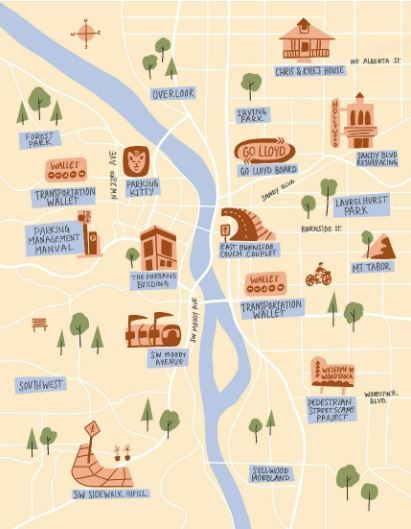
To pay homage to the many projects Chris worked on at PBOT, and the huge impact Chris has had on Portland, her team at Parking Operations commissioned this beautiful map from artist Arial Piazza (whose work can be found on Etsy):
An illustrated map of Portland shows major streets crisscrossing against a pink background. The Willamette River runs through the map from top to bottom, with some neighborhoods and parks sprinkled throughout. Chris’ key projects are labeled in blue. Projects listed west of the river (top to bottom): are the Transportation Wallet, Parking Kitty, Parking Management Manual, The Portland Building, SW Moody Avenue, and SW Sidewalk Infill. East of the river (top to bottom): Chris and Kyle’s house, Sandy Blvd Resurfacing, Go Lloyd Board, East Burnside/Couch Couplet, Transportation Wallet, and Pedestrian Streetscape Project.
Home at Parking Operations
In 2014 Chris needed a change of pace and pivoted her work to the Parking Operations division where she worked her way up from Capital Project Manager to Division Manager in just four years. Early on at Parking Operations, Chris helped implement the Northwest and Central Eastside Parking Management plans. Under her guidance and leadership, PBOT more than doubled the number of parking pay stations in Portland, bringing more than 800 new ones online.
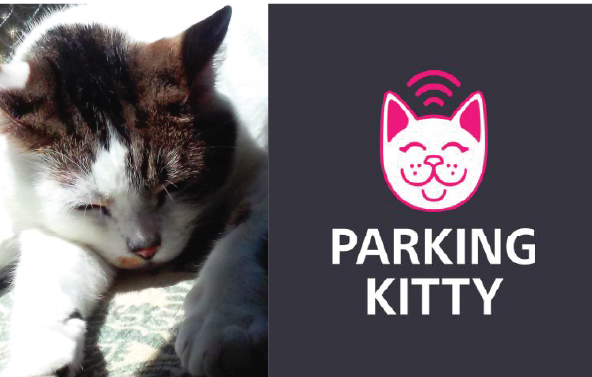
Most notable in Parking Operations, Chris and consultants Parachute Strategies conceptualized the well-known Parking Kitty logo, modeled after her late cat Coconut (RIP) who Chris describes as a “fat and sassy girl.”
Chris also worked with Scott Cohen on the Transportation Wallet program and developed the Parking Management Manual.
On the left, Coconut the cat is pictured basking in the sun with her eyes closed. On the right, a pink outline against a white background depicts the Parking Kitty logo.
“Chris has been so supportive of her staff in Parking Operations,” says Colleen Mosser who works on Chris’s team as a Parking Operations analyst. “She is always promoting self-growth, trusting us to get the job done and understanding when things go awry. She brings years of insight to the political aspect of our jobs and is great at team coordination between work groups through difficult tasks. Overall, she's just a good person,” Colleen adds. “She is funny and witty, but also direct and professional. She always reminds us there's no such thing as a parking emergency.”
Chris leaves behind a staff of 31, the kind of people that have always made her excited to stay at the bureau over her long tenure. As a public employee, she has always valued this camaraderie alongside the common goal of working to build things and change policy to improve the lives of Portlanders, especially during the city’s growth.
In her parting words to her team and to PBOT, Chris says: “When people are mad at you, remember to not take it personally. Being in the public eye, we hear from people who are so angry about our projects, but they just want to vent. Our job is to implement the policy.”
Parking & Regulatory Services Group Director Dave Benson mirrors this idea, saying “I will remember and use the lessons Chris taught us that will keep our team strong, always learning and delivering the service the community needs.”
Although this is Chris’ official last day, she has already moved to Washington’s Olympic Peninsula. She looks forward to this next chapter of life, exploring the Olympic Peninsula, enrolling in a Master Gardener program through Washington State, golfing, kayaking, and some possible dabbling in macramé cat hammocks!
PBOT wishes Chris the best although Colleen perhaps sums it up perfectly: “Although I'm happy Chris is moving on to the next stage in her life, I am still very sad that she is leaving. On both a professional level and a personal level, the days just aren't going to be as good without her.”
You can continue to stay in touch with Chris by contacting her via her personal email at Armes068@gmail.com.

The Congressman Earl Blumenauer Bicycle & Pedestrian Bridge opened to the public with a massive celebration July 31. Thousands came out to bike on the new bridge, hear Congressman Blumenauer and other public officials speak, and engage with community vendors. The celebration spanned the Lloyd and Central Eastside neighborhoods, from the Go Lloyd organized event at the Hassalo Plaza, to the main bridge celebrations run by PBOT, to the Depave event in the central eastside that ran until 10 p.m. The celebration's success was not just the culmination of three months of event planning—it was the culmination of years of planning and construction on the bridge itself.
The bridge is already having a huge, positive impact on pedestrians and people biking. But what you may miss about it’s gorgeous design is one hidden feature: seismic resiliency. While other Portland bridges could be damaged or collapse in a major earthquake, the Blumenauer—like the new Ned Flanders Crossing—can withstand a major quake. In the event of such a catastrophe, these bridges would become emergency routes to get people, supplies, or emergency equipment across the highway.
Before it received its distinctive name, the Blumenauer Bridge was originally conceived in the 1990s when PBOT planners began to look for ways to connect central city neighborhoods east of the river divided by I-84, making them more accessible for pedestrians and cyclists. The idea for the bridge gained support from cyclists and community organizations like The Street Trust and Friends of the Green Loop. By 2015, PBOT secured core funding for the project.
The Blumenauer Bridge faced a few unique challenges during the construction phase. The first concerned land ownership. I-84 and much of the surrounding land is owned by the Oregon Department of Transportation (ODOT). To the west of I-84, near the north landing of the bridge, is a set of railroad tracks owned by Union Pacific Railroad. When building the bridge, Capital Project Manager Dan Layden had to plan with the construction team how the contact points of the bridge would land on PBOT property. They also had to account for construction taking place on railroad and ODOT land which created unique working conditions. For instance, the portion of the bridge over the railroad had to be worked on in 2-hour chunks to avoid scheduled trains. With some tasks requiring uninterrupted work, this meant a lot of strict time pressure.
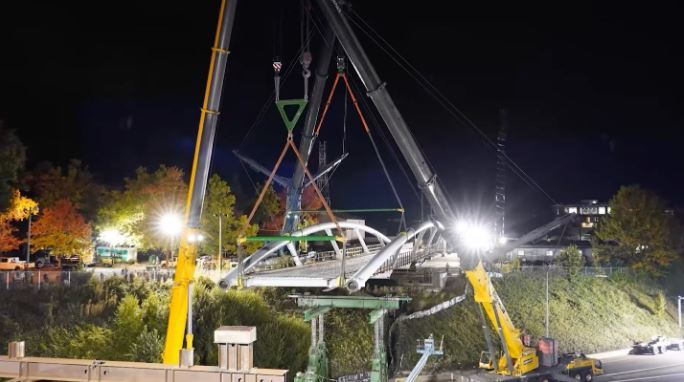
Another construction challenge was building over I-84. Any construction of the bridge directly over the highway required shutting down at least some of the highway. “The only way we can build this thing is to close the freeway.” Dan recalled. “We either close it for a long time, closing lane by lane, or we close the entire highway for one night.” The team opted for the latter.
Photo with yellow and green cranes crisscrossing the frame holding up the Blumenauer Bridge being moved into place across I-84. The sky is dark; bright lights illuminate the highway and the fall folliage in the background.
The ongoing Covid-19 pandemic, amongst other hurdles, slowed construction, so the bridge’s completion this summer was a huge cause for celebration.
PBOT’s Blumenauer Bridge celebration was the largest in the bureau’s recent memory. PBOT worked with many community organizations including the Central Eastside Industrial Council, Go Lloyd, Milagro Theater, The Street Trust, and Depave to put on the daylong celebration, including block parties at multiple sites.
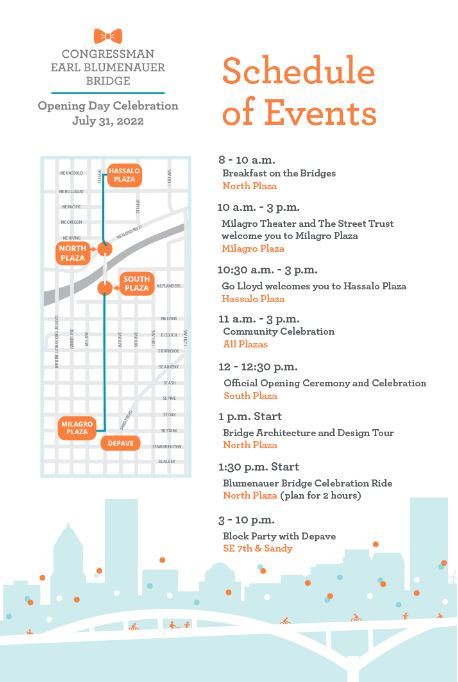
A flyer lists out the schedule of events for the Blumenauer Bridge Opening Day Celebration July 31. On the left of the flyer a map shows key celebration areas: Hassalo Plaza, the north and south plazas of the bridge, the Milagro Plaza, and the Depave event. Event list includes: Breakfast on the Bridges, Milagro Theater and The Street Trust welcomes you to Milagro Plaza, Go Lloyd welcomes you to Hassalo Plaza, Community Celebration, Official Opening Ceremony and Celebration, Bridge Architecture and Design Tour, Blumenauer Bridge Celebration Ride and a Block Party with Depave.
For the PBOT planning teams, one challenge was finding a way for these separate community celebrations to integrate organically with the opening.
Active Transportation & Safety Programs Section Manager Renata Tirta outlined the importance of this process. “This is the day the bridge becomes a public asset,” Renata said. “People will do with it what they want. They will bring their own sense of fun and utility to it.” Integrating community celebrations, in other words, was a key part of handing the bridge over to the public.
Planning for the opening began in early May, with a ton of coordination and time from Renata and the Active Transportation & Safety Programs team alongside PBOT Communications.
From Portland’s own Karma Rivera’s hip-hop performance to local donuts to Congressman Blumenauer's speech itself, every bit of planning was worth it. Over 8,000 people took part in the day’s activities, a celebration that continues today as people use the bridge.
Since its opening, the Blumenauer Bridge has provided an incredible new connection for pedestrians and people biking between the Lloyd and Central Eastside neighborhoods. Based on PBOT’s electronic bike counter, the bridge now averages roughly 1,500 bike crossings a day.
The bridge stays busy. People use it to meet friends and take in the view. Crews are on hand to plant trees and other final touches for the plazas. But no matter who is using it or enjoying it at any moment, the bridge stands as a mighty symbol for active transportation, lowering emissions, and bringing communities together.
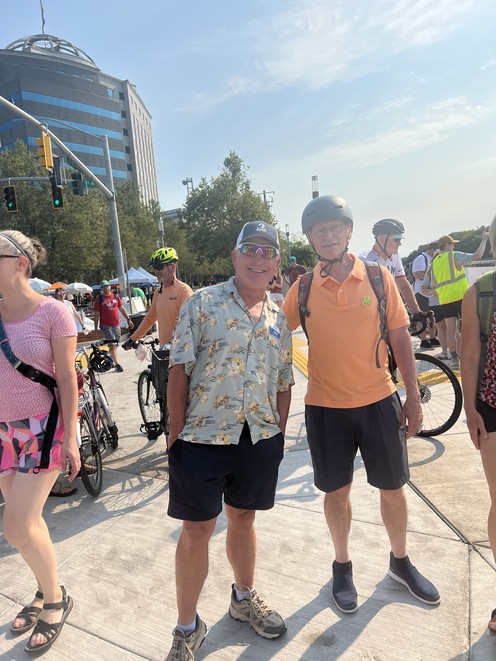
Project Manager Dan Layden (left) stands next to Congressman Earl Blumenauer at the bridge opening celebration.
For Project Manager Dan Layden, this is a farewell project capping over 20 years at the bureau. “It’s a good illustration that Portland still cares about building quality infrastructure,” Dan says. “It’s a unique facility that is beautiful to look at but is also very functional. I’m excited to see it at night because of the lights, it should look really cool. It's had its challenges. It’s been quite a ride, but it was fun and really rewarding. I'm glad we built something memorable that Portland can hopefully be proud of.”
We send a hearty thank you and congratulations to Dan alongside the many current and former PBOT staff who worked to make the bridge and the opening day’s celebration a reality. This doesn’t even include the countless PBOT staffers that came with family and friends to take part. If we missed you, please reach out to Kailyn Lamb for a shout out in an upcoming Scoop or Street Cred.
-
Amy Masoni
-
Andy Sullivan
- Art Pearce
- Cameron Glasgow
- Dan Layden
- David Backes
- Frederick Mangubat
- Kim Roske
- Mario de La Rosa
- Michelle Marx
- Nick Falbo
- Quoc Nguyen
- Roger Geller
- Stephen Bussey
- Steve Szigethy
- Trey Senatore
Event planning and staffing:
-
Abby Hauth
-
Alyssa McGhghy
-
Blair Vallie
-
Brady Lovell
-
Bryan Nguyen
-
Demetri Finch-Brown
-
Dylan Rivera
-
Gui Fonseca
-
Hannah Schafer
-
Kailyn Lamb
-
Michael Espinoza
-
Noah Hanser-Young
-
Reed Buterbaugh
-
Renata Tirta
-
Rob Hemphill
-
Roshin Kurian
-
Sarah Bermudez
-
Sherry Chiang
-
Shoshana Cohen
-
Stacy Brewster
-
Steve Hoyt-Mcbeth
-
Steve Szigethy
-
Timo Forseberg
-
Tom Haig
-
Troy Lynn Craft
Want to share a PBOT story here in Street Cred? Limit your copy to less than 500 words, provide detailed captions for any graphics, and email kailyn.lamb@portlandoregon.gov by 5 p.m. Thursday the week before the edition goes out so we have time to copy edit and proofread. For longer featured articles please reach out to us first so we can target the best date for you.
Upcoming editorial deadlines:
-
Sept. 14 issue [deadline: Sept. 8]
-
Sept. 28 issue [deadline: Sept. 22]
-
Oct. 12 issue [deadline: Oct. 6]
|