Women’s History Month had its origins as a national celebration in 1981 when Congress passed Pub. L. 97-28 which authorized and requested the President to proclaim the week beginning March 7, 1982 as “Women’s History Week.” Throughout the next five years, Congress continued to pass joint resolutions designating a week in March as “Women’s History Week.” In 1987 after being petitioned by the National Women’s History Project, Congress passed Pub. L. 100-9 which designated the month of March 1987 as “Women’s History Month.” Between 1988 and 1994, Congress passed additional resolutions requesting and authorizing the President to proclaim March of each year as Women’s History Month. Since 1995, presidents have issued a series of annual proclamations designating the month of March as “Women’s History Month.” These proclamations celebrate the contributions women have made to the United States and recognize the specific achievements women have made over the course of American history in a variety of fields.
Upcoming Women’s History Events:
As we leave February and move closer to spring, we remind you that every month is Black History Month. Continue to celebrate all Black History—highlighting joy, resilience, and creativity.
From the Oregon Department of Veterans’ Affairs:
In honor of Black History Month, the Oregon Department of Veterans' Affairs is highlighting just a few of the exceptional stories, achievements, and contributions Black Americans have made to our nation's military history. The final entry in our series looks back on the remarkable service and legacy of the 6888th Central Postal Battalion, the first and only all-female Black battalion to be deployed overseas during World War II. You can find the story on their blog here.
In this issue of Street Cred:

Hey Coffee Talkers, make sure to check your inboxes for your next match. Emails went out Monday, Feb. 28. If you think you should have received one but didn’t, email Kailyn Lamb.
Erick Moe, Streetcar System Manager, shared some important work performed recently by Streetcar’s maintenance team and TriMet mechanics to make the Streetcar a little nimbler. This team is developing cutting edge procedures that will be shared with streetcar operators around the country to help preform work on aging fleets. Read more from Erick:
The Streetcar maintenance team was successful in safely separating the three sections of the Streetcar to replace the lower spherical plain thrust bearings that allow the train to make the tight turns and to navigate the steep grades found on our alignment.
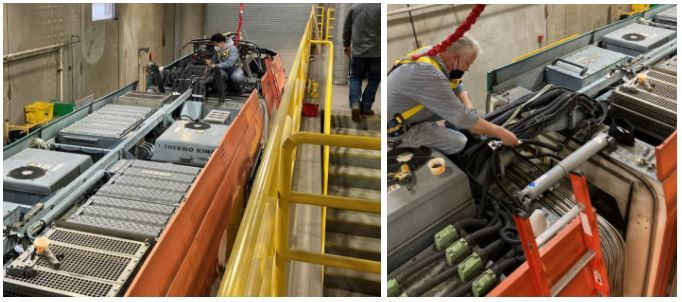
Image on the left: TriMet mechanic Jonathan disconnecting upper articulation link; Image on the right: TriMet mechanic Steve Taylor removing wiring hold downs to allow separation
The maintenance supervisory team, TriMet journeyman mechanics, Mike Cave from Risk, and our operations team were all involved and deserve a thanks. Mike Cave assisted the team by advising on a safe practice to access the roof of the train through his extensive knowledge of OSHA regulations. Operations had to work around a shop bay being out of service and made daily pullouts from our small facility.
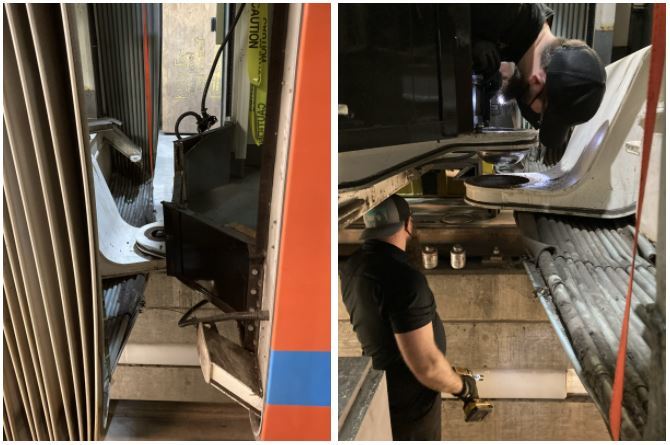
The procedure that this team developed, which uses liquid nitrogen to shrink the bearing for install, will be shared with other U.S. streetcar operations and help them perform work on their aging fleets.
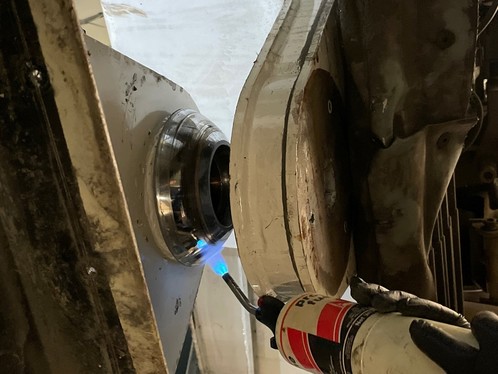
Portland is truly a model other streetcar operations look to when it comes to ingenuity and process development. Without the dedication of this group, our TriMet partner, and networking within the city we would be facing larger funding hurdles that would otherwise require specialized contractors to travel and perform this work. Below is a picture of the bearing:
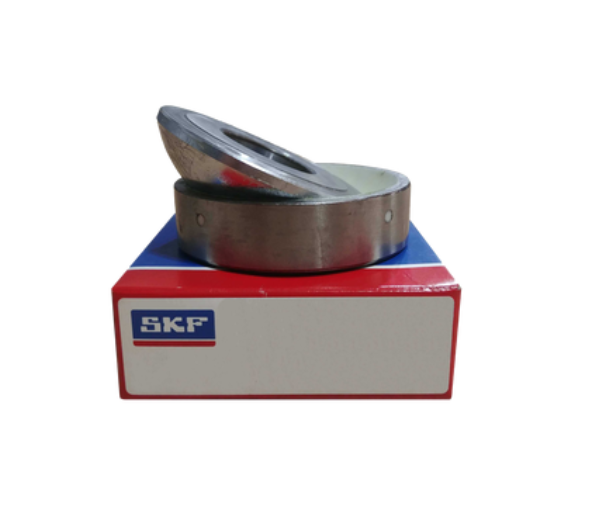
Image of the new bearing
Thank you to Maintenance Manager Will Threewitt, Maintenance Supervisors Lee McIntire, Will Krieger and Jake Keller, Supervisor Lenore DeLuisa and the operations team, and Risk Specialist Steve Fisher, Mike Cave, and Jimmy Gibbons, who consulted on the OSHA best practices.
Portland Streetcar shared this story via their Twitter account, too:
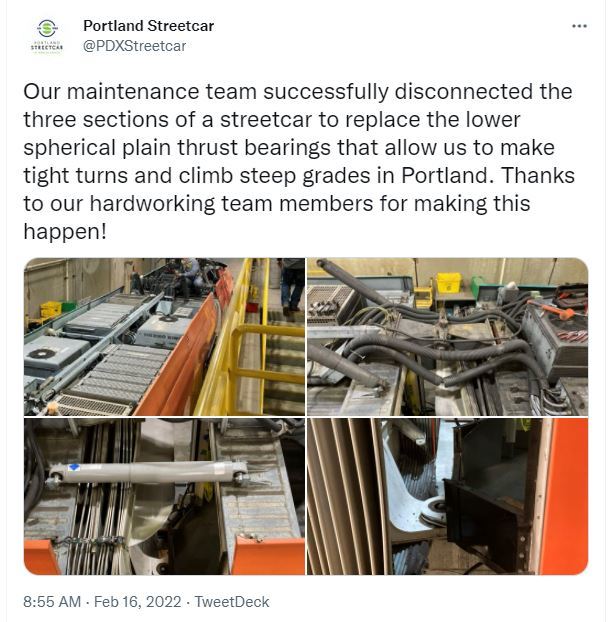
Screen shot of Portland Streetcar tweet which reads "Our maintenance team successfully disconnected the three sections of a streetcar to replace the lower spherical plain thrust bearings that allow us to make stight turns and climb steep grades in Portland. Thanks to our hardworking team members for making this happen!" along with four photos of these parts.
The following note was sent to Abra McNair and Richard Nasiombe from the Rose City Park Elementary School community. This work would not be possible without PBOT’s Project Delivery and Support teams lead by Michelle Rhoads:
“On behalf of the Rose City Park Elementary School community, I want to express our sincere gratitude for your incredible responsiveness, professionalism, and speed in identifying our safety issue with students and families crossing NE 57th Avenue to and from school. Honestly, I was shocked to arrive Monday morning to my duty post to discover the new striped crosswalk and signage installed over a month earlier than we had expected. You are amazing! Please share our gratitude to those who did the installation as well. As the person who watches this intersection every morning and afternoon, I can tell you that the difference in traffic speed and attention to our pedestrians improved greatly.”
Here is a picture of our safety patrol already in action. I’m including our parent leaders so they can share their gratitude as well.
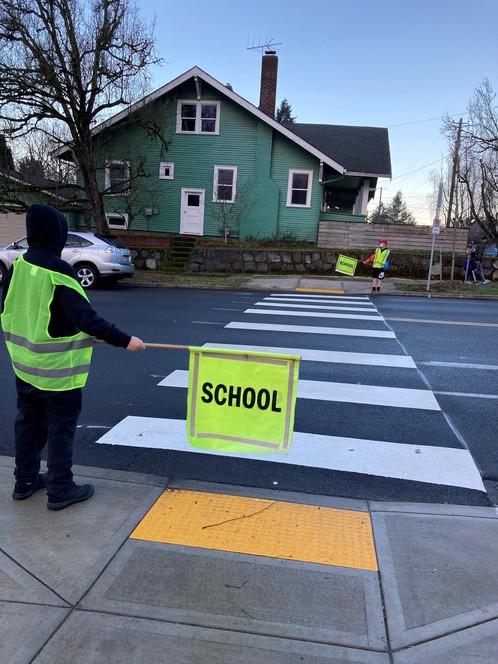
Two people in yellow safety vests stand on either end of a newly painted crosswalk on NE 57th Avenue. They are holding yellow signs that read "SCHOOL".
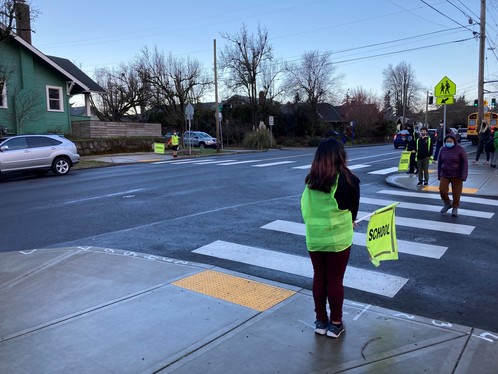
People in yellow safety vests snd holding yellow "SCHOOL" flags help students cross the street.
Shout out to Parking Enforcement Officer Josephine Young for going above and beyond for her community. Josephine was on a service request recently at NE 42nd Avenue and Sandy Boulevard for a vehicle blocking the traffic lane. The driver told her they’d run out of gas. Since he had a gas can, Josephine took it to a gas station a block away, put $5 of gas in, and put it in the tank. The driver was able to continue on their day safely with no ticket. “I thanked Josephine for going above and beyond to help out a fellow community member. This speaks volumes to her character,” wrote Rich Thallheimer, Parking Enforcement Supervisor. We couldn’t agree more.

Last week, De’Angelo Bell and Jerry Munson from PBOT’s Street Signs and Pavement Marking teams, with support from Justin Buchanan and Sara Pope, installed two of the three Bike to Books winners from 2021.
PBOT launched Bike to Books in 2017 in partnership with Multnomah County Library to encourage kids to ride bikes and read books. Every May, we invite kids all over Multnomah County to design new bike lane art for Portland. Grand prize winners get their design installed on a city street.
This program would not be possible without the support, skill, and care these teams give toward the creation of thermoplastic versions of the winning designs, and the final installation.
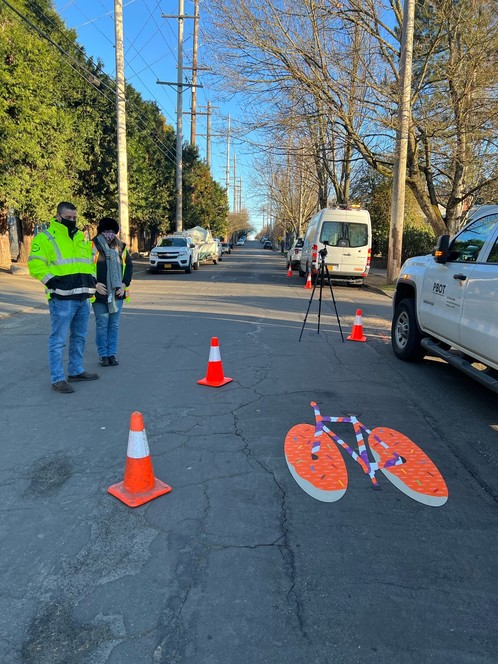
PBOT employees Justin Buchanan and Sara Pope bundled up for the cold in high-visibility jackets and face coverings, stand next to newly installed bike lane art of a purple, white, and orange striped bike with orange sprinkle donuts for wheels.
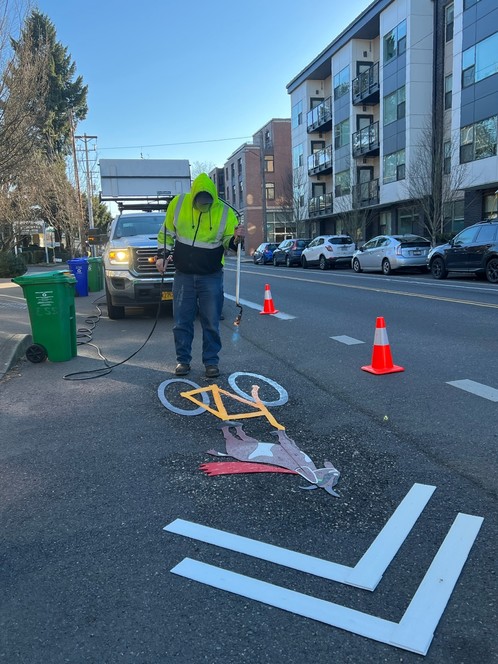
PBOT employee Jerry Munson uses a blow torch to heat up new bike lane art of a brown and white goat wearing a red cape standing on a yellow bike with grey wheels.
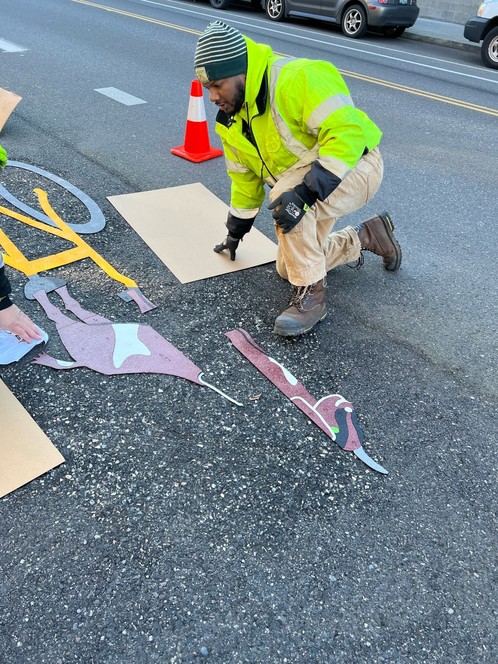
PBOT employee De’Angelo Bell kneeling next to thermoplastic pieces that will fit together to become the Goat Bike bike lane art.
You’ll find “Donut Bike” by Mitzi Duplain, the 7th-12th grade winner, sprinkled along NE Rodney Avenue, just north of Russell Street.
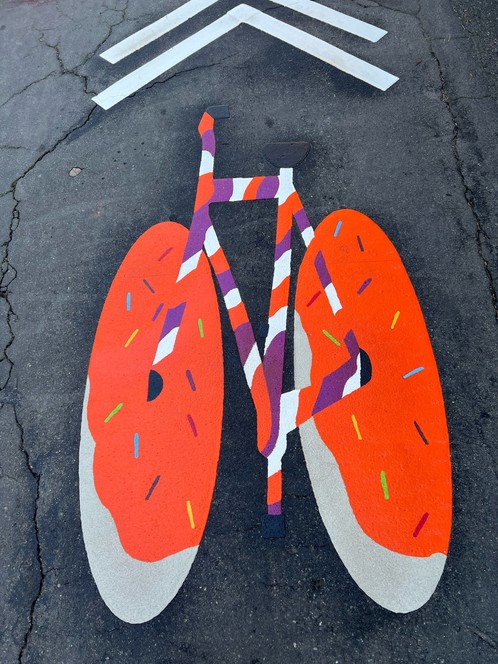
Bike lane art with purple, orange and white striped frame and orange donut "wheels" with multi colored sprinkles.
Go say “hay” to the G.O.A.T.! “Portland Goat” was designed by Ya El Siegel, the 3rd-6th grade winner, on NE Tillamook Street, just west of César E. Chávez Boulevard.

Bike lane art of a goat with a red cape standing on a yellow bike with grey wheels.
Stay tuned for the installation of our final design, “Roarcycle,” designed by Marco De Ieso!

By Kailyn Lamb, Tosin Abiodun, Corinne Kotter, and Stacy Brewster
PBOT’s Equity & Inclusion team is currently updating PBOT’s Five-Year Racial Equity Plan. They kicked off this work late last year with a brief survey of PBOT staff, asking how familiar we were with the previous plan. A big thank you to the roughly 200 employees who took a few minutes out of their day to take the survey. As PBOT’s Equity & Inclusion Manager Tosin Abiodun always says: “equity work takes a village.”
Here are some high-level findings from results of the survey. For those who want to dig deeper, you'll find more details on PBOT’s internal website here.
Just under 200 PBOTers took the survey. Of those, 137 people identified as white, 17 as mixed race, 11 as Asian, 7 as Black or African-American, 1 as American Indian or Alaska Native, and 1 as Native Hawaiian or Pacific Islander. Thirteen preferred not to disclose. The highest number of respondents have worked at PBOT for 10 years or more (70 respondents), followed by those who have worked here 3-5 years (64 respondents). PBOT Maintenance Operations had the most respondents from their group at 59, followed by Policy, Planning & Projects at 41. See the full demographic break down on our internal website.
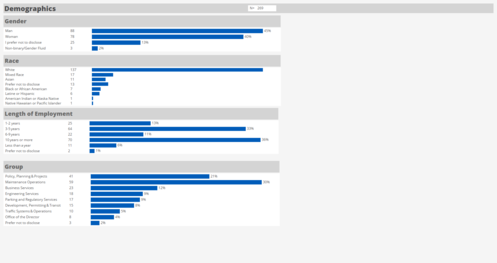
Graphic showing who responded to the survey by gender, race, length of employment, and from which PBOT group. Text is likely too small to read clearly, please go to the PBOT website link above in the article for larger images.
How familiar are you with the plan?
Of those who responded to the survey, a majority (58%) said they were very familiar or somewhat familiar with the plan. Respondents that identify as Black, Indigenous, or People of Color (BIPOC) were more likely to be somewhat or very familiar with the plan (72%) than white respondents (60%).
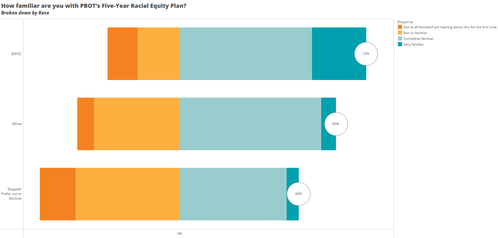
Graphic showing how familiar PBOT employees were with the PBOT’s Five-Year Racial Equity Plan, broken down by race. Top row represents employees who identify as Black, Indigenous, or People of Color (BIPOC), second row as white, third row for people who preferred not to disclose or skipped the question. The center of each bar represents 0% with dark and light orange bars to the left representing those not at all familiar with the plan or not so familiar, respectively. The light and dark turquoise bars to the right of 0% represent those who were somewhat familiar or very familiar the plan, respectively.
Respondents from the Policy, Planning & Projects, Office of the Director, and Development, Permitting & Transit groups were the most likely to be very or somewhat familiar with the plan. Supervising employees were more likely to be familiar with the plan (71%) than non-supervising employees (52%).
Did you contribute to the development of PBOT’s Five-Year Racial Equity Plan in 2017?
While more BIPOC staff answered they were familiar with the racial equity plan, less said they contributed to its development. Seventeen percent of respondents who identify as BIPOC said they contributed to the development of the plan compared to 68% of white respondents.

Graphic with results of the survey by race to the question “Did you contribute to the development of PBOT’s Five-Year Racial Equity Plan in 2017? Top row shows that 68% of white respondents said yes, second row that 20% skipped the question or preferred not to disclose, bottom row that 12% of BIPOC employees answered yes.
Of the respondents, 32% of those who said they contributed to the plan’s development came from PBOT’s Policy, Planning & Projects group, almost double any other group. Respondents who said they have been at the bureau for 10 years or more were the most likely group to have contributed to the development of the 2017 plan.
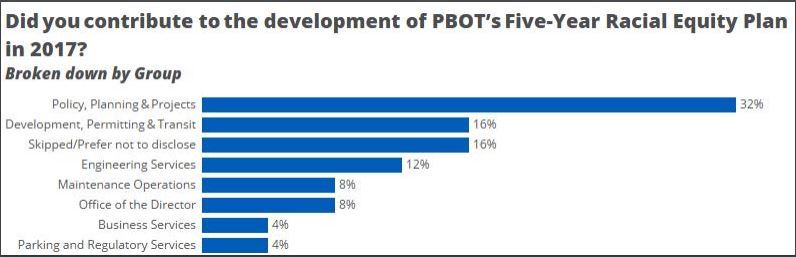
Graphic with results of the survey by PBOT group to the question “Did you contribute to the development of PBOT’s Five-Year Racial Equity Plan in 2017? From top to bottom, answering yes were Policy, Planning & Projects (32%), Development, Permitting & Transit (16%), skipped/prefer not to disclose (16%), Engineering Services (12%), Maintenance Operations (8%), Office of the Director (8%), Business Services (4%), Parking and Regulatory Services (4%).
Finally, the survey showed that supervising employees were more likely to have contributed to the plan (70%) than non-supervising employees (25%).
Equity is built into my performance plan …
Sixty-six percent of respondents agreed that equity is built into their performance plans. Respondents that identify as white were more likely (73%) to agree with this statement than either respondents that identify as BIPOC (65%), or respondents that skipped or preferred to not disclose (52%).
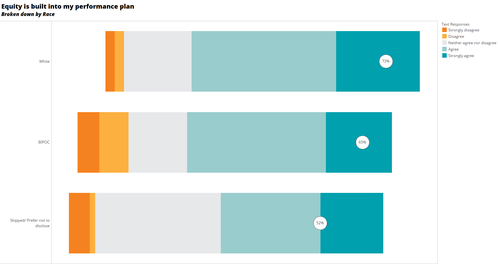
Graphic showing responses broken down by race as to whether equity is built into their performance plan. Vertical stripes read left to right in each row to represent responses of Strongly disagree (dark orange), Disagree (light orange), Neither agree nor disagree (gray), Agree (light turquoise), and Strongly agree (dark turquoise). A percentage is shown for all responses that either Agree or Strongly agree. Top row shows that white staff agreed or strongly agreed 73%, BIPOC staff 65%, and of those who skipped or preferred not to disclose their race, 53%.
Not surprisingly, non-represented employees were more likely to agree with this statement (78%) than represented employees (53%). We can safely assume this is due to the new performance management system, SuccessFactors, which is now used by all non-represented employees.
Supervising employees were more likely to agree with this statement (81%) than non-supervising employees (55%). This may be because supervising employees are non-represented and therefore have performance plans through SuccessFactors.
My team or division discusses PBOT’s racial equity plan regularly (at least monthly or quarterly).
Thirty-one percent of respondents agreed with this statement. Respondents in PBOT’s Traffic Systems & Operations group were the most likely to agree with this statement with 60% agreeing. This is interesting because Traffic Systems & Operations was also the group the survey indicated were less familiar with the plan than other groups (40%).
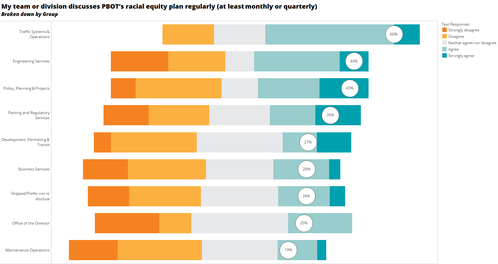
Graphic showing responses by group to the statement “My team or division discusses PBOT’s racial equity plan regularly (at least monthly or quarterly).” Vertical stripes read left to right in each row to represent responses of Strongly disagree (dark orange), Disagree (light orange), Neither agree nor disagree (gray), Agree (light turquoise), and Strongly agree (dark turquoise). A percentage is shown for all responses that either Agree or Strongly agree. From top to bottom results were TSO (60%), Engineering (44%), PPP (43%), Parking & Regulatory (35%), DPT (27%), Business Services (26%), skipped/prefer not to disclose (26%), Office of the Director (25%), and MO (19%).
My team, group, and division have clearly laid out equity workplans.
Twenty-eight percent of respondents agreed with this statement, with supervising employees agreeing at a higher rate (33%) than non-supervising employees (25%) or staff that preferred to not disclose (24%).
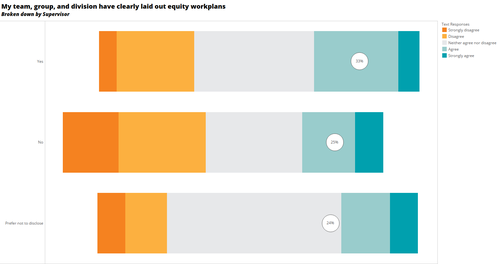
Graphic showing responses by status as a supervisor or not to the statement “My team, group, and division have clearly laid out equity workplans.” Vertical stripes read left to right in each row to represent responses of Strongly disagree (dark orange), Disagree (light orange), Neither agree nor disagree (gray), Agree (light turquoise), and Strongly agree (dark turquoise). A percentage is shown for all responses that either Agree or Strongly agree. Top row shows that supervisors agreed or strongly agreed 33%, non-supervising staff 25%, and those who preferred not to disclose 24%.
Respondents that identify as BIPOC agreed with this slightly more (33%) than respondents that identify as white (28%). Respondents in Policy, Planning & Projects were the most likely to agree with this statement (52%).
PBOT is an anti-racist organization.
Forty-nine percent of respondents agree with this statement. Fifty-four percent of respondents that identified themselves as white agree, 43% that identified themselves as BIPOC, and 41% that preferred not to disclose. In Traffic Systems & Operations 89% of respondents agreed with this statement.
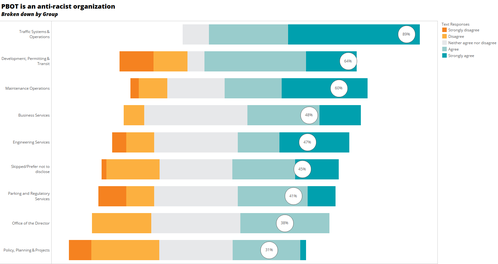
Graphic showing responses by group to the statement “PBOT is an anti-racist organization.” Vertical stripes read left to right in each row to represent responses of Strongly disagree (dark orange), Disagree (light orange), Neither agree nor disagree (gray), Agree (light turquoise), and Strongly agree (dark turquoise). A percentage is shown for all responses that either Agree or Strongly agree. From top to bottom results were TSO (89%), DPT (64%), MO (60%), Business Services (48%), Engineering (47%), skipped/prefer not to disclose (45%), Parking & Regulatory (41%), Office of the Director (38%), PPP (31%).
Supervising employees were more likely to agree (60%) than non-supervising employees (42%) or employees who skipped or preferred not to disclose (44%).
PBOT leadership (including managers and supervisors) provide clear direction and guidance about racial equity work plans.
Respondents did not agree with this statement with only 29% agreeing with it. We see that respondents in Traffic Systems & Operations responded with a higher rate of agreement at 70%.
Employees who have worked at PBOT for less than one year were also in a higher rate of agreement at 50% saying strongly agree or agree.
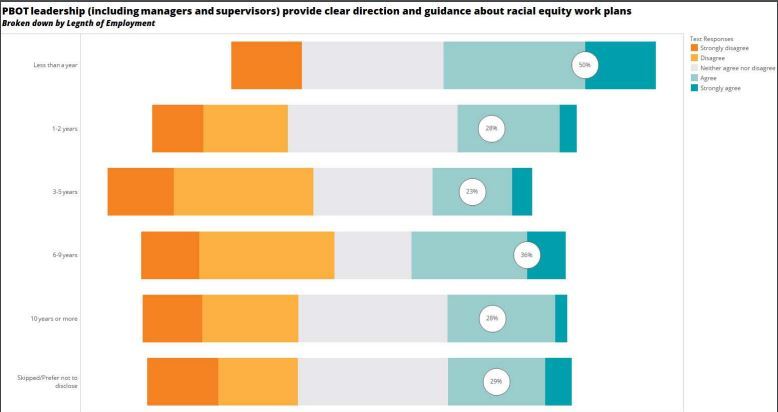
Graphic showing responses by group to the statement “PBOT leadership (including managers and supervisors) provide clear direction and guidance about racial equity work plans.” Vertical stripes read left to right in each row to represent responses of Strongly disagree (dark orange), Disagree (light orange), Neither agree nor disagree (gray), Agree (light turquoise), and Strongly agree (dark turquoise). A percentage is shown for all responses that either Agree or Strongly agree. From top to bottom results were less than one year(50%), 1-2 years (28%), 3-5 years (23%), 6-9 years (36%), 10 years or more (28%), skipped/prefer not to disclose (29%).
When was the last time you reviewed PBOT’s Five-Year Racial Equity Plan?
A great deal of respondents (41%) said they’d never reviewed the plan or hadn’t reviewed the plan in years. Another 23% said they’d reviewed it sometime last year. Thirty-six percent said they had reviewed it at least in the last few months.
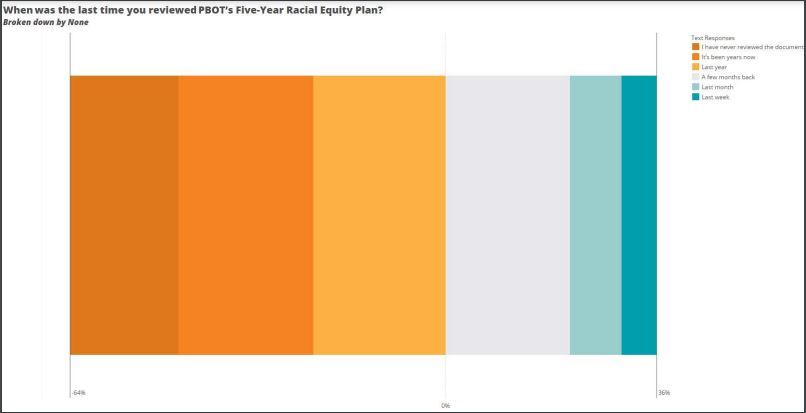
Graphic showing responses by group to the statement “When was the last time you reviewed PBOT’s Five-Year Racial Equity Plan” Vertical stripes read left to right in each row to represent responses of I have never reviewed the document (dark orange) 18%, It's been years now (medium orange) 23%, Last year (light orange) 23%, A few months back (grey) 21%, Last month (light turquoise) 9%, and Last week (dark turquoise) 6%.
Staff in PBOT’s Office of the Director and Traffic Systems & Operations were the most likely to have reviewed the plan recently.
Respondents that have worked at the bureau for less than a year were also more likely to have reviewed the plan recently.
-
PBOT’s newest group, Traffic Systems & Operations, is talking more about equity and the equity plan than other groups.
-
Supervisors were more likely than non-supervising employees to be familiar with the Racial Equity Plan, believe there is clear direction about equity work, or say equity is built into their work plans.
-
Generally, respondents did not think their group, division, or team had equity clearly built into their work plans. As we update our next racial equity plan, it will be important that individual teams, divisions, and groups rethink their work plans and how equity fits into them.
-
Less than half who took the survey see PBOT an anti-racist organization. We agree that PBOT is not at the end of its journey to becoming an anti-racist organization. That is why we need each of you to continue to engage with equity work, including helping to build the next racial equity plan.
Watch the Scoop and Street Cred for the PBOT Employee Engagement Survey. We’ll be asking your opinion about diversity, equity, and inclusion at PBOT, your workplace experience, what our new goals should be, and how we will accomplish them. It’s important we hear from folks across the bureau. Every single PBOTers’ voice is important. Remember: equity work takes a village.
By Abby Hauth
Tammy Boren-King used to be one of the first city employees people would see submitting proposals for new development. Even though she doesn’t work in person at the permit office anymore, she’s still one of the first PBOTers developers will interact with. Tammy has worked as a City Planner ll - Land Use in PBOT’s Land Use Review team for the last three years. She helps developers realize the feasibility of their project. For this article, she walked us through the early assistance timeline as well as some Portland history.
The Development Review division of the Development, Permitting & Transit (DPT) group is a relatively small 26-person team. Together they coordinate major right-of-way improvements without the use of public funds. The team includes civil engineers, traffic engineers, engineering technicians, transportation land use planners, and administrative staff.
As public stewards, the Development Review division balances many competing interests for use of the street, curb, sidewalks, and utilities that are on, above, or below ground. They manage and reduce impacts from Portland development, ensuring improvements to the streets and sidewalks meet PBOT’s strategic transportation goals. It requires countless hours of coordination with developers, their architects and engineers, other city bureaus, and other departments within PBOT all while working under a strict deadline to approve work permits.
This story is the second in a series highlighting the Development Review team and the vital work they do. To read the first article in this series, about five new projects at the North Portland Amazon facility, check out our Feb. 2 issue of Street Cred here.
An early assist for long-term success
Savvy developers know how to submit proposals for early assistance. There’s a cost for early assistance, but there are long-term benefits. For one, developers learn the various bureaus’ requirements prior to designing a project. No matter a project’s size, early assistance can help determine critical details about both the right-of-way and private property requirements.
PBOT’s role in early assistance answer many types of questions. Is the site up to city standards for frontage improvements? What part of the property will be dedicated for right-of-way improvements? Where can the driveway go? When Tammy reviews applications, she’s looking for two primary triggers for public improvements:
-
Does the development increase trips to the property? If so, standard improvements can be requested if the right-of-way is not full standard width.
-
If the plan won’t increase trips, are they altering the property significantly? If the permit value is 35% or more of the assessed value of on-site improvements, then the city can require frontage improvements within the existing right-of-way. Dedication is not required.
If either of these triggers are met, Tammy turns to the PBOT resources and manuals that house all our existing regulations, policy documents, and engineering requirements.
The first of these is Transportation Rule Number (TRN) 1.09, the PBOT Development Review Manual. This manual specifies the width and cross sections for local service streets. It establishes some guidance for streets with a classification other than local service. This 18-year-old manual was last updated December 2020.
The Pedestrian Design Guide is another useful resource for determining how wide a sidewalk needs to be. In places with no existing curb, developers must design stormwater management into their improvements and account for it in the dedication amount.
We also reference the 2030 Bike Plan. For instance, there may be collector streets identified in the plan as needing more separation between bike and vehicle travel lanes, but there’s no curb yet. We help identify improvements that will set these roads up for success in the future. Instead of marking the bike lane piecemeal, one property at a time, we ensure the curb is set back far enough to accommodate these future improvements.
Of course PBOT coordinates with many other bureaus throughout the Development Review process. During early assistance we work with the Bureau of Development Services, the Bureau of Environmental Services, the Portland Water Bureau, as well as Urban Forestry within Portland Parks & Recreation. Each bureau adds more detail on what’s required, from sanitary sewers to stormwater management, from water service to street trees, as well as zoning regulations and more.
When it comes to Development Review, Portland’s past can still be a present-day problem. The legacy of the land annexed over the last century still affects Tammy’s job today.
Many parts of Portland have streets far from the current standards. These are gravel streets or streets without sidewalks. Many of them were under the jurisdiction of unincorporated Multnomah County or built before the current system of land regulation existed at all. This includes much of Portland east of 82nd Avenue, large sections of Southwest Portland, and much of Portland north of Columbia Boulevard. These properties were annexed into Portland for a variety of reasons, such as access to sanitary sewer systems or compliance with statewide land use planning goals.
Coordinating all the many types of improvements (or lack thereof) the past has left us, is one of the many challenges PBOT’s Development Review team deals with daily. It requires tons of coordination across bureaus, as any decisions affects the function of all the various parts of our city system. They must also keep up with constant updates to the city’s long-term plans or state law.
Tammy emphasized how vital good communication is to the function of their team, between bureaus but also within our own, to ensure updates to plans, rules, and guides are communicated clearly and effectively.
Want to share a PBOT story here in Street Cred? Limit your copy to less than 500 words, provide detailed captions for any graphics, and email kailyn.lamb@portlandoregon.gov by 5 p.m. Thursday the week before so we have time to copy edit and proof. For longer featured articles please reach out to us first so we can target the best date for you.
Upcoming editorial deadlines:
-
March 16 issue [deadline: March 10]
-
March 30 issue [deadline: March 24]
-
April 13 issue [deadline: April 7]
|