|
Time to read: 18 - 25 minutes
 Welcome to this special, accessibility takeover edition of Street Cred.
A huge thank you and welcome to Guest Editor Lisa Strader, who has written much of the content for this edition. Lisa is PBOT’s ADA Coordinator. While her job focuses on accessibility, there is work happening all over this bureau that is helping to make our city and our workplace a more accessible place.
This issue highlights that work. We recognize this is only a snapshot, so if you have something to share on this topic, please send it to us so we can include it in a future Street Cred.
As with all issues of Street Cred, you’ll find other timely, important updates here, too, so look for those.
Happy reading!
Your Street Cred team
In this issue of Street Cred:

ICYMI, yesterday’s weekly BHR Bulletin announced that any city employee meeting the frontline worker definition, as described by the Oregon Health Authority (OHA) can sign up for the vaccine clinic run by the City of Portland by filling out this form. Deadline is TODAY, March 31.
Today, March 31 is Transgender Day of Visibility. Join Portland City Council today at 2 p.m. for a proclamation and celebration. Stream the event here.
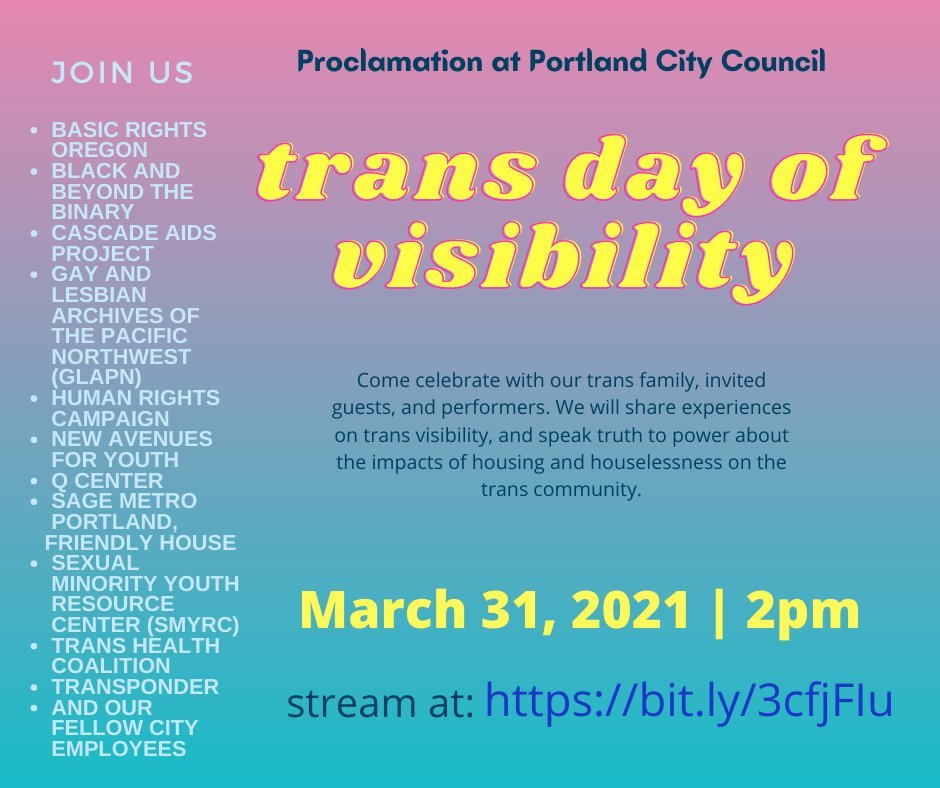 A gradiation of pink to blue runs from the top of the image to the bottom. In bright yellow letters words read, "trans day of visibility. March 31, 2021, 2 p.m." In smaller black letters, words read, "Come celebrate with our trans family, invited guests, and performers. We will share experiences on trans visibility, speak truth to power about the impacts of housing and houselessness on the trans commuity." There is also a list of all the organizations participating. Click the image for the link to the event.
By Marisa Trujillo DeMull
The Engineering Services group is recruiting nominations for our new Equity Committee. We are looking to organize a group of employees committed to learning, deliberating, and integrating new policies. The Engineering Services group’s Equity Committee will:
- Strengthen staff capacity to understand, utilize, implement, and contribute to PBOT’s equity framework
- Contribute to transforming PBOT’s relationship with underserved communities
- Develop a framework informed by the transportation equity framework to guide future equity initiatives and investments
- Contribute to the resilience of communities that are the most vulnerable amid growth and change
- Increase the opportunity for historically underserved communities to participate in the development of projects and decision-making
This is an open recruitment for all levels of staff to participate in translating equity and social justice values into the work of Engineering Services. We are looking for one (or more) representatives from each section who is committed to racial equity and social justice. No experience in racial equity work is required. People from diverse backgrounds and people with previous experience in equity work are encouraged to participate. Once formed, the committee will determine meeting frequency with the expectation that about two hours each month would be needed to participate.
Participants will benefit from expanded access to racial equity training and development. Participants will be allocated authorized time for equity work while participating in a unique and groundbreaking committee.
Please submit this short interest form by April 16 to express interest in participating.
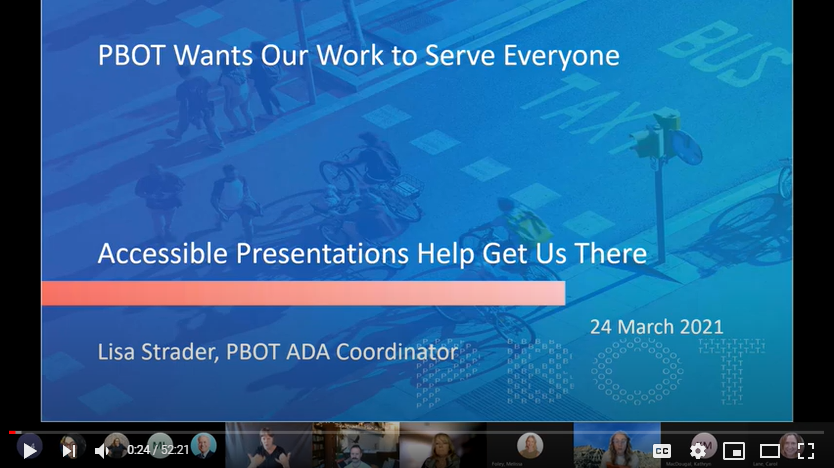 Screenshot of the Accessible Presentations recording. A PowerPoint slide with a blue overlay shows an image looking down on a street with pedestrians and people biking. Words on the slide read, “PBOT Wants Our Work to Serve Everyone. Accessible Presentations Help Get Us There. 24 March 2021. Lisa Strader, PBOT ADA Coordinator.”
Did you miss Lisa Strader’s Lunch and Learn about giving accessible presentations last week? This is a must watch if your job includes giving presentations. Lisa covered helpful tips like how to add alt text to your images, visually describing your slides, and what types of animation are okay and what should be avoided. There are also hands on demonstrations of how to test your documents and presentations for accessibility issues. Watch the presentation here.
Make sure to mark your calendars for our next Lunch and Learn, April 7 from noon to 1 p.m. featuring Alexis Gabriel. Alexis will be presenting, "A new vision for Sunday Parkways." Click here to join the meeting
Later in this issue, you’ll learn about the PBOT’s ADA Curb Ramps program and the work Maintenance Operations does to build ADA-compliant ramps citywide. But there are so many ways that PBOT funds accessibility improvements. One funding mechanism is what is known as “Pedestrian Network Completion” which is part of PedPDX – Portland’s Citywide Pedestrian Plan and work led by Michelle Marx.
Here are the crossing improvements funded this fiscal year through Pedestrian Network Completion:
-
NE 24th Avenue and Glisan Street (crosswalks, curb ramps, median, and lighting)
-
NE 102nd Avenue (multiple crossings with medians, marked crosswalks, and curb ramps)
-
SE 23rd Avenue and Hawthorne Boulevard (curb ramps in preparation for a crossing improvement later this year)
-
SE 162nd Avenue and Alder Street (crosswalks, curb ramps, median, and lighting)
-
SW Dosch Road and Beaverton Hillsdale Highway (curb ramp, pedestrian push button, and a marked crosswalk)
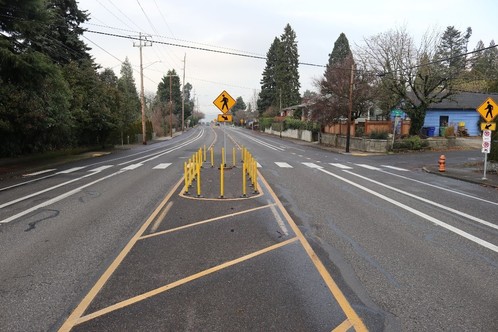 Photo taken from the center of NE 102nd Avenue in Portland showing a high-visibility crosswalk, pedestrian crossing signs, bike lanes in both directions, and a center median refuge island created using yellow candlestick bollards

By Katie MacDougall
In addition to the ADA Curb Ramps program, another way PBOT builds ADA-compliant ramps is when Maintenance Operations does a grind-and-pave project. Currently, crews have been working hard updating curb ramps along a 10-mile segment of Fremont Street. PBOT is doing grinding and paving work there from N Williams Avenue to NE 59th Avenue. This is part of the city’s ongoing maintenance work. So far on this project alone they’ve built over 300 ADA-compliant curb ramps or brought existing ones up to ADA standards! That number grows each week.
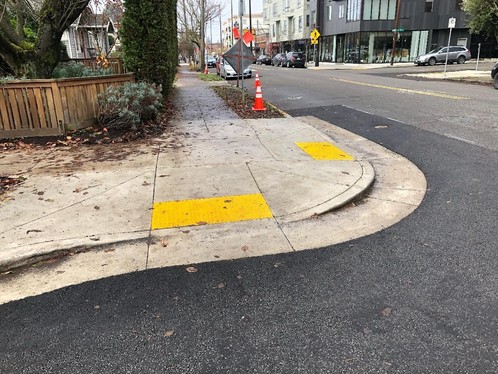 A Portland intersection next to a home, with apartment buildings in the background and cars parked along the street. The intersection has a freshly built ADA-compliant curb ramp with yellow tactile tenji blocks to indicate where the sidewalk ends at the street crossing begins.
“All these crews really care about the work they’re doing,” said Tom Bennett, PBOT’s Maintenance Operations Sidewalks Program Manager. “Everyone on our team has really bought into the idea that, by providing curb ramps, it provides much better accessibility to the traveling public, especially with wheelchair travel or travel for people with vision impairment. We really want to make the city as accessible as possible.”
Maintenance Operations works in lists, identifying a set of 10 intersections at a time. First, Engineering Technicians visit the site of curb ramps and establish a plan to make them ADA-compliant. Technicians mark their plan on the sidewalk, so that saw-cutting crews can cut out the existing sidewalk and street. Then an excavating crew digs out the site. Another crew forms the site, adding pieces of plywood and lumber to shape it before pouring the concrete and waiting for it to cure. Lastly, a clean-up crew removes the lumber and restores the site to working condition.
Learn more about how PBOT crews build ADA-compliant curb ramps by watching this video.
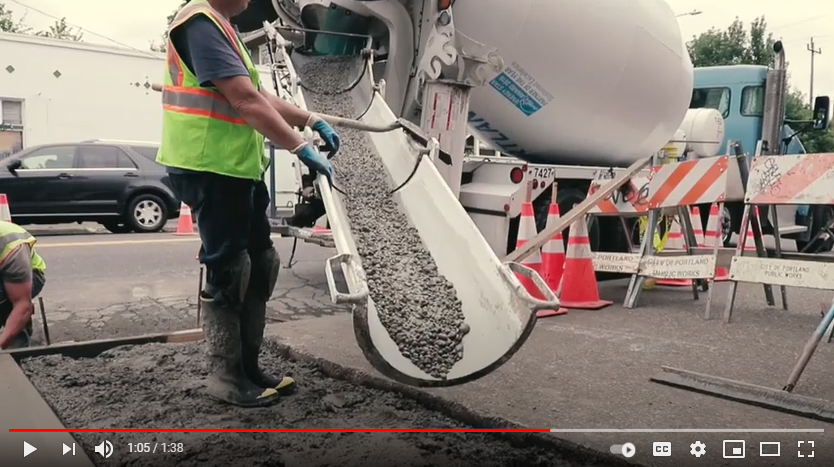 Screenshot from a PBOT video showing maintenance crews in safety vests and gloves guiding wet concrete pouring from a truck into a section of sidewalk that will become part an ADA-complaint curb ramp.
PBOT’s Maintenance Operations also constructs curb ramps for other capital improvements projects--through city gas tax-funded projects from Fixing Our Streets as well as through our Safe Routes to School program. Last year, Maintenance crews constructed 512 curb ramps across Portland.
As we’ve covered before, Maintenance Operations crews have been doing this work throughout the Covid-19 pandemic, in service to Portland. They’ve taken proactive steps to keep one another safe while working, including maintaining strict social distancing, wearing masks, and transitioning to virtual meetings. A lot of the crews’ work is labor-intensive, like pouring concrete, so they worked hard to adjust, including site visits and smaller check-ins.
“Accessibility is huge to the city,” Tom Bennett added, “and we want to be one of, if not the nation’s, best in terms of pedestrian accessibility. We have a lot of crews that will get us there.”
Hey, what about those misspelled street names?
You may have noticed some curbs are stamped with misspelled street names. This is intentional! Although streets have changed names over the years, the city has worked hard to preserve pieces of Portland history. City code requires sidewalk corners maintain their historic names and dates. That includes historic stamps of street names on our sidewalk that may have been misspelled originally.
So, when curb ramps are repaired, the old name and date is restamped into the concrete in as close to their original positions as possible. This means that old or misspelled street names are preserved.
Of course, these misspellings are relatively rare. You can find some “Freemonts” on Fremont Street, a “Tillmok” on the southeast corner of NE 35th Avenue and Tillamook Street, and one at N Overlook Boulevard and Overlook Terrace reflecting the old “Wemme Avenue” name. These unique curb stamps are a reminder of Portland’s history, preserved right under our feet.

By Stacy Brewster
With so much of what PBOT does in the right-of-way, it’s easy to focus simply on the built environment, and the improvements we make there for accessibility. After all, this is where the proverbial rubber meets the road—an audible pedestrian signal, an ADA-accessible curb ramp, and countless improvements that make navigating Portland safer for the more than 25% of us who identify as having some form of disability.
But that’s still only one side of the coin. When it comes to public communications about PBOT programs and projects, it’s just as important you keep people with disabilities in mind when you communicate about what you’re planning to build. Everyone should have the same access to learn about what PBOT is up to, know when projects are happening, and have a chance to weigh in.
The easiest way to do this is to bring that same level of awareness you do with how a program or project is built out as you do with how it’s communicated. Just as an engineer must figure out how to make a hilly, trapezoidal intersection ADA-accessible, so too should you consider what it would be like to navigate your blog post or website for someone with a disability or impairment.
I don’t use the type of screen reader a blind or low-vision person might, but because of a chronic condition, I do use other assistive technology to help me write, edit, and navigate programs on my computer by voice. I know too well the frustration of programs, documents, or websites that don’t work the way they’re supposed to!
Fortunately, we have the tools we need already, and don’t need technical training to make our public communications more accessible.
Here are some helpful questions to ask yourself when you are preparing public communications. Whether you are preparing a postcard, a letter, an interactive map, a PDF, or a website, these will help ensure your public communications are as accessible as possible to the widest audience.
Is my language simple and clear?
Rule number one: use the simplest, clearest language to describe your project or program. Less words mean it’s easier to read, easier to use a bigger font, easier to comprehend, and easier to translate into other languages. Make sure basic facts like our bureau’s name, a detailed location, and relevant dates are included. Rewrite anything too bureaucratic, wonky, or technical. Remember: assistive devices (like us humans) can get tripped up by words they’ve never encountered before, as well as strange abbreviations and acronyms. If in doubt, reach out to me with a language question, or use our writing tip sheets and PBOT glossary of terms for more guidance.
Are my graphics simple, clear, and explained?
Sometimes we see staff over-rely on graphics to tell a project’s story, either on a project or one-sheet. Although well-designed graphics enhance the look and feel of a page and make it more dynamic, be careful how much you burden your graphics with text. Graphics should complement what’s already in the body of your website or the copy itself, not a replacement for writing clear copy. Text in the graphic, such as important street names or landmarks, should also be clear to read, and repeated in the alt-text description (more on alt text below).
One place this advice is critical is on our website. Every image is cropped automatically for various devices. If you leave critical information in a graphic that’s not repeated elsewhere, it could be unreadable, or cropped out entirely. Also, not everyone’s devices automatically download images on websites or email, so you can’t assume these are seen or read at all. That includes the PBOT logo! If you questions on your graphics, please reach out to our Graphic Designer Sarah Petersen.
Have I tagged my content with the “Access and ADA accommodations” topic on Portland.gov?
One of the great new features of our city’s new home at Portland.gov, is the ability to tag pages with specific topics, communities, or neighborhoods. If you have programs or projects at PBOT that have a direct impact on accessibility or ADA accommodations, be sure to add “Access and ADA accommodations” as one of the tagged topics.
Have I included alt text for images?
Alt text is different than a caption. Where a caption might provide context or detail about who is in a photo, they also tend to be in smaller font and harder to read. Alt text is embedded into an image and meant to describe the image itself. Alt text is “read” by a screen reader, an assistive tool used by those who are blind, low-vision, or who otherwise use such a tool to navigate our digital world. Screen readers will also read captions, so it’s important to know the distinction.
If you’re looking for samples of alt text, look no further than each issue of Street Cred, where we use the caption field on all the images to show examples of alt text. Writing alt text is an artform, but easy when you get the hang of it. Right-click images in Microsoft programs and you’ll see an option for alt text so you can practice this in all your presentations and documents.
Have I checked my document for accessibility?
Similarly, you’ll want to use the “Check Accessibility” tool in all your Office programs, available from the “Review” menu. While imperfect, this check will make sure your document images have alt text and ensure that screen readers read what’s on your page, table, or slide, in the order you intend. They may flag other problems you’re not aware of, too, such as weird code, macros, or long URLs that can trip up assistive devices.
Does it need to be a PDF?
Another tool we rely on a great deal at PBOT are PDFs. While beautiful reports and forms may look nice, large file sizes and unreadable text are a real bummer. Whenever possible, make your information available in simpler formats to compliment a PDF. A good example would be a summary page on the website that walks through the main sections, then a link to a full report. It’s also critical that you verify your PDF is accessible for people with disabilities. Adobe has a helpful tool and instructions on their Create and verify PDF accessibility page.
--
These are the questions we are constantly thinking about on the PBOT Communications & Public Involvement team. For more information about accessibility with other communications tools like social media, video, and public involvement, check out Kailyn Lamb’s article below, as well as pages 10-11 of our PBOT Video Guide on closed captioning, or the ADA and Language Access section of the PBOT Public Involvement Resource Guide.

By John Brady
Considering both the theme of this week's Street Cred and the central role that curb cuts play in PBOT's accessibility work, I looked for an article on the history of curb cuts. I found this brief, but thorough account. It's a testament to human creativity and sledgehammers:

By Lisa Strader
On March 9, PBOT’s ADA Coordinator, Lisa Strader, coordinated a roundtable discussion between PBOT staff and blind and low vision pedestrians. The interaction was organized at the request of Traffic Design Supervisor Jamie Jeffrey. Meetings she was having about accessible transportation made her want to hear directly from those who rely on these elements of our system. She wanted to know how they work for blind and low vision pedestrians and what PBOT could do differently, or better, to make the system more navigable and safe for them.
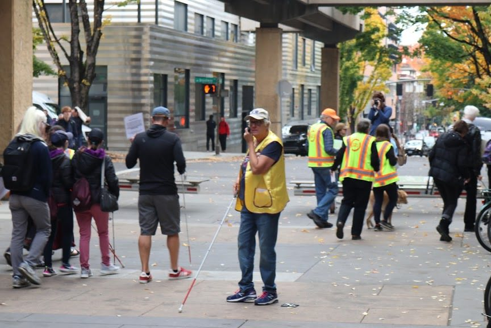 Photo taken on White Cane Safety Day, showing people walking in downtown Portland, some wearing high-visibility vests or caps, some using white canes, and one person with a guide dog
We welcomed six guests to the conversation. They included a representative from the Oregon Commission for the Blind (OCB), the chair of the National Federation for the Blind Portland Chapter, the chair of the Pedestrian Safety Action Coalition, as well as an accessibility trainer. PBOT staff other than Jamie included Chon Wong, Anthony Buczek, Michelle Marx, Roger Geller, and Wendy Cawley.
Our agenda covered where and how to use tactile warnings; mixing zones where two types of users are in the same space; street-level curb extensions; and communicating crosswalk closures.
Each of our guests shared an experience they had navigating the public right-of-way then we discussed the related agenda item.
Some of the things we heard were how candlesticks can be missed by a sweeping cane. However, if there is a curb or raised section under them, they are more likely to be detected. There were similar concerns with single poles that hold “closed crossing” signs. More importantly, even if they detect that sign, there is no information available about what to do instead of crossing. That is, how do they find the accessible route?
Temporary uses of the sidewalk, like sandwich boards, are also a real concern. We heard the challenges and dangers of inadequate temporary pedestrian accessible routes (known as TPAR) through and around construction zones. We also heard from the Oregon Commission for the Blind’s Rehabilitation Instructor who said he’s seen great improvements in TPARs on PBOT projects and that our Maintenance Operations and construction crews are receptive to feedback.
PBOT staff and our guests thought the discussion was mutually beneficial. We plan to reconvene quarterly and to take field trips to look at situations on our right-of-way, with both traffic safety and pandemic safety in mind.
Currently the city doesn’t have a Committee on Disability for staff and projects to consult for lived experiences that inform our work. In the absence of that, PBOT will be using roundtables and focus groups like this to better design our projects for full accessibility. If you are interested in holding one for work you are doing, please contact Lisa Strader.
By Corrine Montana
Adaptive BIKETOWN is part of Portland’s bike-share system with a storefront location along the Eastbank Esplanade just north of OMSI. The program began as a pilot in 2017 in response to community requests for more accessible bike-share options after the launch of BIKETOWN in 2016.
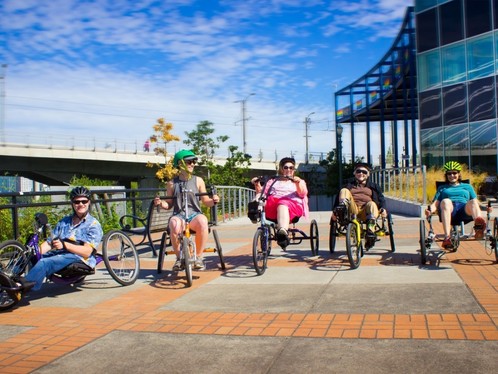 Five people sit on different types of three-wheeled Adaptive BIKETOWN bikes, all facing the camera on the Eastside Esplanade in Portland. It’s a sunny day with blue skies and the Tilikum Crossing behind them.
Many PBOT staff and partners make up the Adaptive BIKETOWN team, including Liz Hormann, Steve Hoyt-McBeth, Roshin Kurian, Ryan Ross from Kerr Bikes—who manages operations—and myself (Corrine Montana). I am new to the team and I am supporting the outreach and engagement opportunities we are getting ready to offer this year. Today we are sharing an update on what we have planned for 2021. Reach out to us if you see ways to partner and connect our work with yours.
2021 Highlights
Changes in ridership: In 2020, Adaptive BIKETOWN had 46 rentals with an average rental time of 24 hours, which is up from about an hour, on average. While the rental numbers were heavily impacted (down from 196 in 2019), the extended rental times made the overall business impact comparable to 215-220 rentals, which is an improvement over the previous years. We are curious to see if this trend continues into 2021.
Partnerships: In response to the need for outdoor recreation as Portland recovers from the pandemic, the Adaptive BIKETOWN team will be working with community partners to incentivize and encourage people to ride. Some of those partners include Mt. Hood Kiwanis Camp, Parkinson’s Resources of Oregon, Multnomah County Health Department, and the county’s Racial and Ethnic Approaches to Community Health (REACH) program. The team is exploring additional partnerships with Challenged Athletes Foundation, Northwest Trail Alliance, and The Street Trust.
Expanding the fleet: We are currently working to expand the Adaptive BIKETOWN fleet from 20 to 27 bikes. All new models will be electric or electric-assist in response to the growing popularity of e-bikes. Our pedal-assist electric bikes are our most popular option. E-bikes increase the distance all riders can travel, which creates new possibilities for our Adaptive BIKETOWN customers.
Community engagement: 2021 will be a key time to gather feedback and learn more about how the program can best serve the community. We will invite community members to share their experiences and the changes they would like to see, then incorporate these recommendations when we update the Adaptive BIKETOWN contract next year.
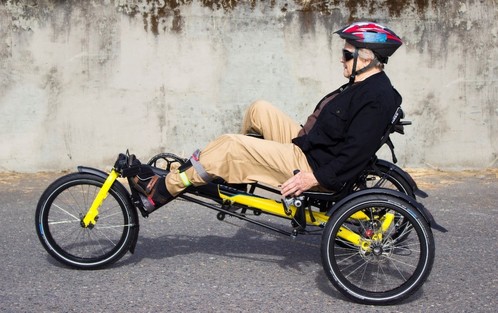 Side view of an older person riding a yellow recumbent bike with three wheels. She sports sunglasses and a red bike helmet.
By Lisa Strader
Last summer, PBOT released its draft ADA Title II Public Right of Way Transition Plan for public comment. We planned to release it in May, but due to the pandemic and on the advice of the community, delayed it in the hopes we would be able to have in-person engagement. We all know that didn’t happen. Instead, we held six virtual open houses via Zoom and presented to 13 organizations that support and serve people with disabilities. We received about 250 responses to our survey and over 600 comments on a wide range of topics.
There were numerous comments supporting a proactive sidewalk policy, noting that new, compliant curb ramps are not particularly useful when the sidewalk connecting them isn’t compliant. Another frequent comment was related to ongoing engagement. People with disabilities want to be consulted when we are planning projects. They also want to know how to get through or around our construction sites, and know when routes have changed once we’ve completed a project.
We saw a lot of support for addressing noncompliance in areas of the city that have been historically underserved. There were comments on accessible parking, the schedule for completion for the plan, coordination between city bureaus, and many comments related to safety, transit, and transit stops. We shared all transit-related comments with TriMet, where and if the issue was their responsibility.
On March 19, we presented the updated draft to the legal team responsible for monitoring the consent decree on curb ramps. According to that agreement, they provide the final review of the draft plan before we take it to city council for adoption. We expect their comments by April 23. After we reconcile those, we will prepare our presentation for city council. Once they adopt our plan, we will move to implementation. Watch for details this summer!
You can view the draft ADA Transition Plan here or learn more by watching our narrated PowerPoint—provided in English, Russian, Spanish, and Vietnamese—on our transition plan website.
By Katie MacDougall
The PBOT ADA Curb Ramps program was created in July 2018. This followed a settlement between PBOT and the Civil Rights Education and Enforcement Center (CREEC) on behalf of people whose movement in Portland was limited by insufficient ADA-compliant curb ramps. PBOT agreed to address the gaps in infrastructure, building 15,000 ramps in 12 years.
This team provides CREEC with annual reports and GIS mapping of every ramp fixed in the city. They also look at the distribution of curb ramps through an equity lens, making sure that underserved neighborhoods are also receiving ADA-compliant curb ramps.
Currently, Portlanders can use our ramp-by-request service to report noncompliant ramps. PBOT’s goal is retrofit these ramp within nine months and is committed to building at least 100 of these ramps each year.
The team also has a long backlog of curb ramps that are not ADA-compliant. They prioritize ramps located on arterial streets and in high-density pedestrian zones, such as streets near schools.
Constructing new ADA-compliant curb ramps is a team effort. The ADA Curb Ramps team works with the Construction, Inspection & Pavement team, the Utilities, Construction & Inspection team, along with Maintenance Operations, to build new ramps.
Once a ramp has been identified as noncompliant, the team begins design work. Engineers visit the site and assess the ramp with inspectors, measuring the slopes and the width of the ramp. There are three engineers on the team as well as consultants who provide design support. It takes approximately six months to design and another three months to construct new ramps.
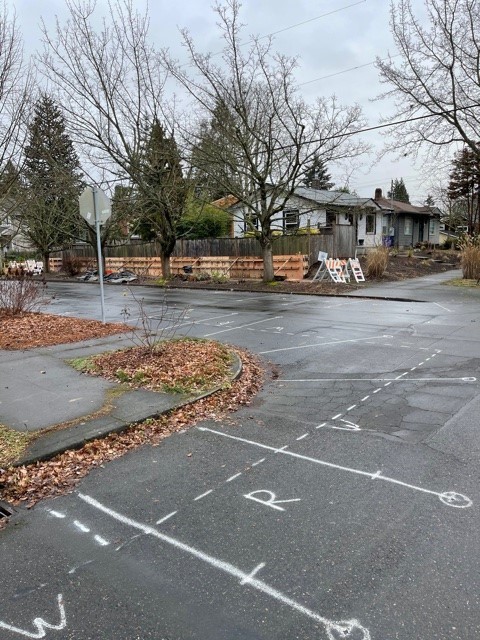 Before photo of a neighborhood intersection and a sidewalk corner with no ADA ramps. White markings in the street indicate where work will be done to build ADA-compliant ramps.
Ramp construction doesn’t go through the typical open bid process. The ADA Curb Ramps team uses a program called Job Order Contracting, which brings in small, minority, or disadvantaged contractors to do some of these jobs on rotation. Once the construction team builds the new ramp, the team inspects the new ramp to ensure it’s ADA-compliant.
On one occasion, the ADA Curb Ramps team borrowed wheelchairs and invited people to try to use the curb ramps. The experience opened their eyes to the realities of navigating curb ramps.
“It looks easy if someone else is doing it, but when you try to wheel up an 8.3% slope, it’s really, really challenging,” explained Raphael Haou, the ADA Curb Ramps Program Manager.
The roads themselves pose a challenge. As roads are repaved there is a slope toward the curbs for drainage which, when there is insufficient drainage, collects water and creates giant puddles where curb ramps meet the street. The team has to incorporate drainage into any curb ramp design.
“I would say, for everyone doing a PBOT project, try to include the ramps into the scope of their project,” said Raphael Haou. “One thing that is challenging is that PBOT has some perception that the program has a lot money. We like to partner with some projects. Let’s say your project is in an area where we have identified some ramps that need to be fixed. We can see if we have some money to build ramps. We need good infrastructure to navigate the city.”
We want to say a big thank you to the small, but mighty ADA Curb Ramps team: Trini Arce, Rex Dohse, Pat Field, Phebi Grude, Raphael Haou, Joel Madrigal, Alex Pierro, and Jim Scanlon.
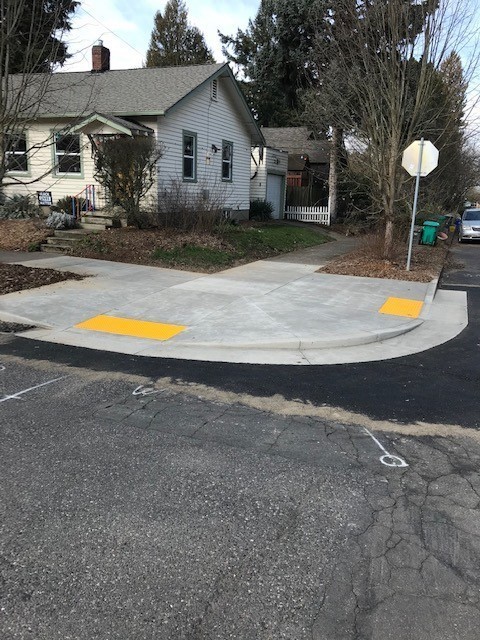 After photo showing the same intersection as the previous photo, but at a different angle, now with ADA-compliant curb ramps with yellow tactile sections, known as tenji blocks, that guide people using white canes.
By Lisa Strader
An accessible transportation system includes ways for people to independently navigate the city, including parking near their destination. People with disabilities may have a permit from the state DMV to use designated accessible parking spaces. It is PBOT’s responsibility to provide accessible parking on Portland right-of-way and in PBOT-managed parking structures. As ADA Coordinator, I was invited to work with PBOT’s On-Street Parking team to update and expand existing guidance related to accessible parking.
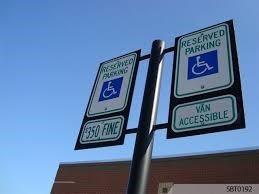
Looking up we see 2 accessible parking signs that read, “Reserved Parking,” with the icon of a person in wheelchair below the words. On the left the sign read, “$350 fine,” under the icon and on the right the sign reads, “Van Accessible,” under the icon
Current policy allows Portland residents (who have DMV permits) to request an accessible parking space near their residence. PBOT also has accessible on-street parking spaces that can be used by anyone with a DMV permit, but we have no guidance for where and how many of these spaces we should plan for.
The U.S. Access Board, a federal agency, has developed Public Right-of-Way Accessibility Guidelines, the only current guidance for accessible parking in the right-of-way. These guidelines have yet to be adopted but are already used (or even adopted) by many jurisdictions. The On-Street Parking team will be using them as a frame of reference as we update our guidance. They require that 4% of parking on our system be accessible. In our three commercial parking districts—downtown, Northwest, and the Lloyd and Central Eastside—there are approximately 20,000 parking spaces. By federal guidelines, that would mean 800 of them should be accessible parking spaces, whereas only 100 of them are currently.
In 2014, a task force was formed to look at pricing for use of accessible parking spaces. The group also discussed the need for more accessible spaces, but that wasn’t in their charter, so it wasn’t inventoried further.
The policy we are drafting will provide the guidance the 2014 effort wasn’t charge with. We will include things like where, along a block face, accessible parking should be located. Other questions we’ll be looking at: what types of property uses should it be near, how many spaces should be van accessible, how many spaces should be in the footprint of a project, and how and where do we relocate existing accessible spaces, if they are disturbed by a project.
We’re also looking at expanding our current policy which allows residents to request an accessible parking space near their home. We are considering whether to allow for similar requests from residents of older apartments or mobile home park developments, where accessible parking is required on-site, but lacking or inadequate. We’ll also address where to have pickup and drop-off spaces, another important accessibility feature for people with disabilities. We’ll consider where signage and wayfinding is needed.
While traffic patterns are different and parking demand is lower, we continue to add accessible spaces strategically, where we know they are needed such as near libraries. We are also working with existing projects to add them during construction.
In late April and early May will be convening two focus groups of accessible parking users. We’ll share with them our concepts and get their feedback. From there, we’ll draft a policy which will go through the administrative rule review process, then to city council for adoption.
If you have any questions about accessible parking, please contact Peter Wojcicki, Kathryn Doherty-Chapman, or Lisa Strader.
By Kailyn Lamb
We can all work to make the world more accessible and one way we can do that is to make our social media channels accessible to people with different disabilities. People who are blind or low vision can use screen readers to access social media content. Folks who are Deaf can participate with your videos if you make sure to use captions. And platforms themselves improve all the time, making it easier to make your content accessible.
Here are simple tips you can use to expand access on social media.
Alt text
What is it? Alternative text, known as alt text, is a visual description added to an image that is read by a screen reader. Using alt text on your social media posts means that a person who is blind can still enjoy, interact, and learn from the images included in your posts. PBOT’s social media posts always include alt text, but my personal mission is to use them in my personal social media posts as well.
How do you write it? As Stacy mentioned in his Shortcuts column, alt text is an artform and everyone approaches it a little differently. Some people like to include a lot of detail. Other people keep it simple. My approach is to think about what a person would miss if they didn’t see the image. That means that if you have put a lot of text or important information on the image, you need to include that in your alt text. It also helps me to remember that alt text is not a caption, it’s a visual description. If you’re looking for inspiration, we write alt text for all images in Street Cred and include them in the captions.
Now here’s how to add alt text to your images on Instagram, Facebook, and Twitter.
Instagram alt text:
- Create your post and click “share”
- Go to the post you just shared and click on the three little dots in the upper righthand corner.
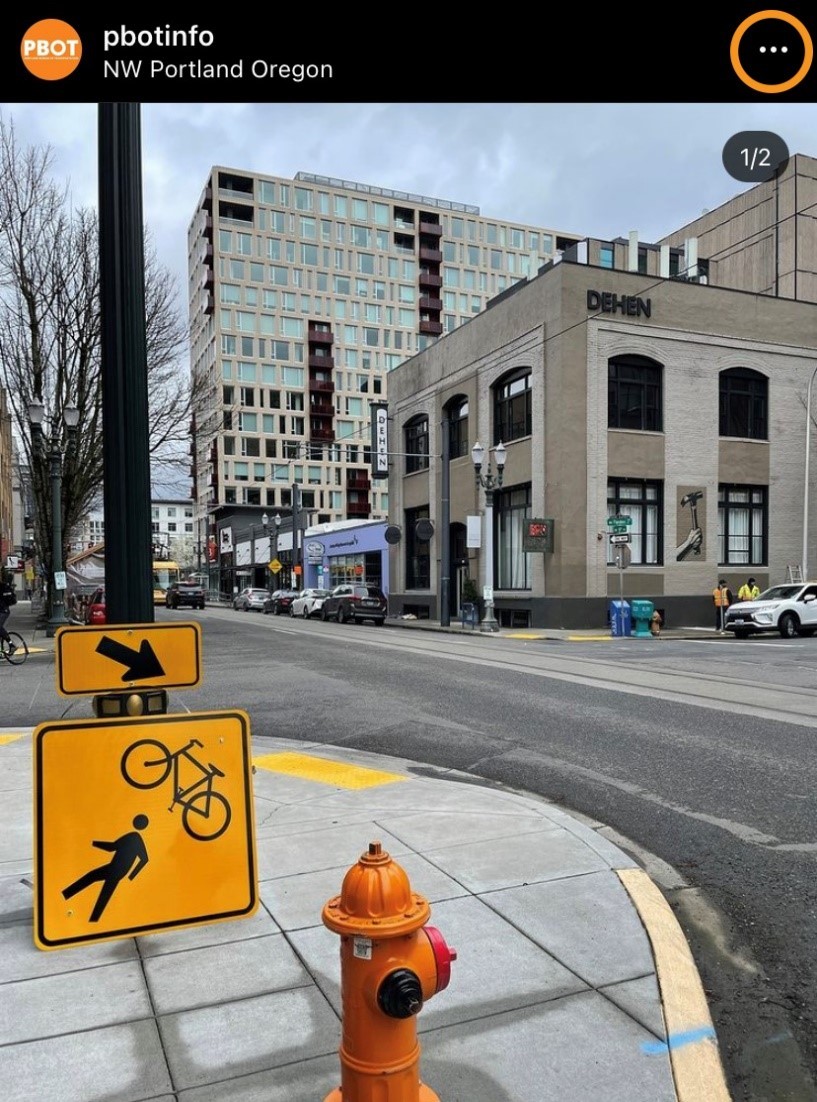 Screenshot from a PBOT post on Instagram. There is an orange circle around the three dots in the upper righthand corner, indicating where to click.
3. Select “edit”
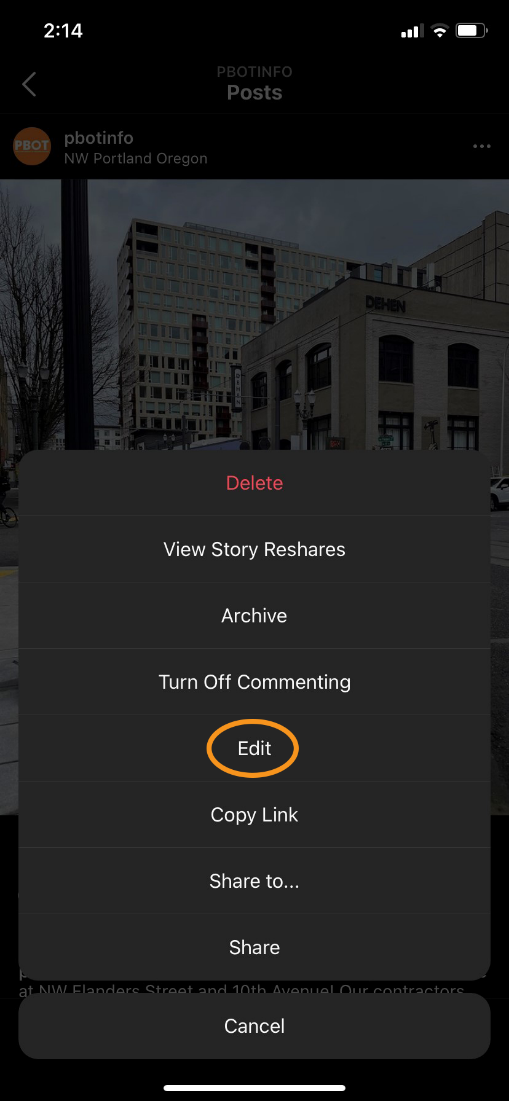 Screenshot of the menu that appears in Instagram after pressing the three dots indicated in the previous photo. The word “Edit” is circled in orange, indicating the option to select next.
4. Click where it says “Edit Alt text” in the lower righthand corner of the image.
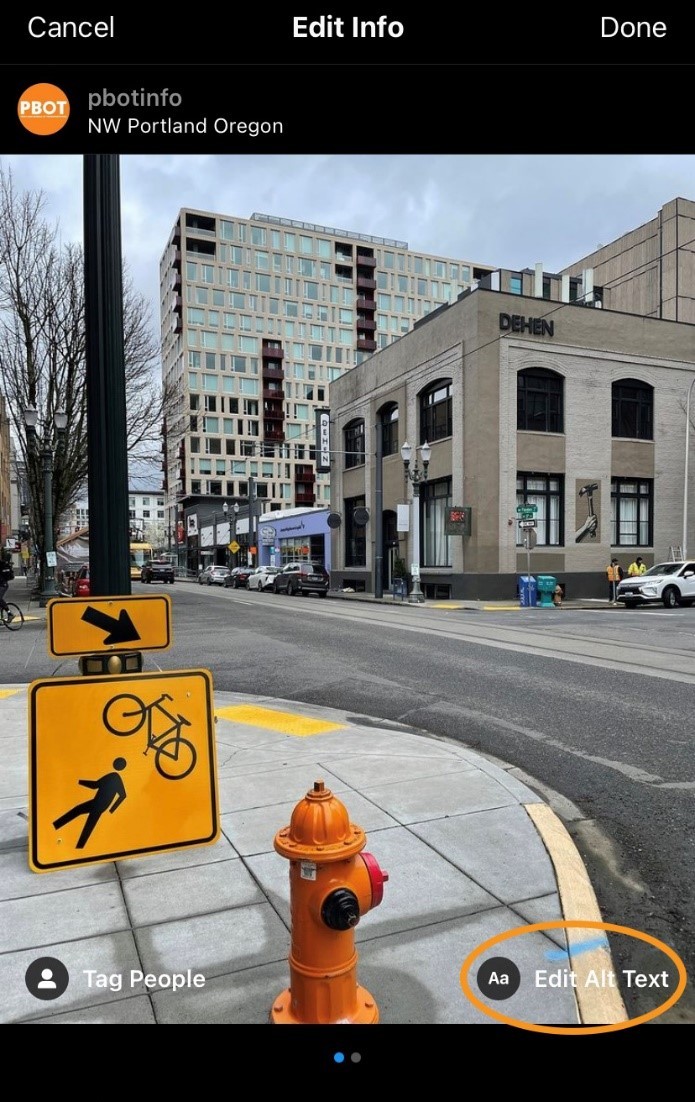 Screenshot of the same PBOT post on Instagram. The words “Edit Alt Text” are circled in orange in the lower righthand corner, indicating where to click to edit alt text.
5. Write your alt text for each one of your images, then click “done”!
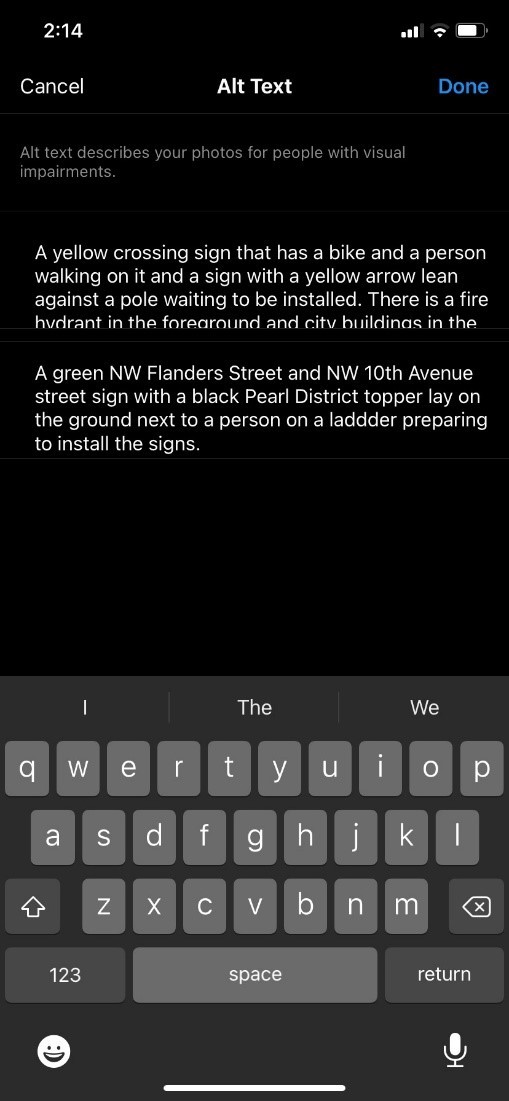 Screenshot of the Instagram screen that appears after you select “Edit Alt Text” from the previous screen. A typewriter appears to enter the alt text for image in your Instagram post. The word “Done” is in blue in the upper righthand corner, indicating where you click when finished.
Adding alt text on Facebook and Twitter is a little different and their websites have instructions for each:
Closed Captioning
The primary reason to add closed captioning to videos is so people who are Deaf can read what is being said in a video. On social media, there are a lot of reasons why this is beneficial.
I know we’ve all been there. We’re scrolling through our Instagram stories, TikTok, or Snapchat and for whatever reason you can’t have sound on. Maybe you’re at work. Maybe your partner is sleeping next to you. Maybe you’re standing in line at the grocery store. Closed captioning makes it so sound isn’t needed for a viewer to interact with your video. Facebook and YouTube have robust closed captioning options, but I’m going to focus on Instagram Stories.
To the excitement of content creators and social media managers, Instagram is finally testing an auto caption solution for Instagram Stories. You can check to see if you have it available to you. To use it, simply record your video either in the app or on your phone. When you go to post the video, swipe up. Look for the captions sticker. There’s a full tutorial in the article Instagram Tests New Auto-Captions Option for Instagram Stories (via Social Media Today, March 9, 2021)
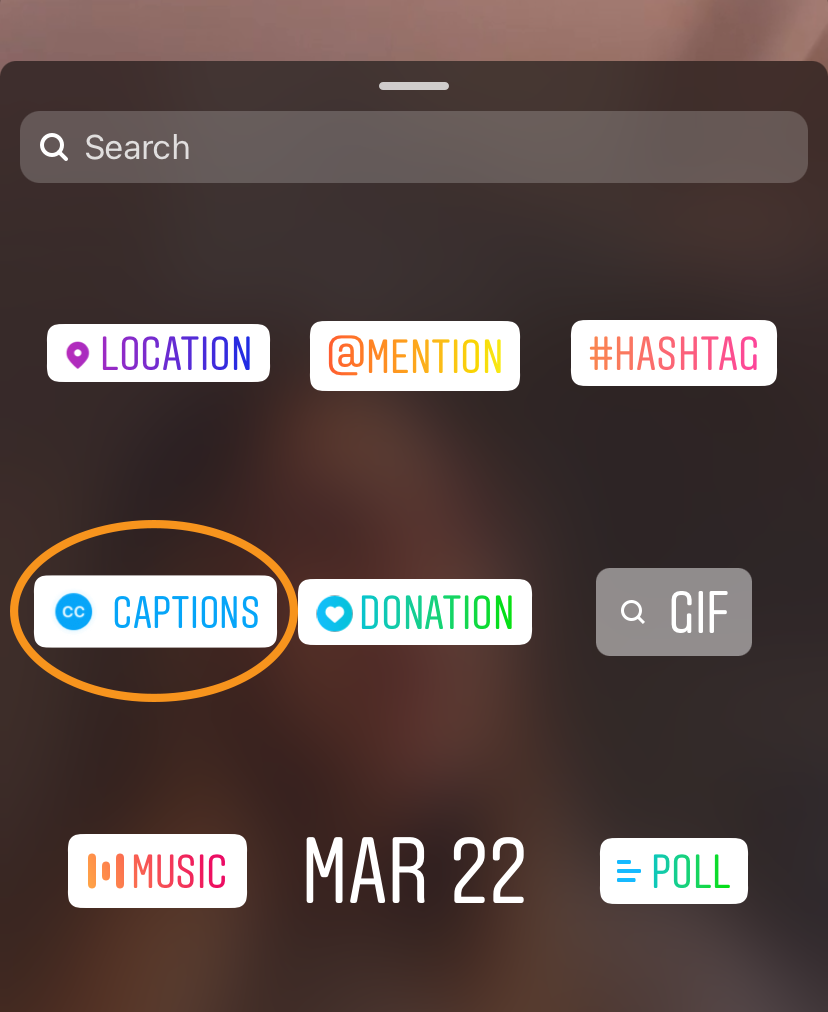 Screenshot of the menu options when you swipe up while creating an Instagram Story. The option “Captions” is circled in orange.
If you swipe up and you don’t see the captions option, you can also download Threads from Instagram. Recording a video in Instagram Threads will also allow you to automatically add captions. Learn more about this the article How to Automatically Add Subtitles to Your Instagram Posts (via Later, Sept. 4, 2020).
There are other apps to create auto captions, too. One that I like is Clipchamp. This app allows you to edit your captions, something I appreciate.
Another option is to type your captions either directly into your Story or Reel, or into a separate document and copy and paste them onto your video.
Hashtags
My last accessibility tip for social media is a very simple one. Capitalize the first letter of every word of your hashtags. For example, instead of #portlandisthebest write #PortlandIsTheBest. This allows screen readers to more accurately read the hashtag.
By Lisa Strader
Consider wearing blue this Friday in support of people with autism. Friday, April 2 is World Autism Awareness Day and April is World Autism Awareness Month.
 A design for the #LightItUpBlue campaign with yellow hashtags and the words “light it up blue” in large blue letters. A logo for Autism Speaks is in the bottom righthand corner. It features a puzzle piece evocative of a seated human body, in a colorful gradient from pinks to blues, over the words Autism Speaks, also in blue.
In 2020, the CDC reported that approximately one in 54 children in the U.S. is diagnosed with an autism spectrum disorder (ASD). Boys are four times more likely to be diagnosed with autism than girls. Autism affects all ethnic and socioeconomic groups, but minority groups tend to be diagnosed later and less often. As a spectrum disorder, people are affected differently and will vary significantly.
Some common signs include difficulties with verbal and nonverbal communication or social interaction, restricted interests, and repetitive behaviors. Common strengths of people with autism include the ability to learn things in detail, to retain details and information, strong visual learning, and strengths in math, science, music, or art.
Again, autism affects people differently so while these are common characteristics, not everyone will exhibit them. A common myth about autism is that it can be caused by vaccines. Extensive research over the last 20 years is very clear: vaccines do not cause autism.
In a less-than-welcoming world, two-thirds of children and adolescents with autism have been bullied. In addition, 28% have exhibited some form of self-harm and half will wander or bolt from safety. Drowning is the leading cause of death for children with autism.
Early intervention can improve brain development and, with consistent services throughout a person’s life, can improve learning, communication, and social skills. Many young adults with autism do not receive any healthcare for years after they stop seeing a pediatrician. This leads to potentially significant, unaddressed issues for adults. While nearly half of 25-year-olds with autism have never held a paying job, research shows that jobs, particularly ones that encourage independence, reduce symptoms and increase independent living skills.
In 2014, the U.S. Congress adopted the Achieving a Better Life Experience (ABLE) Act which allows tax-preferred savings accounts for people with disabilities, including autism, to be established by states. There is an Oregon ABLE Savings Plan and the Autism Society Oregon offers support, resources, and events. Here is a video they share about understanding autism:


Congratulations to the following PBOT employees for their continued service to the city of Portland!
These staff members will be celebrating their city work anniversaries in March:
|
5 Years:
- Gary Brittle, Engineering and Technical Services
10 Years:
- Michael Magee, Maintenance Operations
- Lisa Perry, Maintenance Operations
- Brian Peck, Maintenance Operations
- Benjamin Faber, Engineering and Technical Services
- Ian Schoenman, Development, Permitting & Transit
15 Years:
- Nathan Walloch, Business Services
- Robert Hillier, Policy, Planning & Projects
25 Years:
- Richard Eisenhauer, Development, Permitting & Transit
- Michael Campbell, Development, Permitting & Transit
- Ryan Hoyt, Development, Permitting & Transit
- Angela Hopper, Maintenance Operations
- Steven Davis, Maintenance Operations
- Bruce Easley, Maintenance Operations
30 Years
- Lisa Elbert, Engineering and Technical Services
Want to share a PBOT story here in Street Cred? Limit your copy to less than 500 words, provide detailed captions for any graphics, and email kailyn.lamb@portlandoregon.gov by 5 p.m. Thursday the week before so we have time to copy edit and proof. For longer featured articles please reach out to us first so we can target the best date for you.
Upcoming editorial deadlines:
-
April 14 issue [deadline: April 8]
-
April 28 issue [deadline: April 22]
-
May 5 issue [deadline: April 29]
|