|
News Media contact:
John Brady
(503) 577-8236
john.brady@portlandoregon.gov
@pbotinfo
News Blog:
How should we improve SE Hawthorne Boulevard for safety, business, and transit?
PBOT releases evaluation report of three alternative design options for public review
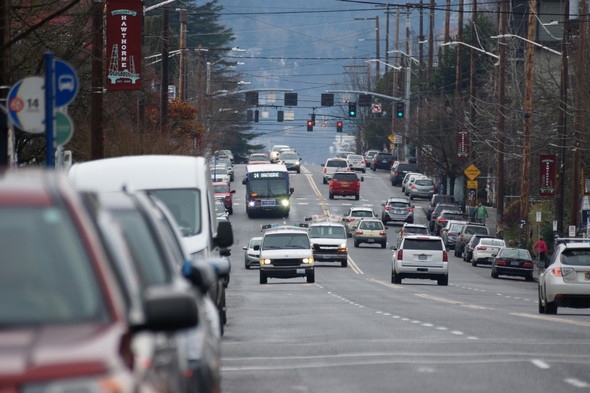 SE Hawthorne Boulevard, looking west. Photo by PBOT.
(Aug. 31, 2020) The Portland Bureau of Transportation (PBOT) released the evaluation of three alternative designs for SE Hawthorne Boulevard today as part of the SE Hawthorne Pave and Paint project. The evaluation report, developed based on community feedback, considers the benefits and impacts of each alternative related to the project’s goals of improving safety, supporting Hawthorne’s Main Street function and helping people get to destinations there, and connecting people to other parts of the city.
SE Hawthorne Boulevard is one of Portland’s iconic main streets, home to a thriving collection of local businesses and a destination for the surrounding neighborhoods, people from other parts of the city, and visitors to Portland. It is also classified as a Major Transit Priority Street and serves as the route for the frequent service Line 14 bus connecting Downtown Portland at the west to the Lents neighborhood to the east. In anticipation of the scheduled maintenance paving of SE Hawthorne Boulevard from SE 24th and 50th avenues during the summer of 2021, to look at ways to improve safety, reduce transit delay, and make other changes to better serve people and businesses on SE Hawthorne. Combining striping changes with maintenance paving is a resource-saving approach that saves on labor by eliminating the need to remove old striping from the street and provides a fresh canvas to efficiently apply striping changes.
From January to March 2020, the PBOT team connected with people in the Hawthorne community—through an online survey, stakeholder meetings, and public open houses—to hear their thoughts, ideas, and needs for the street. Participants were able to share ideas about how to redesign the street, vote on project priorities, share ideas for new crossing locations, and express why they visit, and what they love about SE Hawthorne. Learn more about prior outreach in the Mid-Project Report.
Based on this community feedback, PBOT developed three possible alternatives for further that fit within the scope and budget of the project:
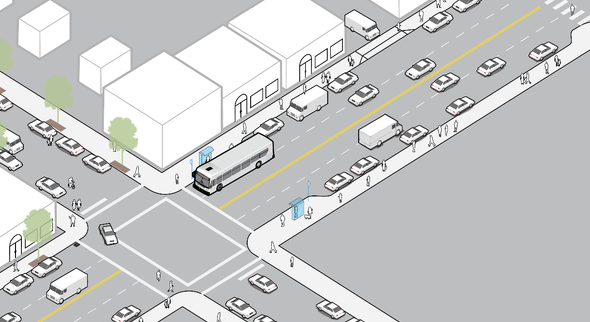
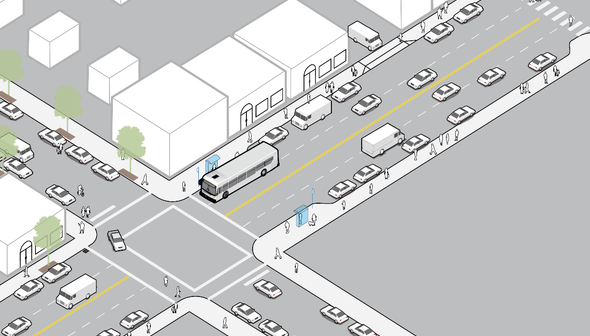
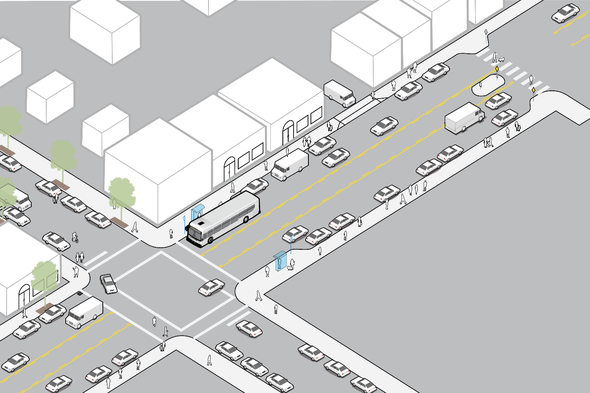
Alternative 1 maintains the existing lane configurations on SE Hawthorne Boulevard, with four general travel lanes west of SE Cesar E Chavez Boulevard and three general travel lanes east of SE Cesar E Chavez Boulevard. This alternative also includes space for on-street parking on both sides of the street.
CONFIGURATION WEST OF CÉSAR CHÁVEZ
 CONFIGURATION EAST OF CÉSAR CHÁVEZ
 Alternative 1 (striping stays the same) key evaluation findings:
- Does the least to address safety for all users
- Does not provide opportunities to fund additional crossings west of SE César Chávez Boulevard
- Removes 5% of the on-street parking for visibility at crossings
- Maintains or improves existing transit and auto travel times
- Does not provide dedicated bicycle lanes on SE Hawthorne
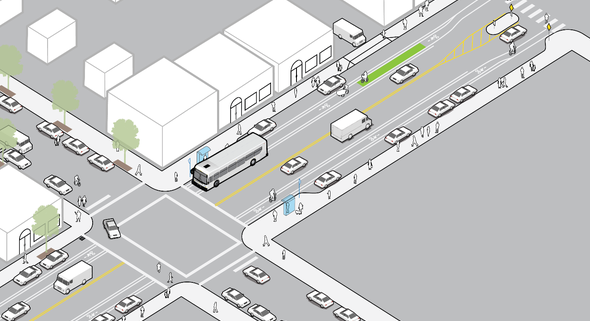
Alternative 2 extends the three-lane configuration currently in place east of Cesar E Chavez Boulevard west to 22nd Avenue, with right turn (except bus) lanes provided at Cesar E Chavez Boulevard. This alternative also includes space for on-street parking on both sides of the street.
 Alternative 2 (extends 3-lane striping west of César Chávez Boulevard) key evaluation findings:
- Does the most to address safety for all users
- Provides opportunities to fund additional crossings with wide median islands
- Removes 5% of the on-street parking for visibility at crossings
- Maintains or improves existing transit and auto travel times
- Does not provide dedicated bicycle lanes
Alternative 3 reconfigures the street from 22nd Avenue to 50th Avenue to include two general travel lanes and two bike lanes, with no center turn lane. This alternative also includes space for on-street parking on both sides of the street, though a significant amount would have to be removed to accommodate bike lanes at crossings. Within Alternative 3, the project team is considering two sub-options:
Alternative 3a maintains space for on-street parking at the curb, with buffered bike lanes between parking and the general travel lanes.
 Alternative 3b considers the potential to shift the bike lane to the curb, creating “parking-protected bike lanes,” with a significant portion of the on-street parking removed to provide visibility.
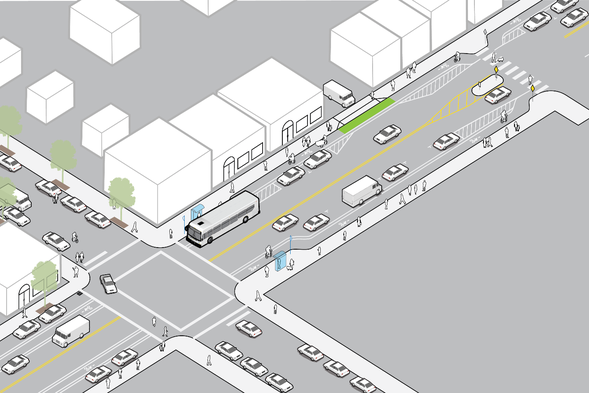 Alternative 3 (adds bike lanes on SE Hawthorne) key evaluation findings:
- Addresses safety for cyclists on Hawthorne
- Provides opportunities to fund additional crossings with narrow median islands
- Removes up to 50 to 60% of on-street parking
- Increases transit and auto travel times by 8 to 16 minutes and increases traffic volumes on adjacent neighborhood greenways
- Provides buffered bike lanes (Alternative 3a) or parking-protected bike lanes (Alternative 3b) on SE Hawthorne
View the report for a more detailed evaluation of each alternative. This project is being done in coordination with other projects on SE Hawthorne Boulevard, including Central City in Motion's SE Hawthorne / Madison Multimodal Improvements and the Sunnyside South Sewer and Green Street Project.
We want to hear from you!
We are interested in hearing from the community about the evaluation of these alternatives. An online survey is on the project website, and you are invited to join one of the bureau’s virtual webinars to learn more about the process and ask questions:
In addition, presentations will be made to various stakeholder groups in the Hawthorne area during the month of September.
The feedback we receive in the survey and at these meetings will help inform the decision on which alternative is advanced for construction as part of the Hawthorne Pave and Paint project. A recommendation on the final alternative will be made in fall 2020. Paving of SE Hawthorne Boulevard is anticipated to begin in the summer of 2021.
The Portland Bureau of Transportation (PBOT) is the steward of the city’s transportation system, and a community partner in shaping a livable city. We plan, build, manage, and maintain an effective and safe transportation system that provides access and mobility. Visit portland.gov/transportation
|