|
Oregon lawmakers are considering legislation that could give Portland more control over speed limit setting.
House Bill 2702-1 would allow the Oregon Department of Transportation (ODOT) to delegate speed limit setting authority to local jurisdictions including Portland.
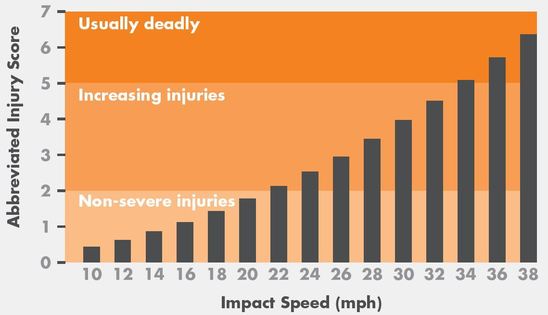
Current law gives ODOT authority over speed limits on all streets in Oregon. This restricts Portland's ability to manage travel speed—a critical factor in the risk of crashing and injury severity.
Other bills we are tracking in the current legislative session related to traffic safety, some of which would have positive impacts and others potentially negative, include:
- Allow 20 mph residential speed limits in cities statewide (SB 558)
- Allow fixed speed safety cameras in cities statewide (SB 559)
- Allow mobile speed safety cameras in cities statewide (SB 560)
- Bike lanes continue through intersections (HB 2682)
- Eliminate local city rules for Lyft and Uber (HB 3023)
- Enhanced driving knowledge testing (Senate Bill 746)
- Legal alcohol limit for people driving lowered to BAC 0.05 (SB 7)
- Legalize e-scooter use without helmets for people aged 16 or older (HB 2671)
- Legalize lane splitting for people on motorcycles (HB 2314)
- Lower local match requirement for Safe Routes to School grants (SB 561)
- No more license suspensions for failure to pay fines (HB 2614)
- Proof of legal presence not required for a driver license (HB 2015)
Many bills introduced during Oregon legislative sessions never become law; bills become law only if they are passed by both chambers of the State Legislature and are signed by Governor Brown. Oregon's legislative session is expected to continue through June.
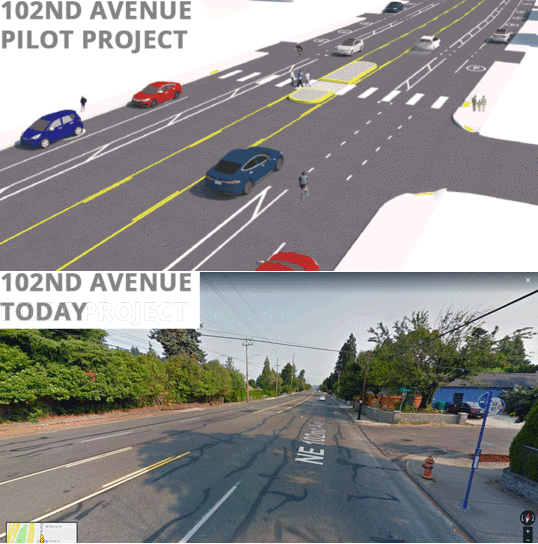 NE 102nd Avenue looking north at Knott Street.
As summer approaches, expect to see construction popping up on more streets. Thank you for your patience as we install urgently needed safety and maintenance fixes!
Below are brief updates on several safety projects on High Crash Network streets:
-
NE 102nd Avenue: In coordination with the City of Maywood Park, we are piloting a street redesign starting in June and will evaluate the impact to inform the long-term plan.
-
SE Foster Street: All sidewalks, lighting, signals, and street trees are complete. Our contractor will be applying the final paving and striping (including bike lanes) in April or May contingent on weather conditions.
-
NE Glisan Street: Depending on the results of contractor sequencing, we will construct this project in early or late summer. Sign up for project updates for the latest details.
-
NE Halsey-Weidler Couplet: Construction is well underway. We expect substantial completion in May.
-
NE Marine Drive: Our contractor is currently fabricating the urgently needed signal for the intersection at 122nd Ave. We expect to start installing this signal, along with associated safety updates including rumble strips and rapid flashing beacons, in July.
A complete list of High Crash Network safety projects under construction this year is available online.
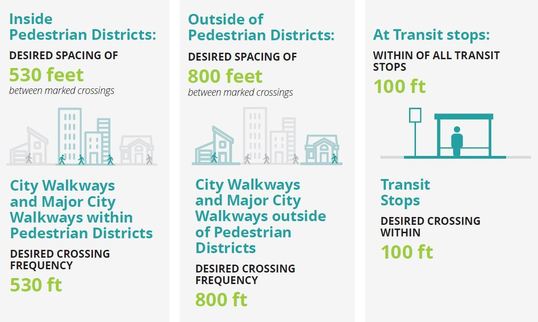 PBOT's first-ever crosswalk spacing guidelines, created through PedPDX, have already taken effect.
After two years of study and work with community partners, PBOT recently released PedPDX: Portland’s Citywide Pedestrian Plan for public review.
The 341-page plan lays the groundwork for a variety of changes intended to make walking safe and comfortable for all people across Portland. PBOT is taking public comments on the draft plan through May 3rd.
Two important bureau-wide guidelines from PedPDX have already taken effect:
-
Improved intersection visibility: Enhance sight lines by pulling on-street parking away from certain intersections.
-
Convenient, desirable crossings: Ensure easy access to safe crossings (see image above).
These two guidelines and other items are described in PedPDX's implementation toolbox.
Pedestrian deaths remain alarmingly high in Portland, particularly on large arterial streets from 82nd Avenue to the east. Preliminary crash data indicate that people walking made up nearly half of Portland's 34 traffic deaths in 2018. As of March 19th, five additional people have died while walking this year. Crash data since 2007 is viewable at map.visionzeroportland.com.
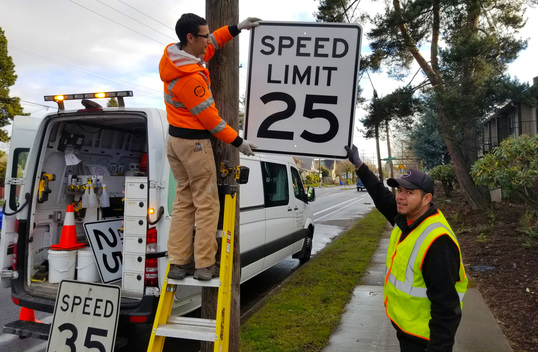 PBOT staff install safer speed limits in St. Johns.
We are continuing to update speed limits in support of safety via requests to the Oregon Department of Transportation.
Most recently, PBOT reduced the speed limit from 35 to 25 mph on N Fessenden Street and on N St. Louis Avenue in St. Johns. We also lowered the speed limit from 35 to 30 mph on N Argyle Street in Kenton.
More updates are coming. Tomorrow we will be lowering the speed limit from 30 to 25 mph on NE/SE 60th Avenue from Halsey to Stark Street. We will soon be updating speed limits on segments of NE/SE 11th Avenue, NE/SE 12th Avenue, SE Belmont Street, NE Fremont Street, SE Holgate Boulevard, and SE Morrison Street.
PBOT has updated speed limits on more than 100 miles of street since 2017, in addition to the residential speed limit update implemented in 2018.
 We are always on the lookout for new tools to enhance street safety. Especially tools we can implement relatively quickly.
One intersection design treatment we are working on uses modular speed bumps similar to those found in parking structures. (The treatment is called "left turn calming" and is used extensively in New York.)
To help decide on a product, our maintenance staff are installing two bump types in their parking lot where they are repeatedly run over by large, heavy trucks. We are also walking, riding bikes, and driving motorcycles over the bumps in wet and dry conditions to identify slip hazards. The safest, most durable product will be used in our forthcoming design.
Portland adopted its Vision Zero Action Plan in December 2016.
So what has changed? And what is next?
We are nearly finished preparing a two-year update that describes how Vision Zero is working in Portland and identifies future focus areas. Look for the report in coming weeks.
|