|
Celebrate New Year’s Eve in Portland with Safe Ride Home travel options:
Safe Ride Home is a partnership to prevent impaired driving. It supports Vision Zero Action I.1 to work with driver-for-hire services to encourage safe travel. More than half of traffic deaths in Portland involve people traveling impaired.
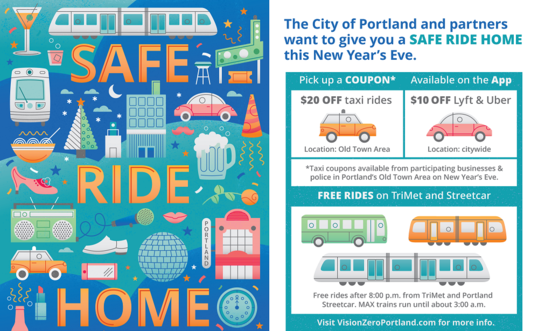 $20 cab coupons will be available New Year’s Eve at many Old Town area venues. Must use Broadway Cab app (Android/iOS) for Broadway Cab discount. $10 rideshare discount will be available through Lyft and Uber apps.
 Starting Jan. 1, people driving must must over or slow down for roadside vehicles. (Cute photo courtesy ODOT)
Two new state traffic laws take effect automatically on Jan. 1, 2018:
-
Move over: People driving must move over to another lane or travel at least five miles per hour below the speed limit for ANY vehicle stopped next to the side of the road displaying hazard lights or other signs of distress.
-
Fewer crash reports: People involved in a non-injury crash (e.g. a fender-bender) are required to submit a crash report only if there was at least $2,500 in damage; the increased threshold will help ODOT focus on injury crashes.
In addition, recent passage of House Bill 2682 will allow Portland to reduce the speed limit on residential streets to 20 miles per hour. A City Council date to authorize the speed limit reduction is set for January, with updated signage following soon after. Look for more information soon.
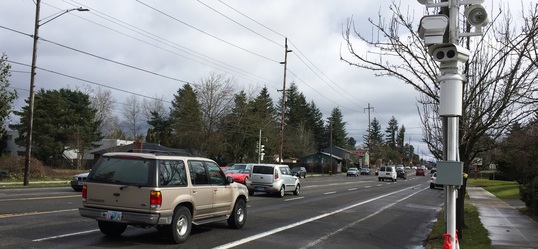 The percentage of people speeding has declined by 47 percent near the speed safety cameras on SE Division Street.
PBOT will install its final pilot-phase speed safety cameras in January on Marine Drive. Once complete, PBOT will evaluate results from the four pilot-phase speed safety camera systems before exploring expansion in 2019.
In addition to Marine Drive, PBOT has speed safety camera systems on 122nd Avenue, Beaverton-Hillsdale Highway, and Division Street. The percentage of people driving over the speed limit has declined by between 47 and 68 percent near these cameras since their installation.
Under state law, PBOT can install speed safety cameras on a subset of the city's 30 High Network Streets and must report regularly on the program's results.
Safety fixes on three of Portland's High Crash Network streets are making progress:
-
82nd Ave.: staff presented to the Bicycle Advisory Committee on Dec. 12 about a draft plan for safety fixes from NE Killingsworth to SE Johnson Creek. In addition, safety fixes at Foster, Woodstock, and Flavel are planned for 2018.
-
Outer Division: team continues to hold one-on-one discussions with businesses to resolve issues related to bike lane protection and freight movement.
-
Powell: safety fixes planned for spring 2018 from 20th to 34th and at nine additional intersections. Timeline for outer Powell safety fixes funded through the 2017 legislative session is still being determined.
Next year, PBOT and partners expect to construct safety fixes on a total of 17 High Crash Network streets.
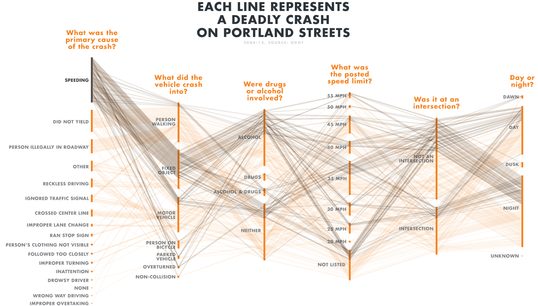
A new interactive visual shows the factors involved in deadly traffic crashes that occur in Portland. What patterns do you notice? (Works best on bigger screens.)
The visual helps explain why Portland's Vision Zero Action Plan has four focus areas: speed (and speeding), impairment (drugs and alcohol), other dangerous behaviors (e.g. not yielding right-of-way), and street design.
Keep in mind that:
- Street design impacts behaviors. For example, person "illegally in roadway," a term on Oregon's crash report form, may reflect a lack of safe crossings.
- The top cause of serious injuries and deaths involving people walking is people driving failing to yield to people legally in the street.
- Crash data is not comprehensive. For example, crashes not involving motor vehicles are excluded.
The visual uses traffic crash data compiled by the Oregon Department of Transportation. For data visualization fans, this visual is inspired by Sankey diagrams.
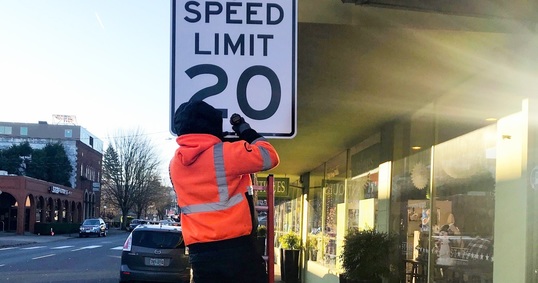 A PBOT employee installs updated speed limits signs on SE Milwaukie on Dec. 6.
PBOT is lowering the speed limit today on NE 42nd Avenue, the 24th street to receive a lowered speed limit in 2017. An additional 22 streets are in various stages of the state's speed limit change request process.
Updated speed limits support Vision Zero because lower driving speeds result in fewer crashes. When crashes occur, lower driving speeds make it more likely that people will survive. While speed limits do not guarantee compliance, they help PBOT to pursue design, education, and enforcement strategies that align posted speeds with travel behavior.
 Portland's Vision Zero Action Plan turned one year old this month.
To mark the occasion, PBOT will report on 53 performance measures that track each of the plan's 31 actions. The report will also preview 2018 actions and summarize the latest crash data.
Look for the report in January.
|
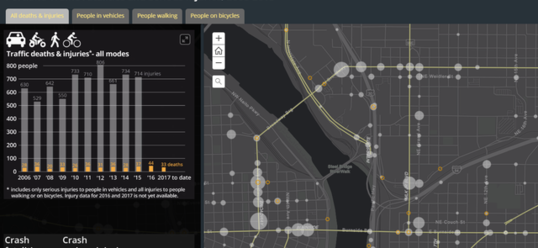 A revised citywide crash map includes newer and more comprehensive data.
PBOT recently updated its citywide map of traffic crashes to include 2017-year-to-date information, more precise location info, crash details, and refreshed colors. Check it out at map.visionzeroportland.com.
|