News media contact:
Dylan Rivera
(503) 823-3723
dylan.rivera@portlandoregon.gov
@pbotinfo
News Blog:
Safe speeds are key to Portland's Vision Zero strategy
By Matt Ferris-Smith, Portland Bureau of Transportation
 (Nov. 18, 2016) Small changes in motor vehicle speed have a big impact on safety for street users.
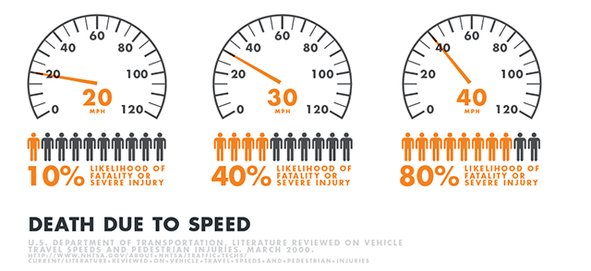
In a crash, a person walking is eight times more likely to die when hit at 40 miles per hour compared to 20 mph.
The close relationship between speed and safety explains why Portland’s
draft Vision Zero Action Plan makes speed one of the four primary focus
areas, joining impairment, dangerous behaviors and street design. Unsafe
speeds contributed to 47 percent of deadly crashes in Portland from 2005 through
2014.
|
 “An average trip in Portland is
less than four miles,” says Clay Veka, Vision Zero Project Manager at PBOT. “High
speeds may shave just a few minutes off of trip time, while greatly increasing
the chance of seriously injuring or killing someone in the event of a crash.”
Portland’s draft Vision Zero
Action Plan, heading to Portland City Council on December 1, has three actions to
support safe speeds, including adding more speed safety cameras
on High Crash Network streets, gaining local authority to set speeds, and
using street design to align posted speeds with actual travel speeds.
Veka says that the goal is to
create streets that help all people reach their destination safely, regardless
of how they choose to travel. “As we travel on Portland streets, let's look out
for each other and chose safe speeds.”
First speed safety cameras
show results
Speeds are safer on SW
Beaverton-Hillsdale Highway following installation of speed safety cameras in
August.
The automated cameras photograph people driving over the speed limit. After police review, the City issues citations based on these photographs. The new cameras have resulted in a 91 percent reduction
in top-end speeders—people traveling more than 50 miles per hour in the 40 mph
zone (see table). Overall speeding is down by 60 percent at SW 39th
Ave. near the location of the cameras. Safer speeds extend at least four blocks
west for eastbound drivers.
 Speeding on SW Beaverton-Hillsdale Highway before and after speed safety camera installation.
Over the next year, PBOT will install speed safety cameras on 122nd Avenue, outer SE Division and Marine Drive, all of which are part of the High Crash Network.
Posted speeds getting safer
across Portland
In addition to enforcing
existing speed limits, PBOT looks for opportunities to make posted speeds safer.
Under Oregon law, the state
controls speed limits on all streets, including those in Portland.
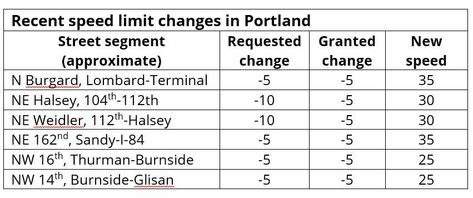
PBOT frequently requests—and
receives—permission from the Oregon Department of Transportation to lower
speeds on street segments (see table). The process is time consuming, however,
and speed reduction is based on existing motor vehicle travel speeds rather
than recommended safe speeds for all street users.
A new process,
approved by ODOT in October, will help PBOT accelerate changes to speed limits
while placing greater weight on the safety of people traveling by all modes.
“This new method will help us
deliver on the promise of Vision Zero,” says Dana Dickman, PBOT's Safety
Section Manager. “Changing posted speeds, in combination with street design improvements,
education and enforcement, makes streets safer for everyone.”
###
Portland is committed to ending traffic violence in our
communities. Through the Vision
Zero program, the City of Portland and our partners are working to
eliminate deaths and serious injuries on our streets by 2025.
The Vision Zero Task
Force has overseen the creation of a draft Vision Zero
Action Plan with specific steps to make streets safe. This draft plan
will go to Portland's City Council for approval on Thursday, December
1, at 3 p.m.
The Portland Bureau of Transportation (PBOT) is the steward of the City’s transportation system, and a community partner in shaping a livable city. We plan, build, manage and maintain an effective and safe transportation system that provides access and mobility. Learn more at www.portlandoregon.gov/transportation
|